
The diagnostic journey
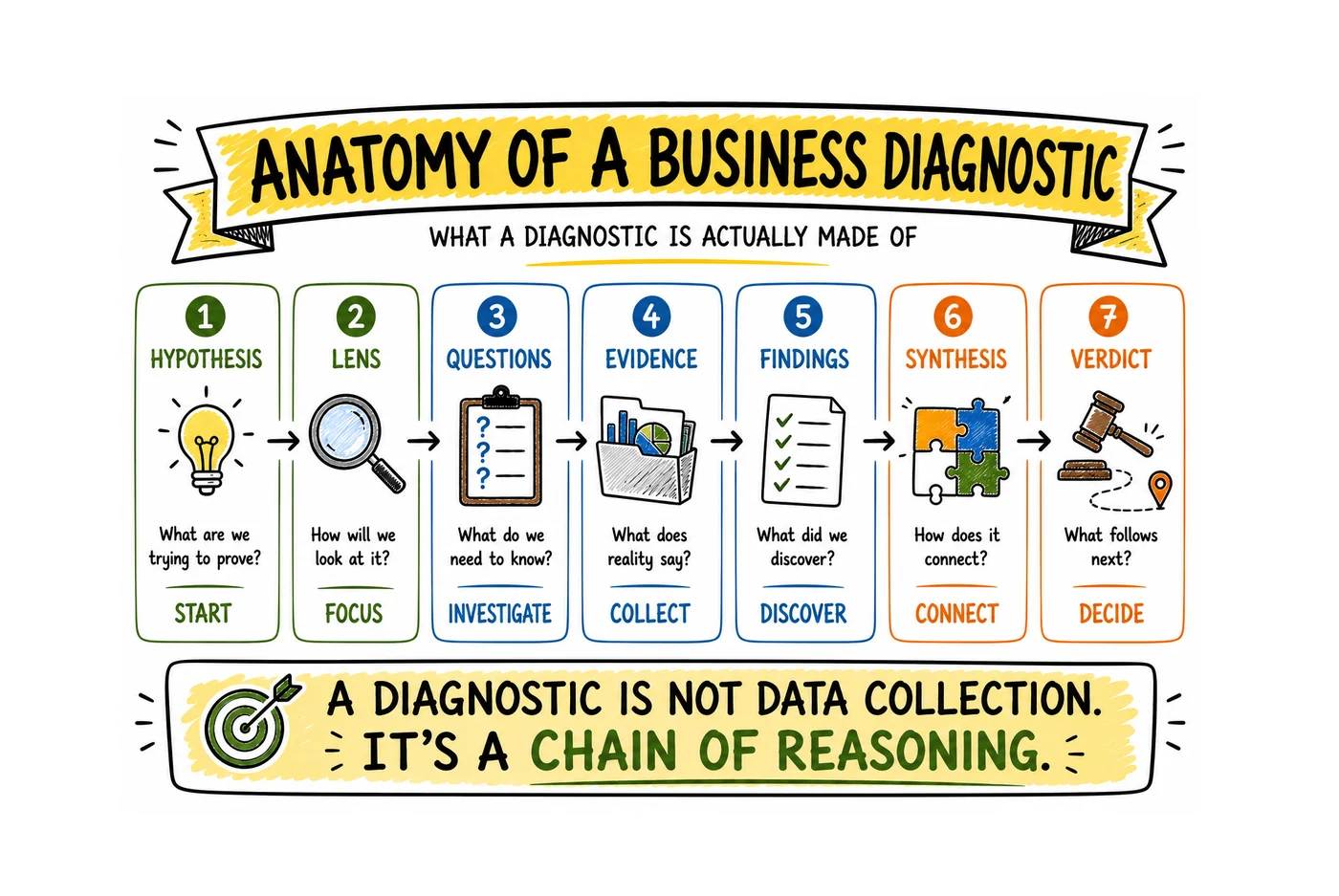
A diagnostic moves through recognisable stages: understanding what is actually wrong, testing an explanation, gathering evidence, and turning that evidence into a verdict. It is not data collection, it is a chain of reasoning, and the seven links below describe a way of reading rather than a fixed procedure.
Articles can relate to several stages at once. Wider consulting topics, fees, pricing, selling diagnostic work and professional standards, sit alongside the journey rather than inside it.
Link 01 of 07
Hypothesis
What are we trying to prove?
Name the real problem instead of accepting the presenting symptom, and state what would prove it wrong.
Reading for this stage
- Hypothesis or Framework: The Choice You Make Before the Diagnostic Starts7 min read
We all have a default. Some of us open every engagement with a hypothesis and go straight at it. Others reach for a framework and start filling it in - the SWOT, the five forces, the checklist. Both are legitimate ways to run a diagnostic. The mistake is choosing the mode out of habit instead of...
- How to Run a Diagnostic Properly - and Where AI Actually Fits9 min read
Most things sold as a business diagnostic are not diagnostics. They are questionnaires that spit out a score, or thick reports that list everything and conclude nothing. And here is the uncomfortable part for us: plenty of those come from consultants.
Link 02 of 07
Lens
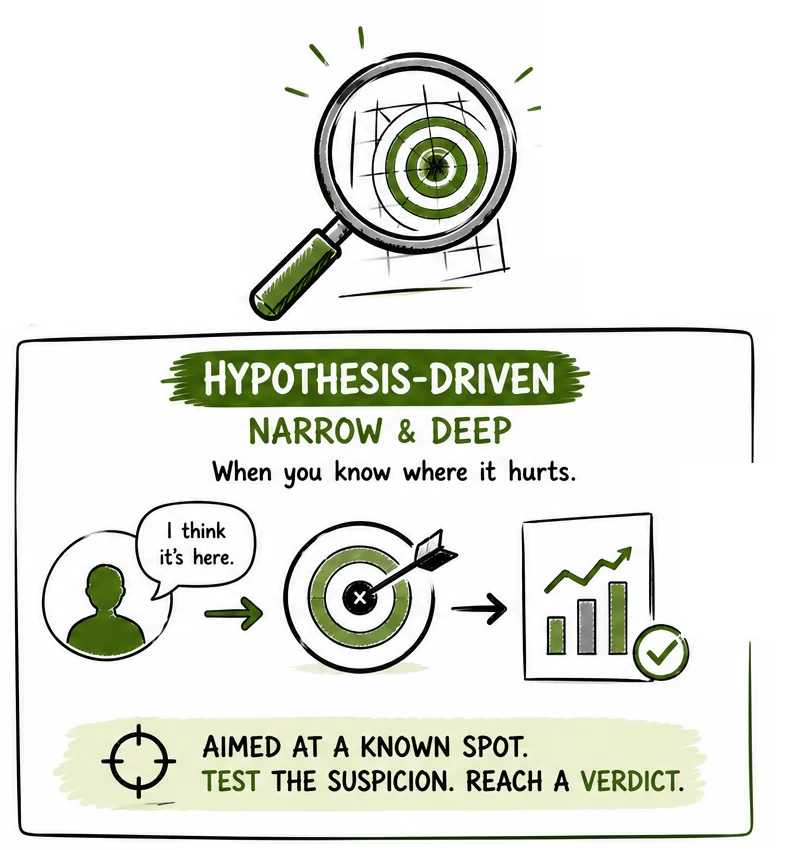
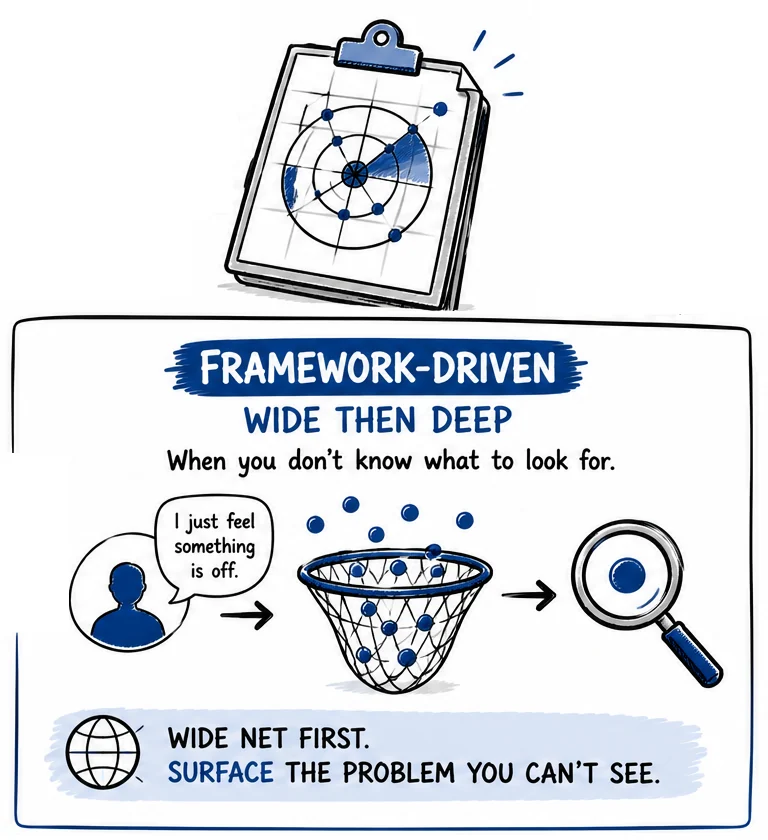
How will we look at it?
Decide whether to go deep on a suspicion or cast a wide net to surface the problem you cannot yet see.
Reading for this stage
- Hypothesis or Framework: The Choice You Make Before the Diagnostic Starts7 min read
We all have a default. Some of us open every engagement with a hypothesis and go straight at it. Others reach for a framework and start filling it in - the SWOT, the five forces, the checklist. Both are legitimate ways to run a diagnostic. The mistake is choosing the mode out of habit instead of...
- How to Run a Diagnostic Properly - and Where AI Actually Fits9 min read
Most things sold as a business diagnostic are not diagnostics. They are questionnaires that spit out a score, or thick reports that list everything and conclude nothing. And here is the uncomfortable part for us: plenty of those come from consultants.
- The Depth Behind Real Consulting Advice: Grading a Franchise Against a Tailored Framework7 min read
A great business spots a new opportunity - say, turning its success into a franchise - and hires a consultant to help capture it. Get generic advice, though, and you can pour months and money into the wrong move and miss the opening. Real advice is the opposite: researched, measured, specific....
Link 03 of 07
Questions
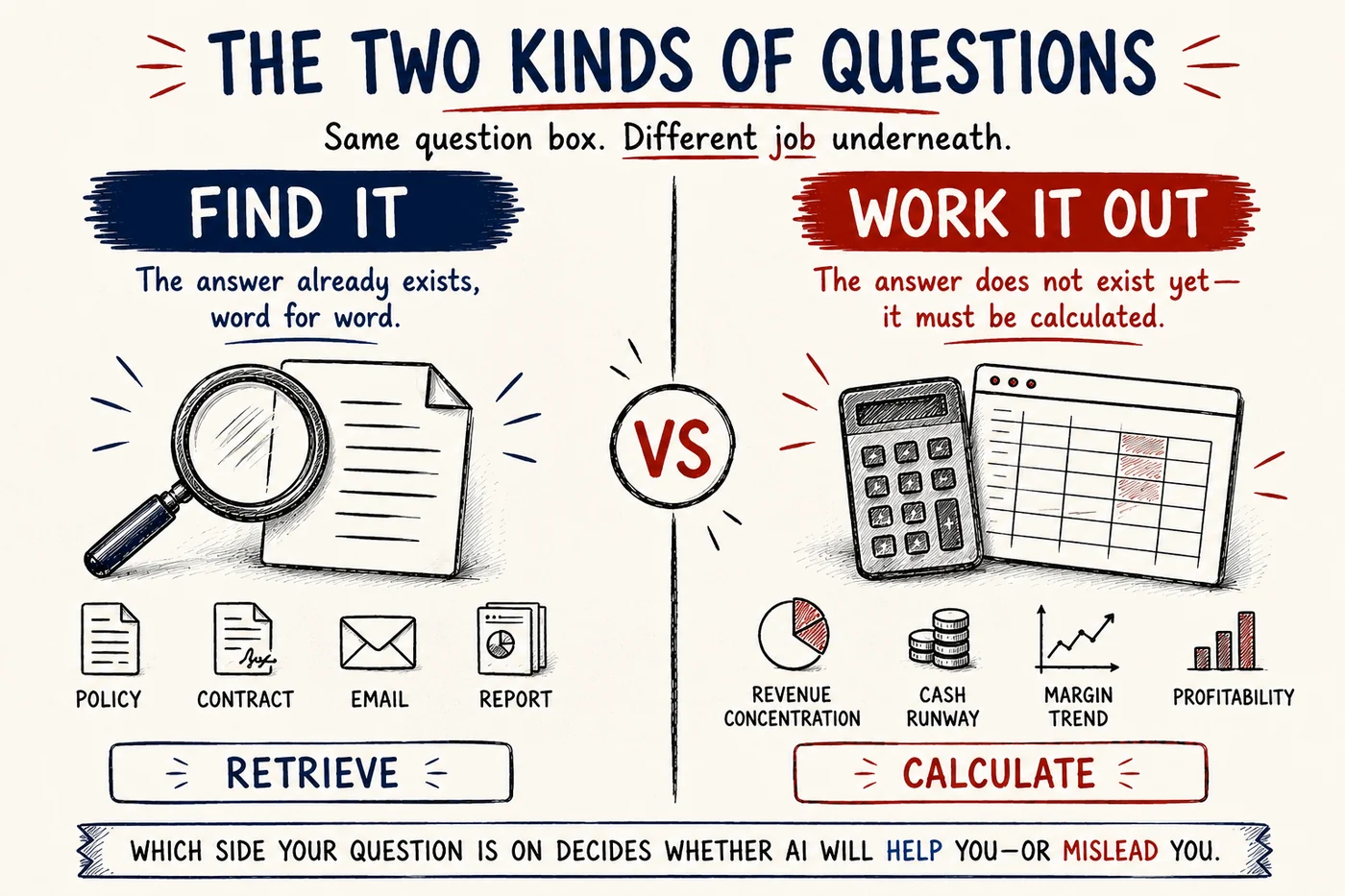
What do we need to know?
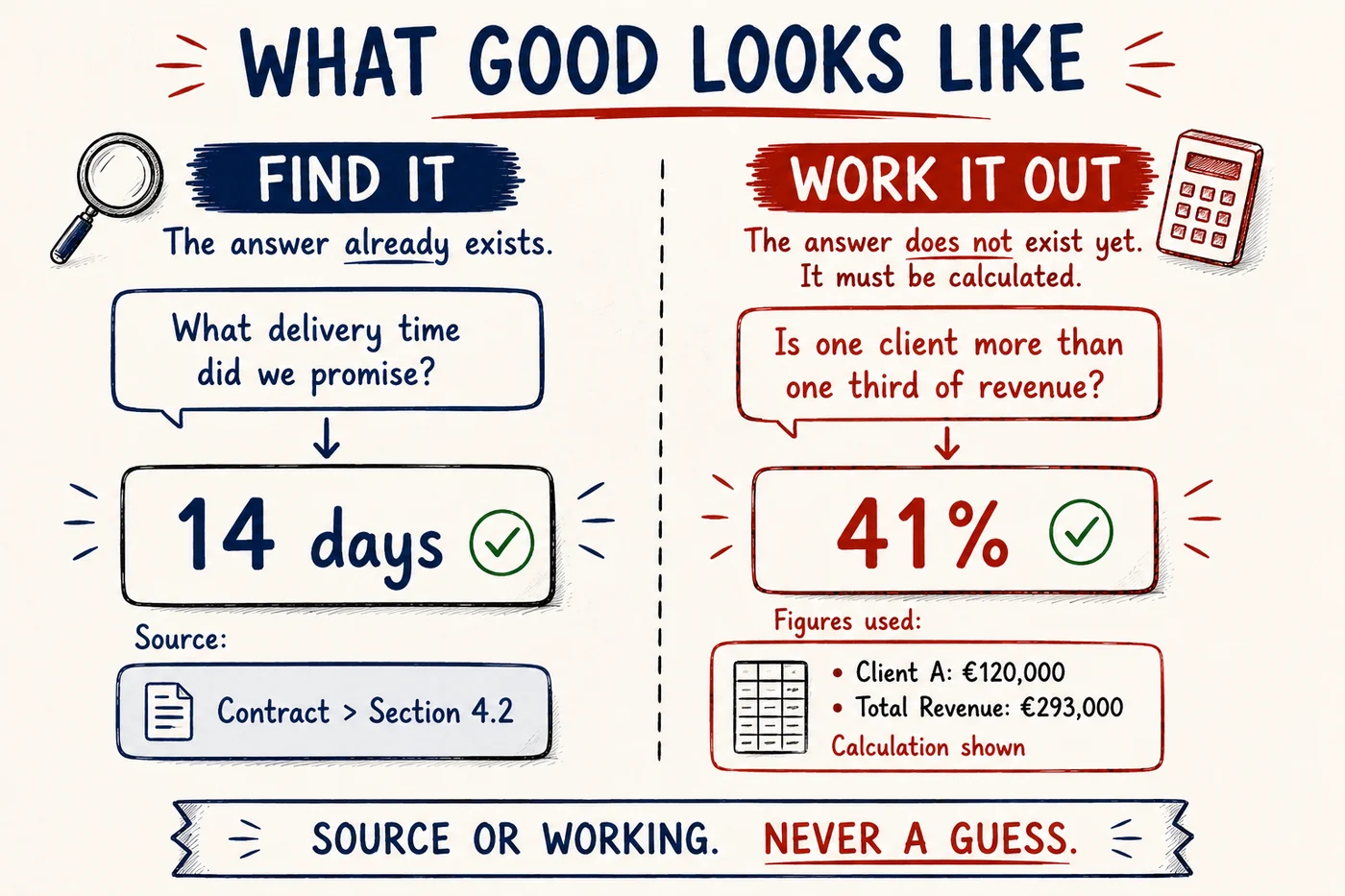
Separate questions whose answer already exists from questions whose answer must be worked out.
Reading for this stage
- Retrieve or Compute: The Read That Decides Whether AI Helps or Lies11 min read
A while ago a business owner came to see me, genuinely excited. He had been at a presentation where someone demonstrated an AI tool, and it had stayed with him. The presenter typed in an ordinary question, the tool answered in two seconds, and it even pointed back to the document the answer came...
- How to Run a Diagnostic Properly - and Where AI Actually Fits9 min read
Most things sold as a business diagnostic are not diagnostics. They are questionnaires that spit out a score, or thick reports that list everything and conclude nothing. And here is the uncomfortable part for us: plenty of those come from consultants.
- The Depth Behind Real Consulting Advice: Grading a Franchise Against a Tailored Framework7 min read
A great business spots a new opportunity - say, turning its success into a franchise - and hires a consultant to help capture it. Get generic advice, though, and you can pour months and money into the wrong move and miss the opening. Real advice is the opposite: researched, measured, specific....
Link 04 of 07
Evidence
What does reality say?
Combine desk research with conversations, observation and field work — every number carries a source or a calculation.
Reading for this stage
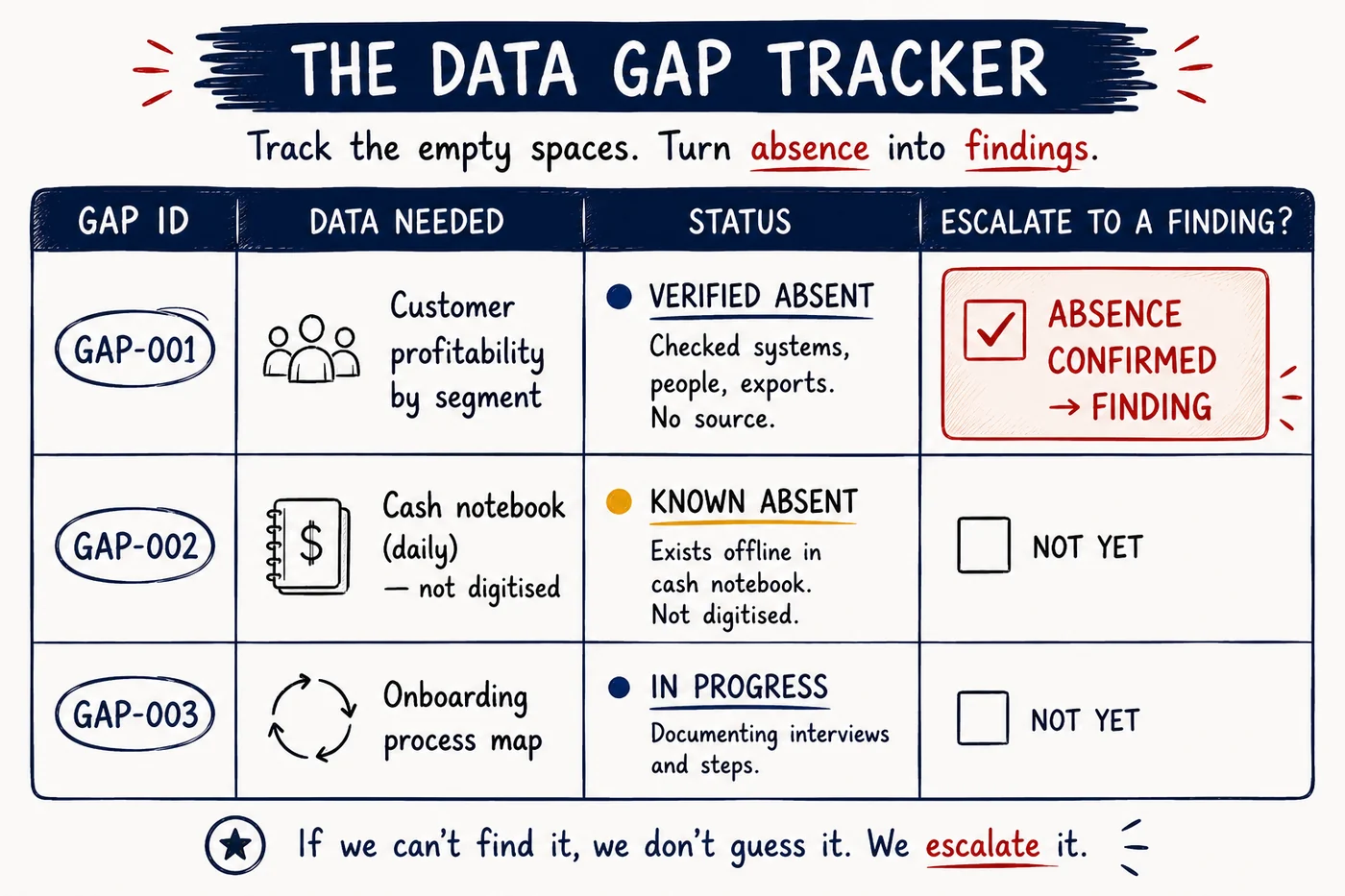
- What They Couldn't Show You: When the Missing Data Is the Finding9 min read
As a management consultant, I have run business diagnostics more times than I can count, and the same small moment keeps coming back in almost every one. You ask for the number, and it is not there. Nobody can tell you which customers actually make money. There is no org chart. The cash "is in a...
- Retrieve or Compute: The Read That Decides Whether AI Helps or Lies11 min read
A while ago a business owner came to see me, genuinely excited. He had been at a presentation where someone demonstrated an AI tool, and it had stayed with him. The presenter typed in an ordinary question, the tool answered in two seconds, and it even pointed back to the document the answer came...
- How to Run a Diagnostic Properly - and Where AI Actually Fits9 min read
Most things sold as a business diagnostic are not diagnostics. They are questionnaires that spit out a score, or thick reports that list everything and conclude nothing. And here is the uncomfortable part for us: plenty of those come from consultants.
Link 05 of 07
Findings
What did we discover?
Record what the evidence shows, including the gaps — an absence you have confirmed is itself a finding.
Reading for this stage
- The Diagnostic Report: A Verdict, Not a Binder7 min read
You have seen the report. Maybe you have written one. Sixty pages, properly bound, a cover with the client's logo on it, an executive summary that is somehow six pages long. It landed on the founder's desk with a satisfying weight, everyone agreed it was thorough, and then nothing happened. Six...
- When the Founder Is the Problem: The Finding Nobody Says Out Loud8 min read
Run enough diagnostics in small companies and one root cause comes back more often than any other. It is not pricing. It is not the funnel. It looks like this: every approval waits for one signature, the biggest clients all live in one person's phone, and the whole company quietly holds its...
- Specialist or Generalist: The Read You Make Before Taking the Engagement7 min read
Every owner runs a free diagnostic on their own company, every single day. It has no methodology and no report, but it works. Anything weak that they can see, they fix. A broken process, a wrong price, a supplier who slips. Seen, fixed, forgotten. Owners are smart: if they can see it, they can...
- What They Couldn't Show You: When the Missing Data Is the Finding9 min read
As a management consultant, I have run business diagnostics more times than I can count, and the same small moment keeps coming back in almost every one. You ask for the number, and it is not there. Nobody can tell you which customers actually make money. There is no org chart. The cash "is in a...
- The Depth Behind Real Consulting Advice: Grading a Franchise Against a Tailored Framework7 min read
A great business spots a new opportunity - say, turning its success into a franchise - and hires a consultant to help capture it. Get generic advice, though, and you can pour months and money into the wrong move and miss the opening. Real advice is the opposite: researched, measured, specific....
Link 06 of 07
Synthesis
How does it connect?
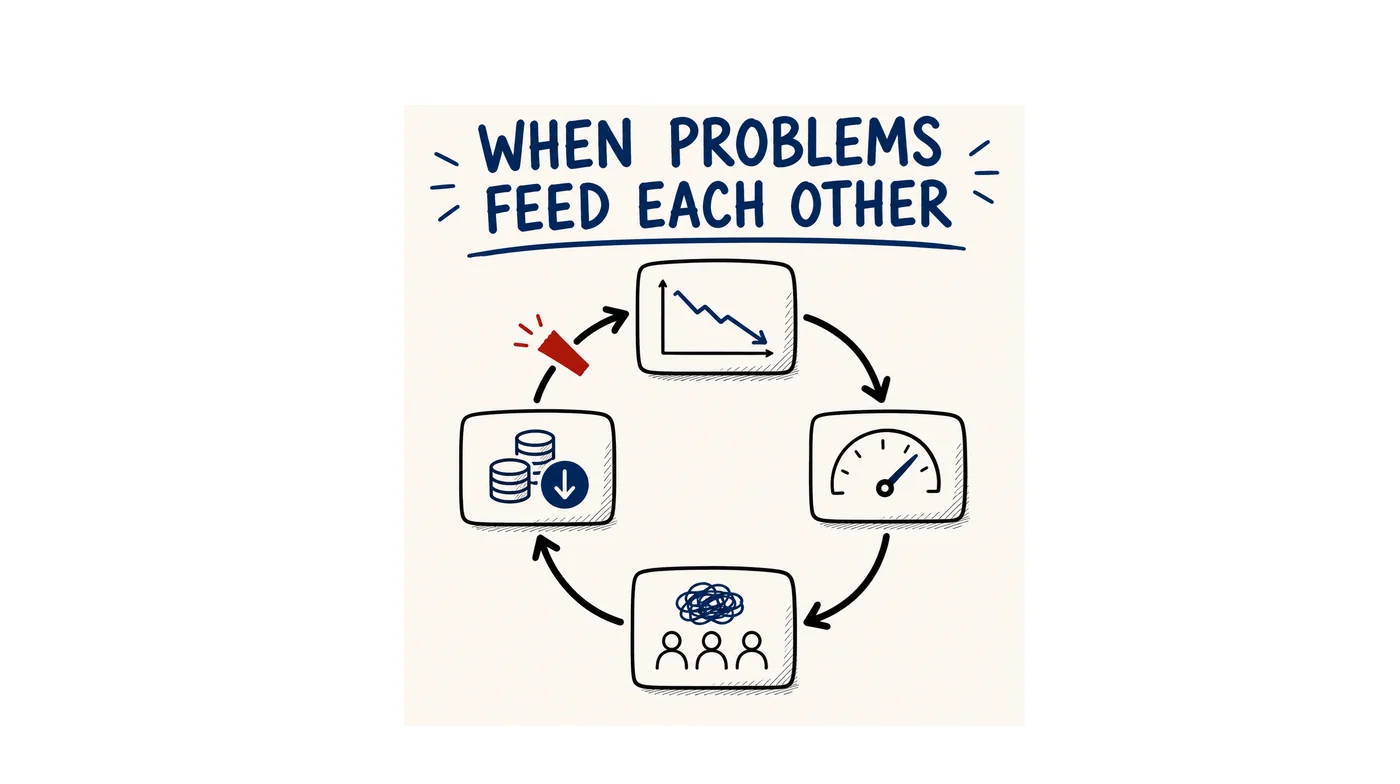
Understand causes across departments, and the problems that quietly reinforce each other.
Reading for this stage
- When Problems Feed Each Other: Why Your Prioritised List Fixes Nothing7 min read
Over the last few issues, we have been building one idea layer by layer. First, that a symptom is not the problem: weak sales are almost always a mirror of something upstream. Then, that a problem can hide by going wide, spreading across departments where no single specialist can catch it. Then,...
- When the Founder Is the Problem: The Finding Nobody Says Out Loud8 min read
Run enough diagnostics in small companies and one root cause comes back more often than any other. It is not pricing. It is not the funnel. It looks like this: every approval waits for one signature, the biggest clients all live in one person's phone, and the whole company quietly holds its...
- Specialist or Generalist: The Read You Make Before Taking the Engagement7 min read
Every owner runs a free diagnostic on their own company, every single day. It has no methodology and no report, but it works. Anything weak that they can see, they fix. A broken process, a wrong price, a supplier who slips. Seen, fixed, forgotten. Owners are smart: if they can see it, they can...
Link 07 of 07
Verdict
What follows next?
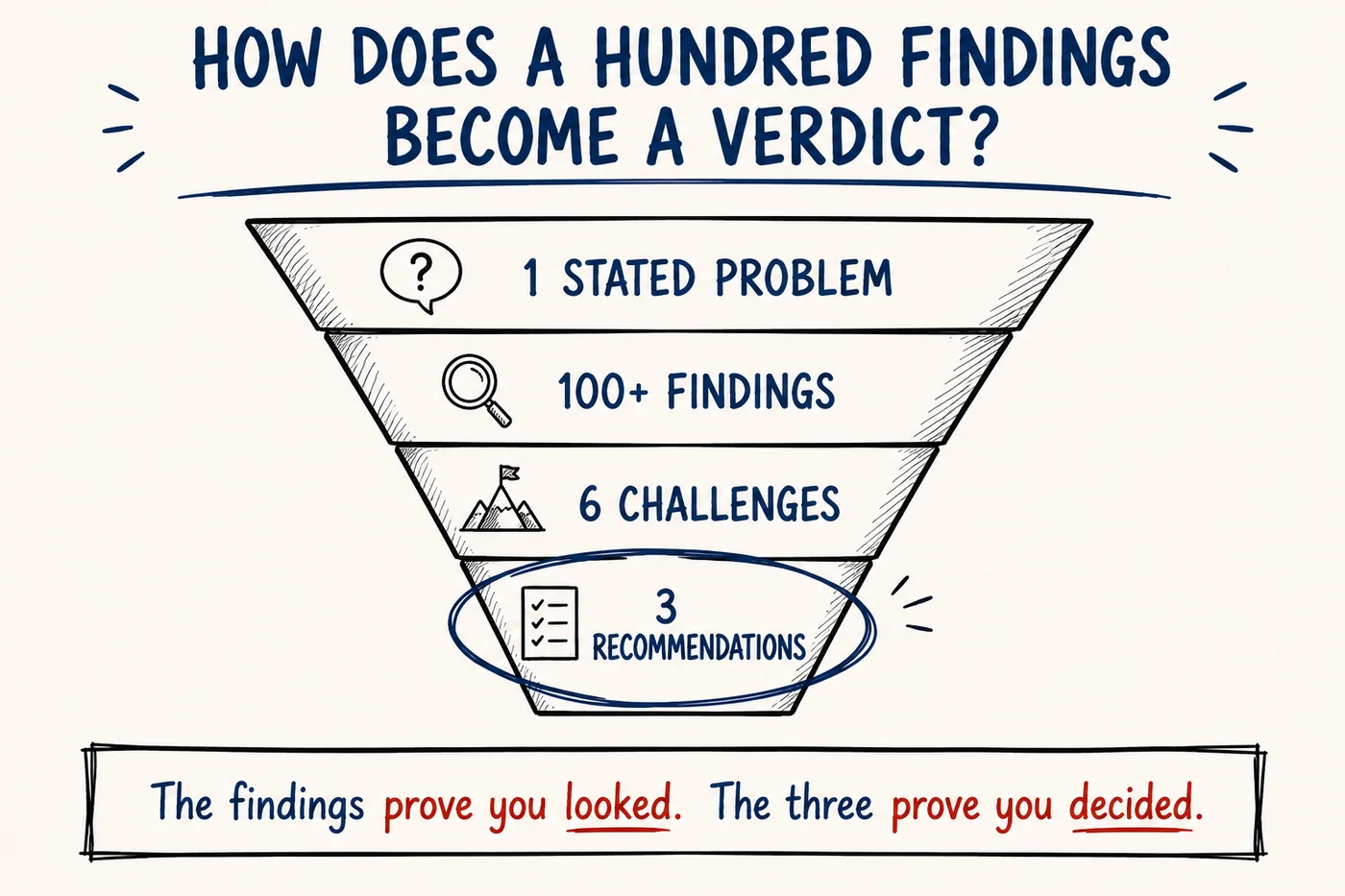
Turn a hundred findings into the few priorities and recommendations a business can actually act on.
Reading for this stage
- The Diagnostic Report: A Verdict, Not a Binder7 min read
You have seen the report. Maybe you have written one. Sixty pages, properly bound, a cover with the client's logo on it, an executive summary that is somehow six pages long. It landed on the founder's desk with a satisfying weight, everyone agreed it was thorough, and then nothing happened. Six...
- When Problems Feed Each Other: Why Your Prioritised List Fixes Nothing7 min read
Over the last few issues, we have been building one idea layer by layer. First, that a symptom is not the problem: weak sales are almost always a mirror of something upstream. Then, that a problem can hide by going wide, spreading across departments where no single specialist can catch it. Then,...
One link at a time, every week
Each edition takes one part of the chain apart and shows the reasoning behind it.