
How to Run a Diagnostic Properly - and Where AI Actually Fits
Most things sold as a business diagnostic are not diagnostics. They are questionnaires that spit out a score, or thick reports that list everything and conclude nothing. And here is the uncomfortable part for us: plenty of those come from consultants.
Edition 4first published on LinkedIn
Most things sold as a business diagnostic are not diagnostics. They are questionnaires that spit out a score, or thick reports that list everything and conclude nothing. And here is the uncomfortable part for us: plenty of those come from consultants.
It is not that we do not know how. It is that the diagnostic is the one instrument most of us run on instinct and never actually name. And when you cannot name the parts, you skip them under pressure. You take the client's problem at face value. You reach for a framework because it is familiar. You hand over a long list and call it thorough.
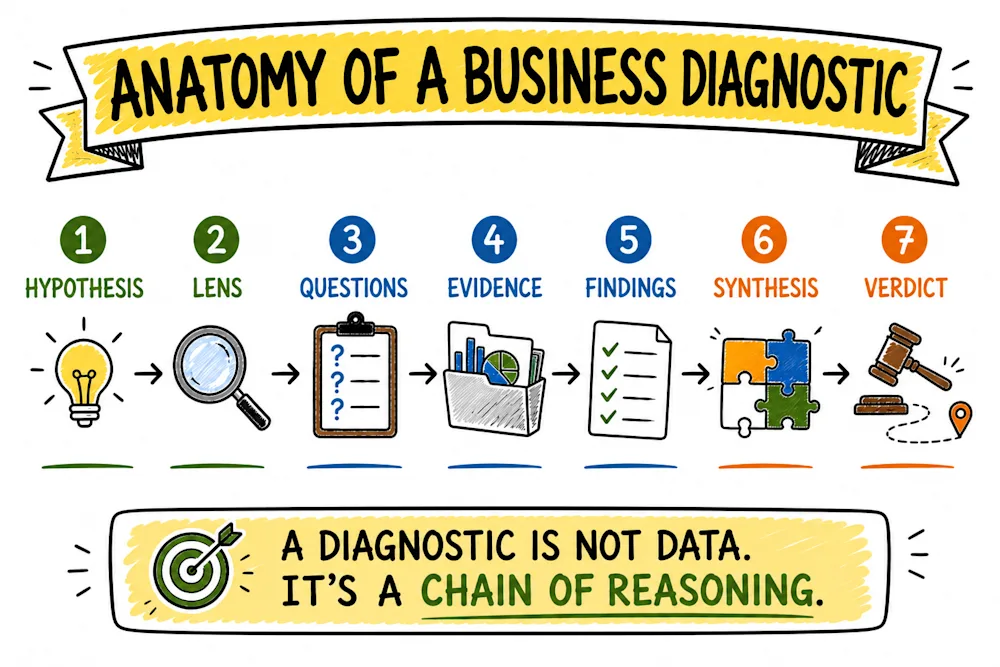
So before we get to AI, let us do the boring, valuable thing and lay the instrument out properly. Here is the anatomy of a diagnostic, part by part.
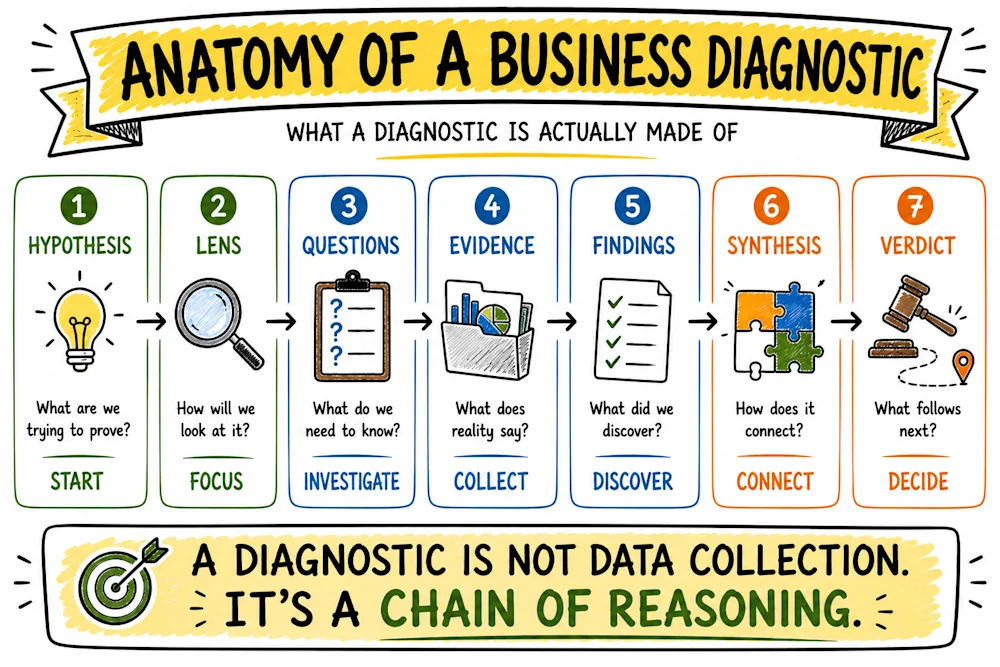
The anatomy: seven parts, one chain
1. It starts with a hypothesis. The client arrives with a problem or an opportunity, and your first job - before any data, before any framework - is to turn it into a single statement you can confirm or deny. "We need more sales" is not a hypothesis, it is a symptom. "Revenue is unpredictable because we have no pipeline and cannot tell which projects make money" is. A good hypothesis names three things: the visible symptom the founder actually feels, the cause you suspect sits underneath it, and the evidence that would prove you right or wrong. Get this one wrong and everything downstream is beautifully executed work aimed at the wrong target. A diagnostic without a hypothesis is a high-school project: a tidy pile of facts that answers nothing, because nothing was ever asked.
2. The lens is chosen from the hypothesis. You do not pick a framework and then go hunting for a problem to fit it. You hold a hypothesis, and you choose the lens that interrogates it best - SWOT, Porter's Five Forces, a financial review, a value-chain map. Each lens is a different way of looking, so the choice is not cosmetic: it decides what you will and will not see. Pick the one, or two, that actually throw light on this hypothesis, and leave the rest in the drawer.
3. The lens dictates the questions. This is the step most of us blur, so it is worth slowing down on. The questions are not invented freely; they fall out of the lens you chose. Run Porter and you are asking about buyers, suppliers, rivals, substitutes and new entrants. Run SWOT and you are asking a completely different set. So the logic runs both ways at once: downward, the hypothesis picks the lens and the lens generates the questions; upward, the questions exist only to complete the lens, and the lens exists only to give you a view on the hypothesis. Each big question then breaks into smaller, answerable ones - and the moment a question does not ladder back up to the hypothesis, it does not belong in the engagement.
4. Evidence is where the questions meet reality, and it comes from two places. Internal data - finance, operations, sales, HR - answers how the business runs. External data - market, competition, industry, regulation - answers where the business sits. The lens you chose quietly decides which of the two you need, and this is exactly where consultants get caught. For example, SWOT makes the split obvious: strengths and weaknesses are plainly internal, opportunities and threats plainly external, so you know to go and gather both. But run Porter's Five Forces on its own and the split disappears - every force points outward, and it is easy to walk away with a sharp picture of the industry and no read on whether the company can actually respond to it. A pure financial review has the mirror-image blind spot: all internal, no market. That is why strong diagnostics rarely run a single lens; they stack two, so the blind spot of one is covered by the other. And whatever lens you use, hold on to what evidence actually is: raw material. A number on a page is not yet a finding. It is the input to one.
5. Findings are answers, and they come in two kinds. A fact is what the data plainly says: revenue fell 12 percent. A derived finding is the conclusion you build from facts: revenue fell because the two largest clients both cut scope in the same quarter, which means the real exposure is client concentration, not soft demand. Keep the two separate and keep each finding atomic - one claim, tied to its source - because the client will push back, and a finding you can trace to a cell in their own spreadsheet is one they cannot wave away. Every finding has exactly one job: to strengthen or weaken the hypothesis. One that does neither, however interesting, does not earn a place in the report.
There is one special kind of finding worth pulling out on its own: the answer you cannot get. When you ask a question and the data simply is not there, the instinct is to treat it as a hole in your analysis, something to apologise for in a "limitations" note. It is the opposite. A missing answer is itself a finding about the business. If a company cannot tell you which products make money, that is not a gap in your report - it is the discovery that they have been pricing blind. If the cash lives in a notebook, "you cannot see your own cash" is very often the loudest line in the whole diagnostic, because most of what they cannot control traces back to it. So do not bury missing data in a disclaimer; name it, rank its severity, and let it stand as a finding in its own right.
6. Synthesis is the step a questionnaire skips, and it is where the diagnosis actually happens. Up to this point you have a stack of findings, each true on its own. A questionnaire stops at the stack and calls it a report. The diagnosis lives in seeing how the findings interact: the five "separate" problems the founder listed turning out to be five faces of one, or worse, a self-reinforcing loop where each problem feeds the next - no sales system, so revenue concentrates in a few clients, so the founder spends every week firefighting to keep them, so there is never time to build a sales system. Lay the findings side by side and the pattern surfaces - and the pattern is the thing the client could never see from the inside, because they were standing in it. That, not the list, is what they are paying you for.
7. The verdict is a position, not a binder. A report should answer the hypothesis directly - does it hold, fully, partly, or not at all - and then commit to the few things to do about it, in order. This is the hardest discipline in the whole job, because it means leaving things out. A business can only act on a handful of priorities at once; hand it twenty recommendations and you have handed it paralysis, and the report goes in a drawer. Hand it the three that matter, sequenced, and they get done. Cutting the list down is not laziness, it is judgement, and it carries real risk, because you are saying "this one first" and you might be wrong. A data dump never takes that risk, which is precisely why it is worthless: it gives the client everything so that it can be held accountable for nothing. The verdict is you putting your name on an answer.
One test holds the whole chain together. Take any recommendation in the report and trace it backwards: to a finding, to the evidence behind it, to the question, to the lens, to the hypothesis, to the client's original concern. If you can make that walk without a single link breaking, the recommendation is grounded. If you cannot, it came from somewhere other than the client's actual problem, and no amount of formatting will save it. That trace is the difference between a diagnostic and a nicely formatted opinion.
Where AI actually fits
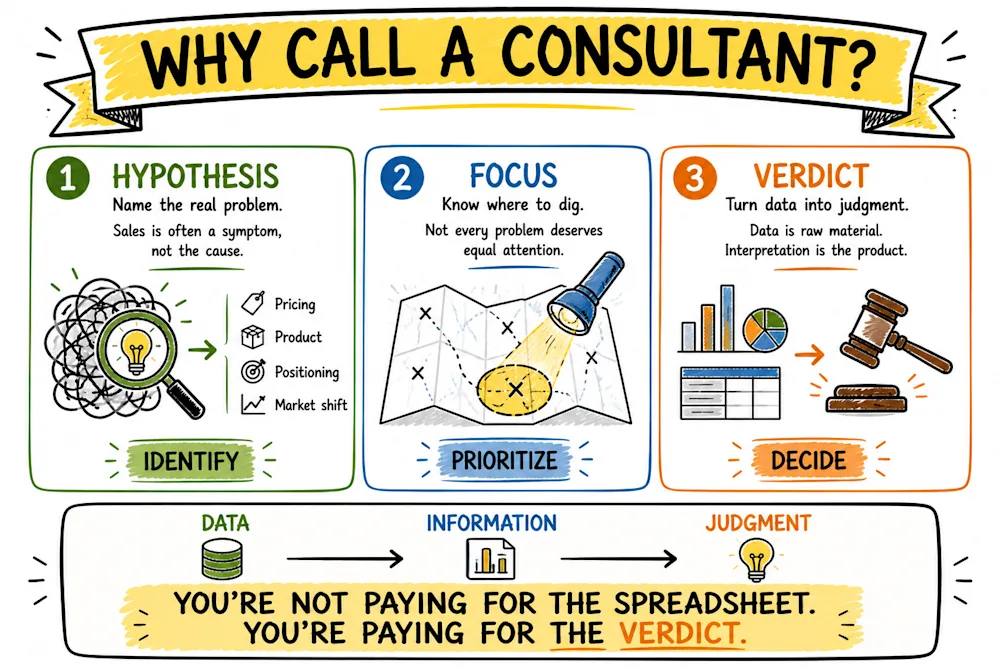
Lay AI over that chain and the picture sorts itself out. The middle of the diagnostic - the questions, the evidence, the first cut of the findings - is gathering and answering work, and that is exactly what AI is good at. It will build the lead list, pull the market data, run the comparisons and hand you a first draft of the findings faster than any junior analyst, and it will do it at two in the morning without complaint. If you are still doing that part by hand, you are paying yourself to do the cheapest work in the engagement.
The two ends are a different story, and the two ends are where the job actually lives. AI cannot name the hypothesis for you, because naming the real problem means hearing past what the client said. They tell you "we need more sales"; you have sat across enough tables to know it is pricing, or a product the market has quietly moved away from. A model trained on the average of everything ever written gives you back the average framing - the symptom everyone names, not the cause underneath it. And at the far end, AI cannot write the verdict. Choosing the three things that matter, committing to an order, being willing to be wrong in front of the founder - that is judgement, not retrieval, and it is the part with your name on it.
So the play is not "AI or me," it is sequence. Do the diagnostic properly first: own the hypothesis, choose the lenses, insist on the traceable chain. Then turn AI loose on the middle and let it run fast, while you spend your attention at the two ends where it cannot follow. Used that way, AI does not replace the consultant - it quietly deletes the part of the work that was never your real value, and hands all that time back to the part that is.
Which is why the consultants who lose to AI will be the ones whose entire diagnostic was the middle: a questionnaire with a logo on it. The ones who pull ahead will be the ones who were always strongest at the ends - the ones who could name the problem no one else saw, and stake a verdict on it.
Two questions for the comments. Which end do you find harder, framing the hypothesis or committing to the verdict? And have you found a part of the middle that AI still cannot run properly?
Questions readers ask
What makes something a diagnostic rather than a questionnaire?
A diagnostic is a chain of reasoning that ends in a verdict. A questionnaire produces a score. If the output could have been generated without anyone thinking about this particular company, it was not a diagnostic.
What are the seven parts of a diagnostic?
Hypothesis, lens, questions, evidence, findings, synthesis, verdict. They are one chain, not seven boxes. Skip a link and the ones after it have nothing to stand on.
Where does AI actually fit in a diagnostic?
On the data layer: cataloguing, cross-checking and the first pass over the numbers. The three places where judgement decides, the hypothesis, the conclusion and the recommendation, stay human. That split is not caution, it is where the work is.
Which end of the chain do consultants get wrong more often?
Both ends, in opposite ways. The hypothesis gets skipped because it feels like guessing before the evidence is in. The verdict gets avoided because it is the part you can be wrong about in writing.
Can a client run this on themselves?
They can run the parts that involve their own data. What they cannot do is frame a hypothesis about their own company or commit to a verdict that costs someone their remit, which is why the two ends of the chain are what they are paying for.
About the author
Dancho Dimkov writes Anatomy of Consulting, a publication about the practice of business diagnosis. Read more about the publication.
Stages referenced here are links in the diagnostic journey (7 links in total).