
What They Couldn't Show You: When the Missing Data Is the Finding
As a management consultant, I have run business diagnostics more times than I can count, and the same small moment keeps coming back in almost every one. You ask for the number, and it is not there. Nobody can tell you which customers actually make money. There is no org chart. The cash "is in a...
Edition 8first published on LinkedIn
As a management consultant, I have run business diagnostics more times than I can count, and the same small moment keeps coming back in almost every one. You ask for the number, and it is not there. Nobody can tell you which customers actually make money. There is no org chart. The cash "is in a notebook, more or less." Early in your career this feels like the engagement grinding to a halt - how are you supposed to diagnose a business that cannot hand you its own numbers?
Later you learn to read it the other way around. The missing number is not the work stalling. It is the work succeeding. You went looking for something specific, and the fact that it is not there is itself a result - and often a louder one than the figure you were hoping to find.
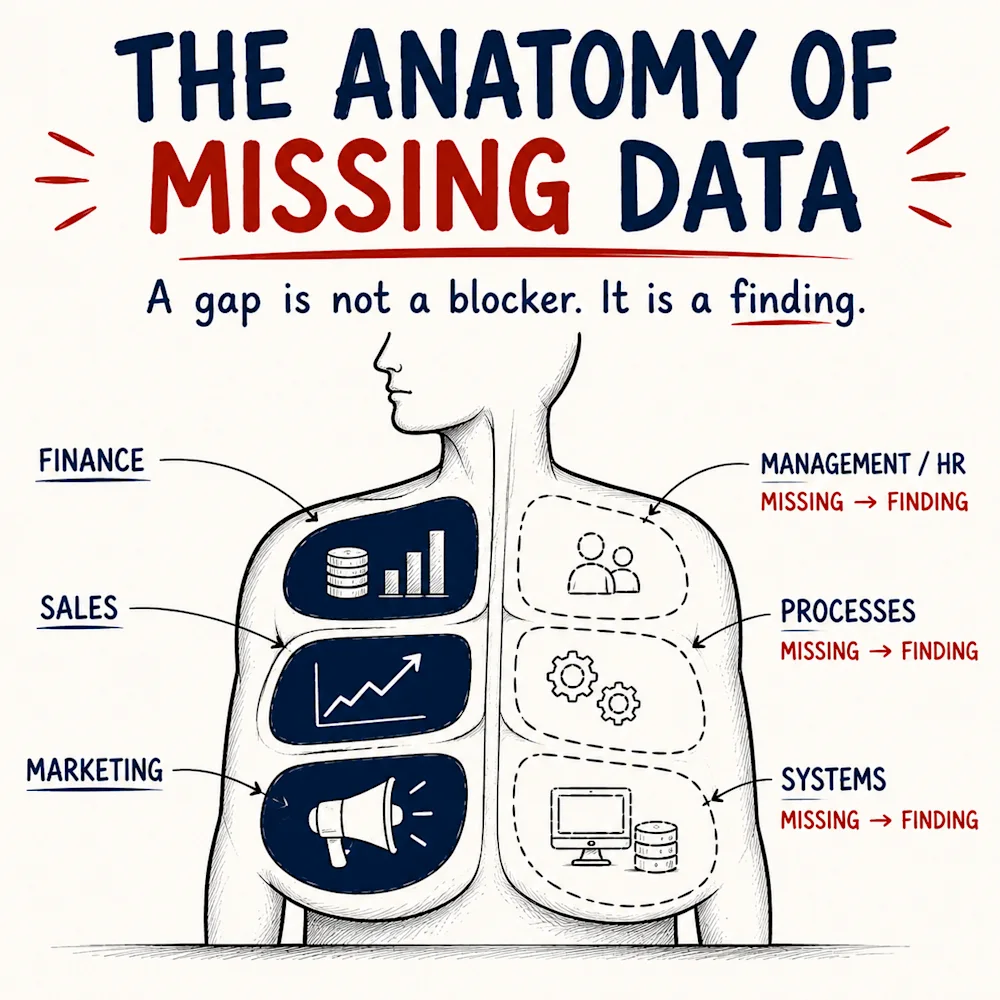
What a company cannot show you is often more revealing than what it can. A gap is not a blocker. It is a finding.
A gap is simply an unanswered question
To see why, go back to how a problem-led diagnostic is built, because the gap is not an accident - it is a designed output of the method.
You start with a hypothesis: a visible symptom, a proposed cause, and the evidence that would confirm or deny it. From that hypothesis you write a precise set of questions - the specific things the data has to answer before you can say the hypothesis stands or falls. Only then do you go and collect the evidence to answer them. A diagnostic that skips this and just gathers data is, in our methodology's blunt phrase, "a high-school project" - an unfocused dump where every finding is a fact and an answer to nothing.
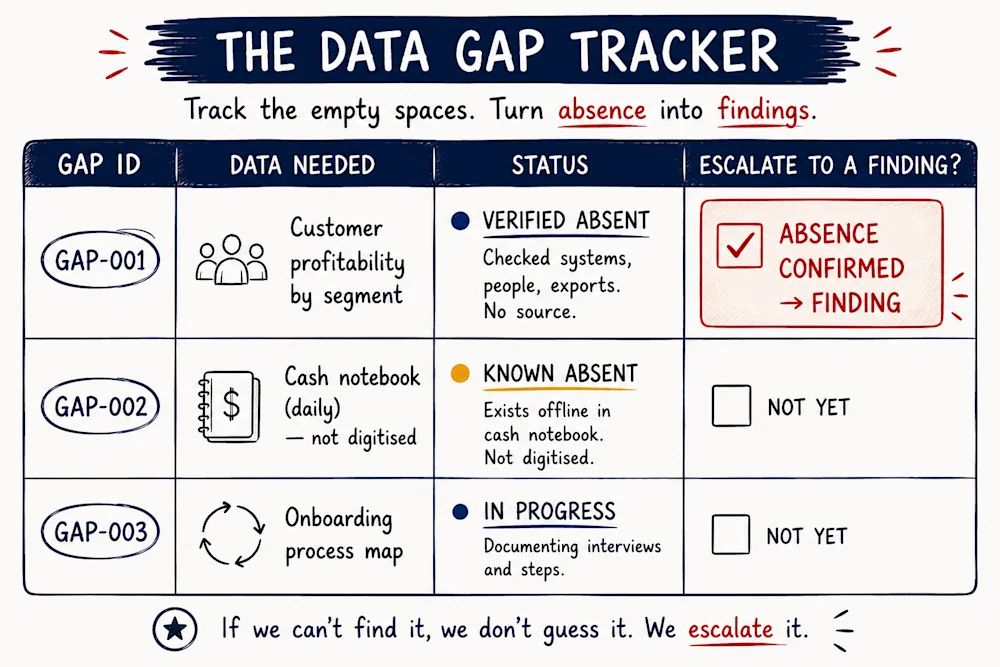
Now the move juniors skip. As you collect, you keep a running ledger of every question: did the evidence answer it, or not? We literally keep it as a tab called the Data Gap Tracker - one row per missing item: what we needed, which hypothesis it served, who we asked, the date, the status, and one decisive column, escalate to a finding? yes or no. A gap is simply an unanswered question - one of the things your hypothesis needed to know that the evidence did not deliver. Keep the ledger and you always know exactly where you stand. Skip it, and you do not know what you missed - you will write a confident verdict with silent holes in it and never see them.
This is also why the hypothesis matters so much here: it is what makes a gap visible at all. You only notice a number is missing because you specifically asked for it. A vague diagnostic never finds gaps, because it never asks anything a company could fail to answer. The sharper the questions, the louder the silences.
And an unanswered question is a finding
The reframe that turns this from frustration into value is one of our six diagnostic principles: data gaps are findings too. If a company cannot provide basic data, that absence does not get an apology in a footnote. It gets escalated to a finding, often a priority one.
A small, real example: in one engagement, the cash takings lived in a handwritten notebook, never digitised. The amateur chases it for three weeks and feels behind. The diagnostic move is to write it down: this is a data-reliability finding. A business that cannot see its own cash in real time is exposed in a way that has nothing to do with how much cash it has, and everything to do with flying partly blind. The gap was the finding.
Two companies, two silences
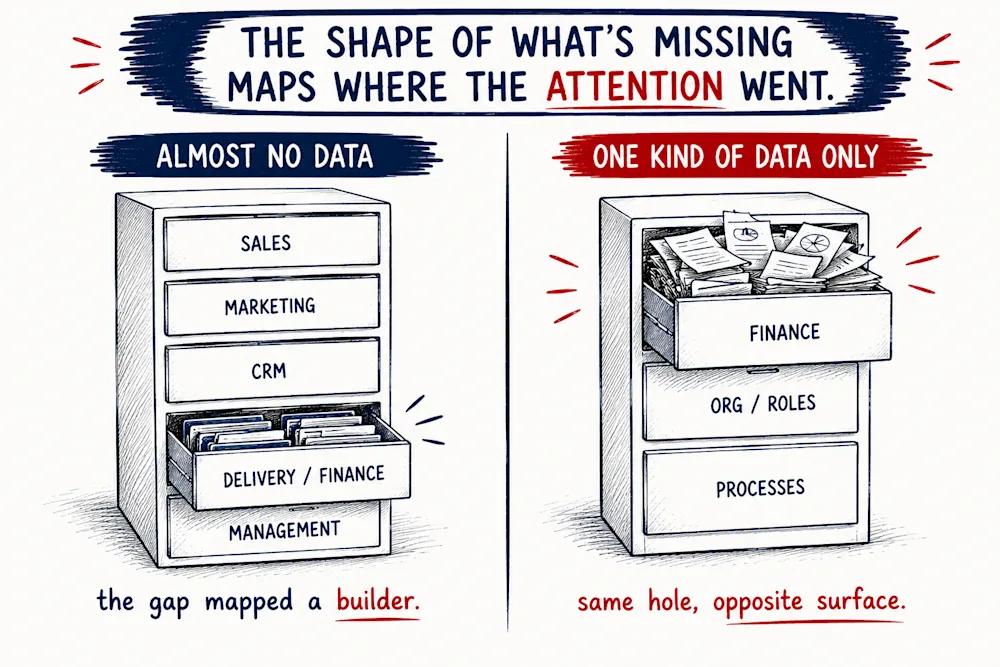
The deepest version of this is when the shape of what is missing maps exactly where a business has been pointing its attention. Two of our engagements taught me this from opposite ends.
A software house: a company that had almost no commercial data at all
The first was a mobile software company, and it was our very first diagnostic. On paper it was healthy - consistently profitable, a strong delivery team, real engineering discipline. So we went looking for the commercial picture: how it wins clients, what the pipeline looks like, which segments it targets, how it markets. And there was almost nothing to find.
No CRM. No customer database. No sales pipeline, no marketing activity to speak of, no management dashboard or KPIs - even though detailed financial data existed in spreadsheets. The absence went so deep that several standard sales-and-marketing diagnostic tools simply could not be applied: things like funnel analysis or demand-generation maturity assume there are processes and activities to assess, and here there were none. You cannot map a customer journey that was never designed.
That absence was the diagnosis. The company was a brilliant workshop with no commercial engine bolted on - a founder who had poured himself into building the product and almost nothing into building the business around it. And the missing data did not just describe that; it explained the biggest risk on the table. With no system for developing new business, the company had drifted into deep dependence on a handful of inbound relationships - roughly seventy percent of its revenue sitting in three clients, most of them intermediaries rather than end customers. The gap and the risk were the same finding seen twice.
A Skopje bistro: a company drowning in one kind of data, and silent on another
The second case looked like its opposite. A fast-growing restaurant arrived buried in data - hundreds of supplier and delivery invoices, full exports from its delivery platforms, detailed cost sheets, even written kitchen standards for each role at the stove. If the problem were "not enough data," this place had solved it.
Then we moved off the financials and asked the management questions. Who is actually responsible for what? Where is the org chart? Which processes are documented and followed? What are the roles, the KPIs, the way decisions get made? And the room went quiet. Responsibilities were divided informally, by habit. There was no org chart, no role descriptions, no KPIs, no documented management structure. In the gap tracker, the line for job descriptions and onboarding closed with three words that say everything: absence confirmed. We marked it: escalate to a finding.
Same lesson as the software house, inverted. The mountain of financial detail and the silence on management were not two separate facts - together they mapped a business run entirely on instinct and the kitchen, with no management layer underneath it. Exactly the layer it would need to survive its own growth. What they could not show us was the thing they most needed to build.
The shape of what a company cannot show you maps exactly where its attention has gone - and where it has not.
The discipline: answer what you can, flag what you can't
So what do you do the moment a number does not arrive? The rule we run is simple: answer what you can, and flag what you can't. The analysis is allowed to leave a question open. What it is never allowed to do is hide that the question is open.
First, never fill the hole with a guess. Under deadline, the temptation is to drop in a reasonable assumption and keep moving so the deck looks complete. That is exactly how a guess hardens into a "finding" nobody can defend later. In our chain, every recommendation has to trace back through the evidence to the founder's original concern - and an assumption dressed as a fact is a broken link you cannot see. A gap stays a gap, logged and visible, until real data closes it.
Second, re-ask, then escalate. The first time a number does not come, assume friction, not absence: ask again, more specifically, to the right person, in the format they actually keep. If it still does not come, that silence is your answer. Now the tracker earns its place - the gap gets a row, a status, and that one column: escalate to a finding, yes. The absence becomes part of the report, on purpose.
The loudest line in the report
Which is the real point of this whole issue. In most diagnostics, the single most valuable sentence is not a clever number. It reads like the software house's did: the company has no commercial engine, and that, not any single metric, is the thing to fix first. Or like the bistro's: the business has no management structure, and it will not survive its own growth without one.
That is the move that takes a client from "we think" to "we know." A founder who has lived inside the blindness so long it stopped registering hears that line and, often for the first time, sees the shape of what he could not see. It lands harder than any chart - because you did not just analyse what he gave you. You saw what he couldn't.
The AI Layer
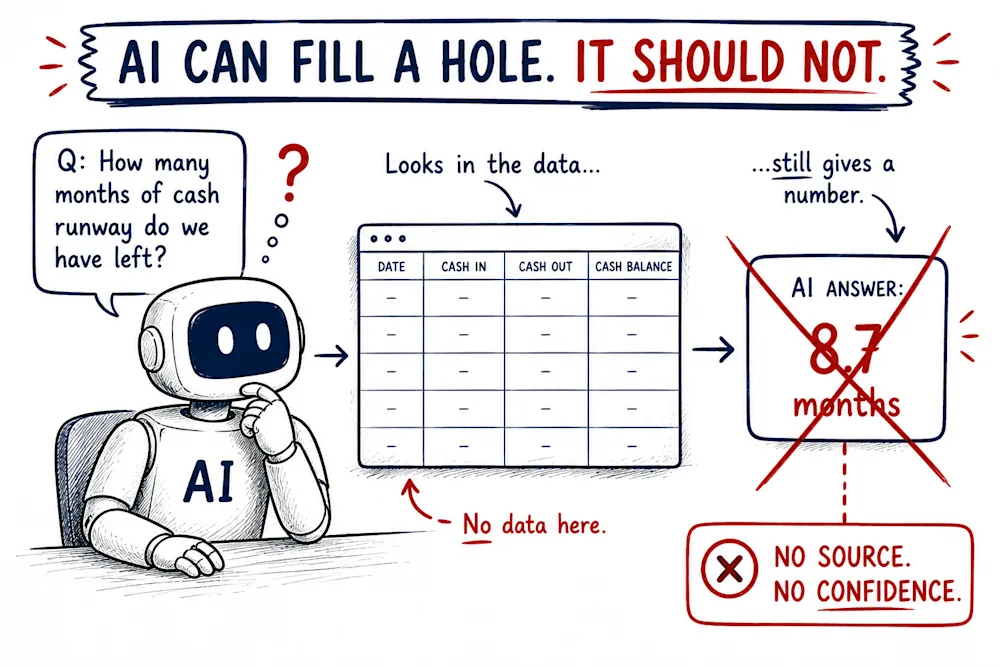
Used well, AI makes this faster - an engine can scan a whole data room and flag what is missing in minutes, which is the gap tracker, automated. But here is the trap that matters in this precise chapter, and it is a sharp one. When you ask an AI a question and the answer is not in the data, a general tool does not always tell you it is missing. It can imagine one: a clean, plausible number that fills the hole. And the instant it does, you have not just got a wrong figure - you have lost the finding. The very gap that was about to be your most valuable observation gets quietly painted over, and you never even see it was there.
So the rule for this station is simple and non-negotiable: make the tool show its source for every number it gives you. A figure with a citation you can open is a fact. A figure with no source is not an answer - it is a candidate for your gap log. No source, no confidence.
Two questions for the comments. What is the most telling gap you have hit - a number a client simply could not produce - and what did its absence turn out to mean? And how do you keep a gap visible in a report, instead of letting a tidy assumption quietly fill it?
Questions readers ask
Why is missing data a finding rather than a blocker?
Because a gap is an unanswered question, and a confirmed absence answers something about the company. If an owner cannot produce a number that their business should generate weekly, you have found out something real about how decisions get made there.
What do I write in the report when the client cannot give me the data?
Answer what you can and flag what you cannot, in the same table, with the gap named. Never leave a blank and never fill it with an estimate that later reads as fact.
How do two companies produce opposite silences?
The software house had almost no commercial data at all, so the silence covered the whole revenue side. The Skopje bistro was drowning in one kind of data and silent on another. Same discipline, two very different findings.
Doesn't flagging gaps make the report look thin?
It usually makes it the loudest line in the report. A named absence tells the owner what they have been deciding without, which lands harder than another table of numbers they already had.
How do I stop a gap becoming an excuse for a weak conclusion?
By separating what is missing in the evidence from what is missing in the business. The first is your problem to solve or declare. The second is a finding, and it belongs in the report with the rest of them.
About the author
Dancho Dimkov writes Anatomy of Consulting, a publication about the practice of business diagnosis. Read more about the publication.
Stages referenced here are links in the diagnostic journey (7 links in total).