
When Problems Feed Each Other: Why Your Prioritised List Fixes Nothing
Over the last few issues, we have been building one idea layer by layer. First, that a symptom is not the problem: weak sales are almost always a mirror of something upstream. Then, that a problem can hide by going wide, spreading across departments where no single specialist can catch it. Then,...
Edition 13first published on LinkedIn
Over the last few issues, we have been building one idea layer by layer. First, that a symptom is not the problem: weak sales are almost always a mirror of something upstream. Then, that a problem can hide by going wide, spreading across departments where no single specialist can catch it. Then, that the most stubborn problem of all can be the founder, the person who signs your invoice.
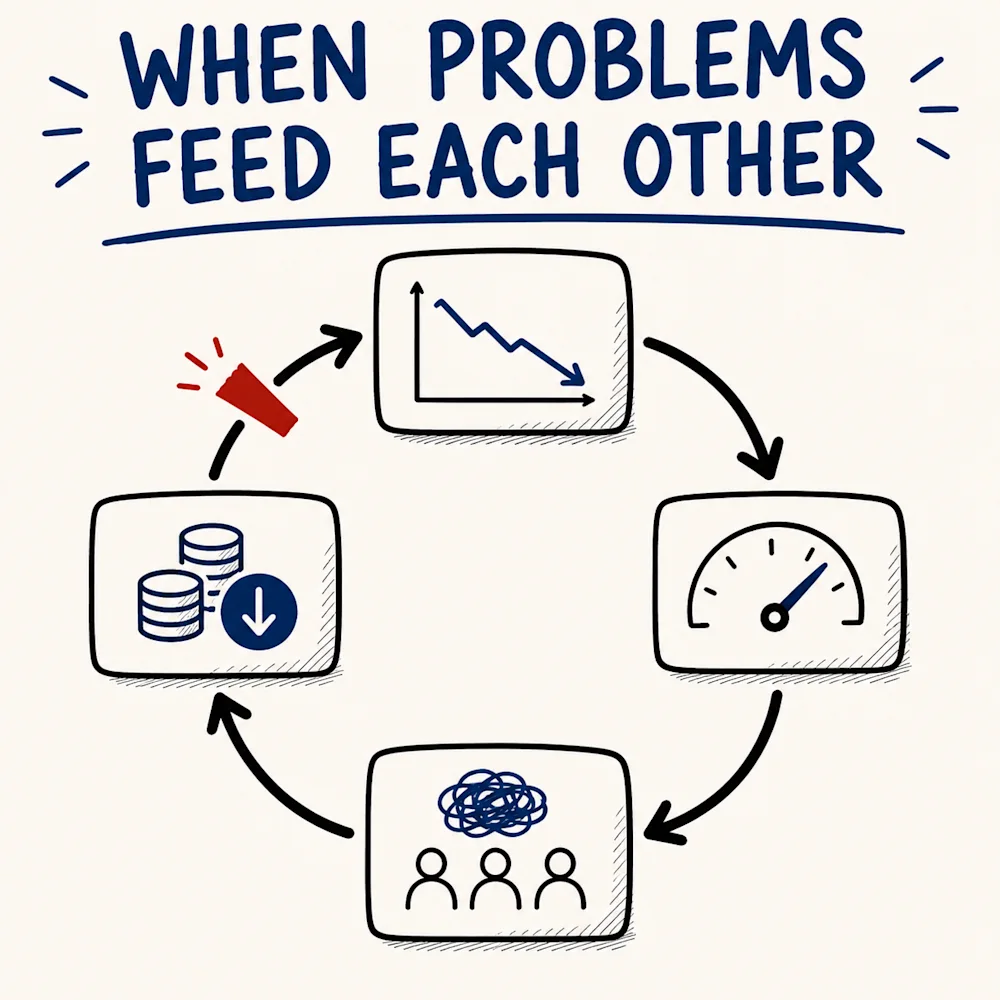
Every one of those treated the problem as a single thing to find and name. This issue is about what happens when it is not one thing. Because sometimes a company does not have a problem. It has three, and they feed each other in a circle.
The list every consultant hands over
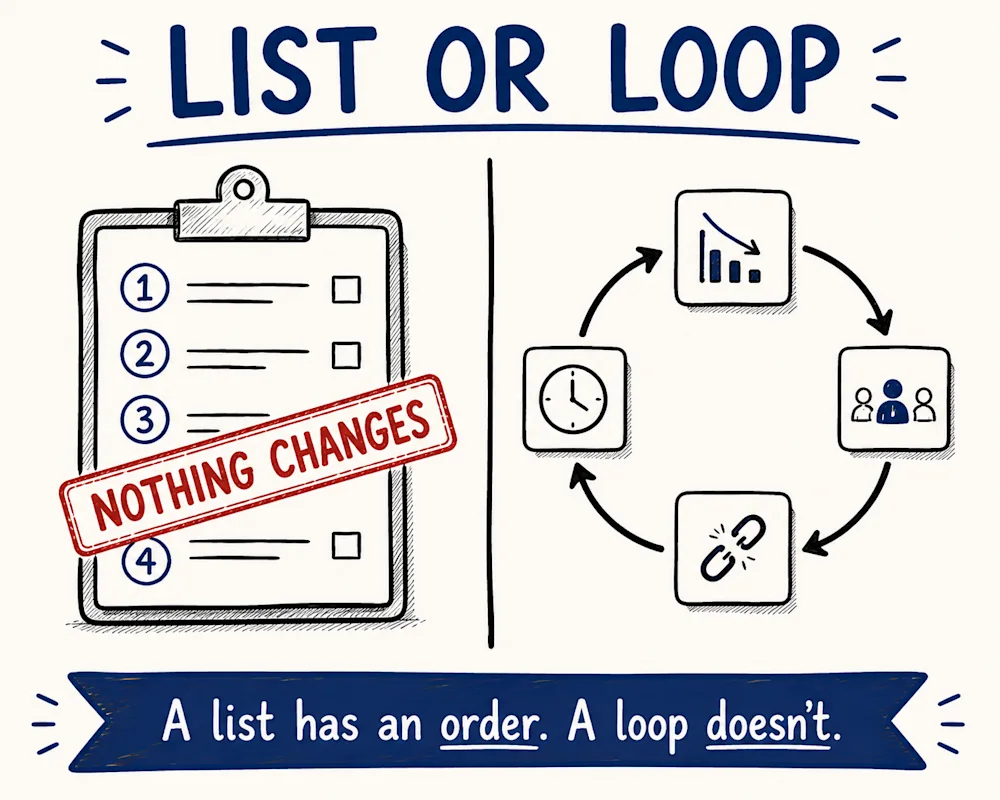
When a diagnostic surfaces four or five challenges, there is a deliverable everyone expects, and almost everyone provides: a prioritised list. Fix this first, it matters most. Then this. Then this. It feels rigorous. It photographs well in a report. And when the problems are genuinely independent, it is exactly the right thing to hand over.
But that list carries a hidden assumption, that the problems can be ranked, which means each one can be fixed on its own without the others undoing it. And a surprising amount of the time, in small companies, that assumption is quietly false.
Some problems are a system, not a list
Real SME problems are rarely strangers to each other. They wire together. Each one causes the next, and the last one loops back and feeds the first. Take a shape you have almost certainly seen: no real sales system, so revenue concentrates in a handful of clients, so the founder spends every week firefighting those clients to keep them, so there is never any time to build a sales system. Four findings. But they are not four problems. They are one loop wearing four faces.
And a loop does something a list cannot: it regenerates. Cut any single link and the other three grow it back. That is why some companies stay stuck for years on problems everyone can already see and name. They are not failing to fix things. They are fixing them one at a time, and the circle keeps healing behind them.
You start seeing them everywhere
Once you are looking for loops instead of lists, you find them in almost every diagnostic. A few I meet again and again:
The concentration squeeze. Most of the revenue leans on one or two big clients, so the company cannot afford to lose them, so those clients quietly set the price and the priorities, so the margin and the attention thin out, so there is less left over to go and win new clients, so the company leans on the big ones even harder. The knot tightens the more you pull on it.
The empty-week trap. Costs are almost entirely fixed, so an empty week is frightening, so the company takes any project that pays, on target or not, so the team scatters across unrelated work, so nothing gets done well enough to earn repeat business or a referral, so the pipeline stays thin, so the next empty week arrives and it takes whatever comes again.
The opportunity treadmill. There is no real strategy, so every opportunity looks worth chasing, so effort scatters across a dozen unrelated bets, so nothing compounds into an actual edge, so nothing pulls the right clients in on its own, so the company keeps waiting for whatever comes and chasing it when it does.
None of these sits on anyone's problem list under that name. Each one shows up as three or four separate complaints, gets fixed separately, and quietly comes back.
Why the ranked list fails
Here is the uncomfortable part, and it is about our own deliverable.
A prioritised list says: do number one, then number two. On a loop, you fix number one, and number three quietly undoes it while you are busy. You reduce the churn, but the leaders are still buried in delivery, so quality still slips, so the churn comes back. Six months later the client is exactly where they started, only now they have paid for a diagnosis and learned to distrust the next one.
So when the findings form a loop, a ranked list is not merely insufficient. It is the wrong shape of answer. And handing it over confidently is one of the quieter ways a good consultant fails.
The break point
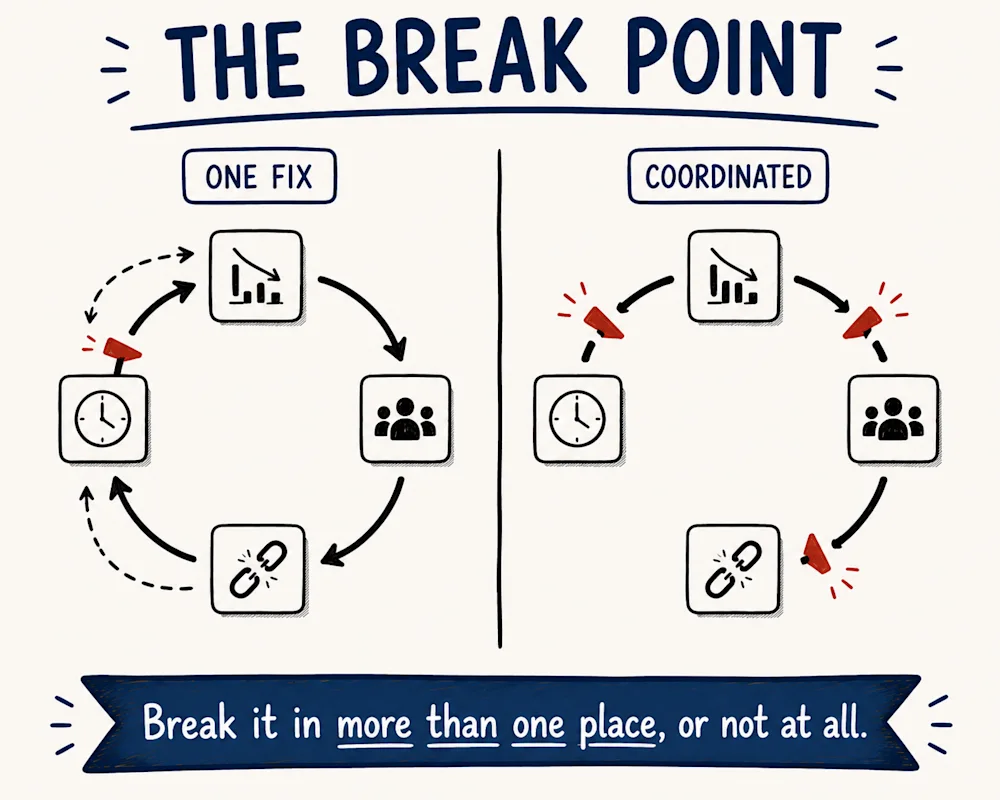
The move is different. First, recognise what you are looking at: not a list to rank, but a loop to break. Second, find the break point, the link, or more often the two or three links, where a coordinated intervention can snap the cycle so it stops healing.
The word that carries the weight is coordinated. A loop rarely breaks at a single point, because a single fix routes around it. You do not do the top priority and work down. You move on several links at once, together, so that when the circle tries to regenerate, too many of its steps are already gone. Broken together, or not broken at all.
The agency that grew 426% while running in a circle
I once diagnosed a B2B agency that had grown its revenue 426 percent in three years. By every headline number, a success story. And it had been trapped in the same loop for four of those years.
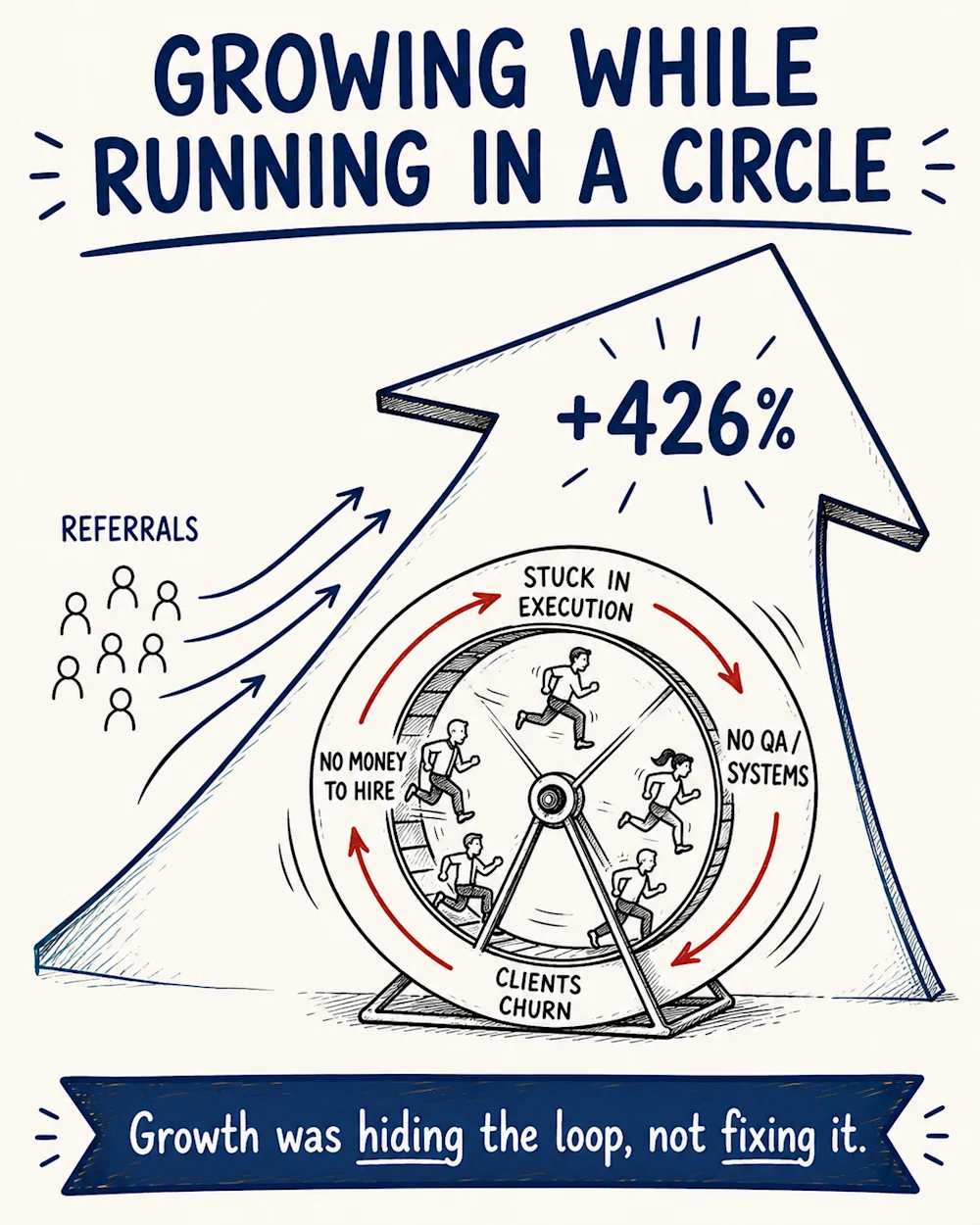
It ran like this. The leaders were stuck in execution, doing the client work themselves. Because they were in execution, nobody built quality control or delivery systems. Because delivery was inconsistent, clients churned at six to nine months, often before the results they were paying for had even appeared. That churn cost around 256,000 euros a year across a handful of clients, and retention never rose above 67 percent. And because that revenue kept leaking out the bottom, there was never money to hire the capacity that would free the leaders from execution. So the leaders stayed in execution. Back to the top of the circle.
Now the real question: how does a company running in a circle grow 426 percent? Because the growth was not coming from the circle. It was coming from referrals, arriving faster than clients churned, and quietly hiding the leak. The company had even built the CRM, the processes, the extra headcount, and never switched them on, because the referrals kept the lights on. As the diagnostic put it, every growth event traced to a relationship deepening, not to any system the company had built. The company was growing in spite of itself.
A ranked list would have died on this case item by item. "Reduce churn" fails while the leaders are still in delivery. "Hire capacity" fails while the churn is still eating the money to pay for it. "Free up the leaders" fails while every client needs firefighting. The only thing that breaks the wheel is a coordinated move on the execution load, the delivery quality, and the capacity at the same time, timed so that none of them gets the chance to regenerate the others.
Two things to take from it
Success can hide a structural trap. Growth is not proof that a system works. Before you congratulate a client on their numbers, ask one quiet question: is this growth coming from the system, or in spite of it? If it is coming from referrals, one big client, or the founder's personal hustle, you may be looking at a loop that simply has not caught up with them yet.
When your findings form a loop, change your deliverable. Not a ranked list of recommendations, but a break-point plan: the coordinated intervention, and the handful of things that have to move at the same time. It is harder to build and harder to sell, because clients are trained to expect the numbered list. It is also the only version that actually works.
You cannot fix a loop one piece at a time.
Two questions for the comments.
What is the most vicious reinforcing loop you have ever diagnosed, and could you point to its break point?
And how often does your final report come out as a tidy ranked list, when the findings were really a circle?
Questions readers ask
Why does a prioritised list of problems fix nothing?
Because a ranked list assumes the problems are independent. When they feed each other, fixing number one lets number four push it straight back, and the client concludes the diagnostic did not work.
How do I spot a loop rather than a list?
Take each finding and ask what it makes worse, then follow the arrows. If they come back to where you started, you have a system. Once you have seen one you start seeing them everywhere, which is a hazard of its own.
What is the break point?
The one place in the loop where an intervention holds, because the circle cannot re-form around it. You are not looking for the biggest problem in the loop. You are looking for the one that stops it turning.
Can a company grow while running in a circle?
Yes, and that is what makes it hard to see. One agency grew 426% while the loop was still turning, because growth was covering the churn the loop kept producing. Revenue is not evidence that the system is sound.
How should the report present a loop?
As a loop. If the findings were a circle and the report hands over a tidy ranked list, the shape of the answer contradicts the finding, and the client will act on the list.
About the author
Dancho Dimkov writes Anatomy of Consulting, a publication about the practice of business diagnosis. Read more about the publication.
Stages referenced here are links in the diagnostic journey (7 links in total).