
In development
Anatomy of a Business Diagnostic
Your client's problem is a clue, not the diagnosis
Most things sold as a business diagnostic are not diagnostics. They are questionnaires that produce a score, or thick reports that list everything and conclude nothing. This book is about the other kind: the chain of reasoning that starts with a hypothesis and ends with a verdict somebody signs.
A diagnosis is not a score.
The verdict is the work.
You have seen the deliverable. Sixty pages, properly bound, an executive summary that is somehow six pages long. It lands on the founder's desk with a satisfying weight, everyone agrees it was thorough, and then nothing happens.
The problem is not effort and it is not intelligence. It is that the document lists findings and never commits to a verdict. Findings cannot be wrong. A verdict can, which is exactly why it is the part worth paying for.
Underneath that is a second problem. Most diagnostics treat a company's problems as a list to be ranked. They are usually a system that feeds itself, so fixing the item at the top lets the item at the bottom push it straight back, and the client concludes the work did not help.
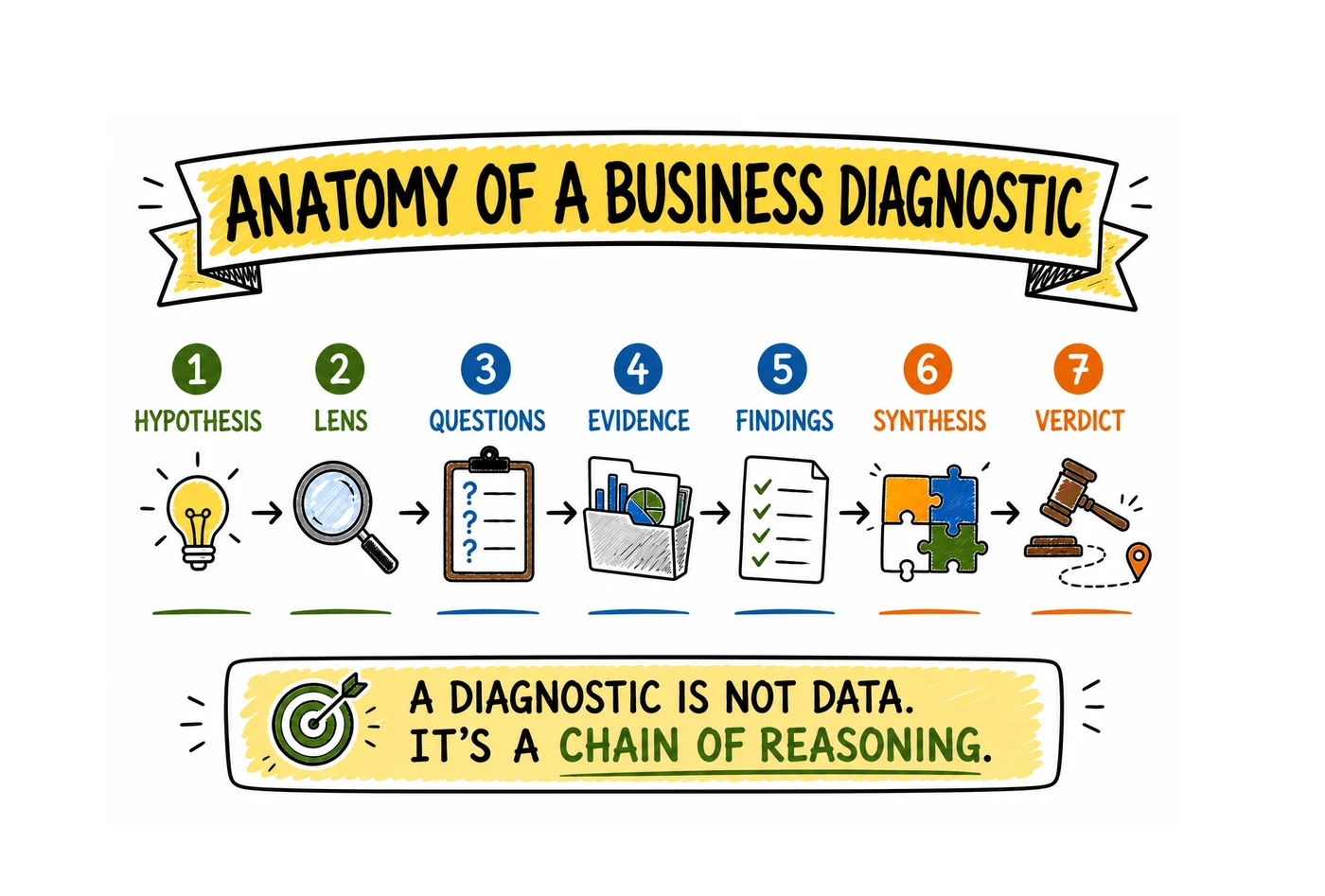
Anatomy of a Business Diagnostic sets out the chain a diagnosis actually runs on, the seven links from a working hypothesis to a recommendation that escalates. It comes out of doctoral research and more than six hundred client engagements, and it is the method behind the Anatomy of Consulting publication.
In “Anatomy of a Business Diagnostic” you will learn how to:
- Name the real problem instead of accepting the symptom the client presents
- Choose between a hypothesis and a framework, and know what each one costs you
- Separate the questions whose answer already exists from the ones that must be worked out
- Treat a number the client cannot produce as a finding rather than a blocker
- Trace a cause across departments, and spot the loop a ranked list will never fix
- Commit to a handful of recommendations, and deliver the verdict without flinching
- Decide where AI belongs in the work, and where it will confidently lie to you
This book is for consultants who investigate businesses for a living, and for owners who want to know what they should be getting for the fee.
Meet the author
Dancho Dimkov
Dancho Dimkov is a speaker, management consultant and coach, and a bestselling author who published four books before he turned 40. He started his first company at 21 and was named a World Bank Global Innovator at 22.
In 2015 he founded BizzBee Solutions, a B2B lead generation company that has run more than 600 client engagements since. Today he works with founders and business owners directly, as a coach, a consultant or a fractional executive, on sales, growth and AI.
He is currently doing his doctorate (DBA) at University American College Skopje, researching how small businesses adopt AI. He holds an Executive MBA from the University of Sheffield and an MSc in entrepreneurship. He is a Chartered Manager (CMgr) and a Certified Management Consultant (CMC).
He has spoken at more than 35 events in 9 countries, hosted over 300 episodes across five podcast and video shows, and writes Anatomy of Consulting, a weekly LinkedIn newsletter. This book grows out of it.

The thinking is already published
The book is being written in the open. Seventeen editions of Anatomy of Consulting are published and readable now, each taking one part of the diagnostic apart, with the diagrams that ended up shaping the chapters.
Ready to run a diagnostic that reaches a verdict?
- Find the real problem instead of the one the client named
- Build a case on evidence with a source or a calculation behind every number
- Turn a hundred findings into the few recommendations worth signing
- Say the uncomfortable conclusion out loud, in the report
Frequently Asked Questions
What is Anatomy of a Business Diagnostic about?
How a consultant finds the real problem in a business and proves it. It sets out the diagnostic as a chain of seven links, from a working hypothesis through evidence and findings to a verdict, and it argues that the verdict is the part clients are actually paying for.
When is the book out?
There is no publication date yet. It is being written out of doctoral research, and the thinking is published weekly in the Anatomy of Consulting newsletter as it develops. Subscribe there and you will hear when the book is ready.
Who is it for?
Consultants who investigate businesses for a living, and business owners who want to judge whether a diagnostic they are buying is worth the fee.
What are the seven links in the chain?
Hypothesis, lens, questions, evidence, findings, synthesis and verdict. They are one chain rather than seven boxes, and skipping a link leaves the ones after it with nothing to stand on.
How is this different from a business assessment or a scorecard?
A scorecard produces a number, and the same number could have been produced without anyone thinking about that particular company. A diagnostic produces a conclusion about this business that somebody signs their name to.
Does the book cover AI?
Yes, as part of the work rather than as a separate subject. The useful distinction is between questions whose answer already exists, where AI is reliable, and questions that have to be calculated, where it will produce a confident and wrong number.
Is it related to the Anatomy of Consulting newsletter?
The newsletter is where the method is worked out in public, one part at a time. Seventeen editions are published and the book grows out of them.
Can I read something now?
Yes, all seventeen published editions are on this site, and the newsletter continues on LinkedIn.