
When the Founder Is the Problem: The Finding Nobody Says Out Loud
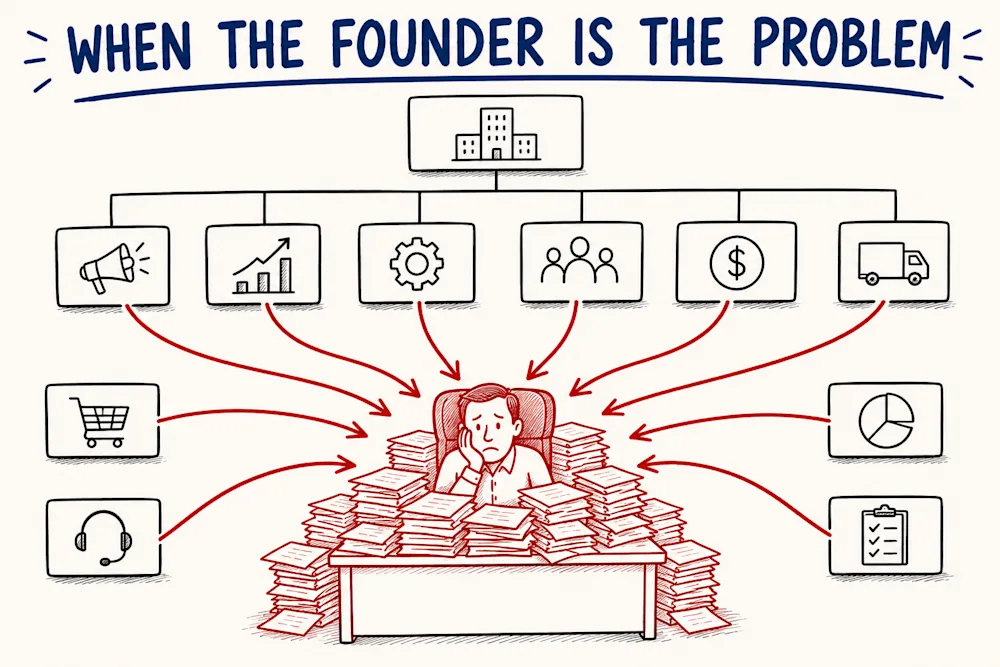
Run enough diagnostics in small companies and one root cause comes back more often than any other. It is not pricing. It is not the funnel. It looks like this: every approval waits for one signature, the biggest clients all live in one person's phone, and the whole company quietly holds its...
Edition 12first published on LinkedIn
Run enough diagnostics in small companies and one root cause comes back more often than any other. It is not pricing. It is not the funnel. It looks like this: every approval waits for one signature, the biggest clients all live in one person's phone, and the whole company quietly holds its breath whenever that person is away for a week.
That person is the founder. The founder is your client. And that is the moment this job gets genuinely hard.
I keep meeting the same finding in different costumes. A software founder personally signing off on everything that leaves the building. An agency where every growth event in its history traced back to one of the founder's personal relationships, not to anything the company built. I ended up co-writing a whole book about this pattern, Success Ceiling Breakthrough, and its opening truth applies to no company more literally than the founder-dependent one: the strategies that get you to success are rarely the ones that take you past it. The founder's way of working built the company. Now it is the ceiling on it.
And notice what founder-dependency does that other problems do not. It regenerates them. No documented processes, because everything lives in one head. No sales system, because the founder is the sales system. No leadership layer, because until now nothing ever needed one. You can treat each of those separately for a year and change nothing, because they all grow back from the same root.
The finding nobody says out loud
Here is the uncomfortable part, and the reason this issue exists. Every consultant who works with SMEs has sat on this finding, and most of us, at least once, have softened it into something safer: "you need better processes," "you should invest in middle management."
The reason is simple. Every other finding criticises a decision. "Your pricing is wrong" is about a number. "Your funnel leaks" is about a system. This one sounds like it criticises the person, and that person is paying for the engagement. So the sentence gets wrapped in euphemism, the report treats the symptoms, and the root cause walks out of the project untouched, still signing everything.
Let me name that for what it is: quiet malpractice. Kind, well-intentioned, relationship-preserving malpractice. The client paid for the diagnosis, and the one finding that would change everything stayed in the drawer.
How to detect it before anyone admits it
The good news is that you do not need anyone's confession. The dependency is sitting in the data before a single interview.
Look for three signals. First, the approval trail: pull any process, a hire, a discount, a purchase, and watch where it converges. In a founder-dependent company every trail bends toward the same desk. Second, revenue attribution: list the top clients and ask where each one came from. When the answer is "the founder knows him" five times out of six, the revenue does not belong to the company, it belongs to a person. Third, the travel test in the calendar: find the week the founder was at a conference, and look at what moved. In these companies, nothing does.
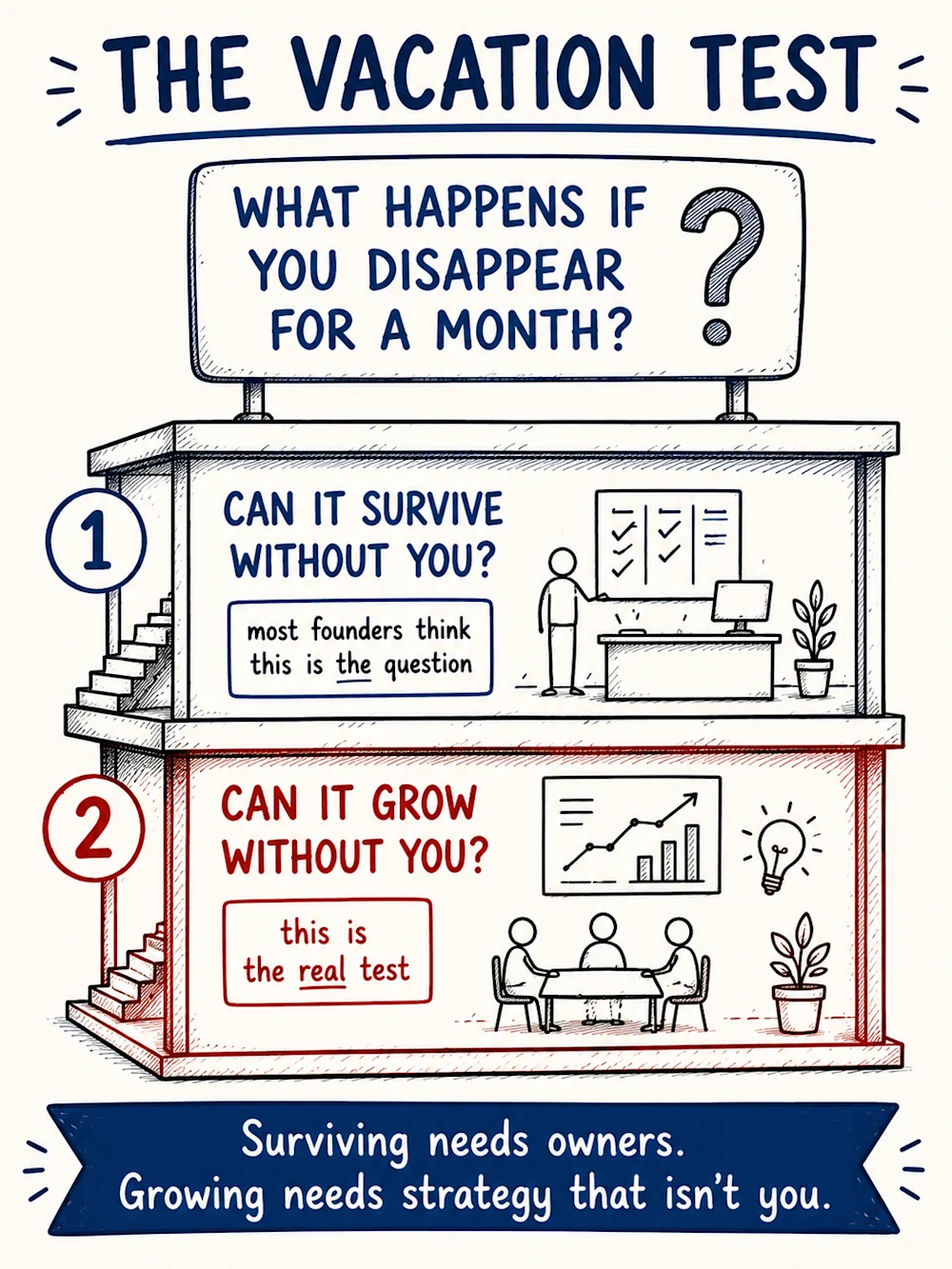
And then there is the probe, one question you can ask in the very first meeting, long before you open a spreadsheet: "What happens if you disappear for a month?"
I call it the vacation test, and it is not self-help advice, it is a diagnostic instrument with two layers.
Layer one: can the business survive without you? This is the layer most founders think the question is about. Some can honestly answer yes: the work gets delivered, the invoices go out, nothing burns down.
Layer two: can the business grow without you? This is the real test, and it is where almost every founder goes quiet. Surviving means the operations have owners. Growing means the strategy does: someone other than the founder is developing the offer, opening the partnerships, steering the direction.
I know the difference because I failed the second layer myself. I documented exactly these two questions in my latest book, Success Ceiling Breakthrough, which I co-authored with Joe Kapp. The survive question I could answer with a yes: marketing brought the prospects, salespeople closed, a team delivered. The grow question stopped me cold. All the strategic work, the service development, the partnerships, the direction, was me. "I can probably get there, but I am not there yet" was the most honest answer I could put on the page.
The two layers grade the finding for you. A company that fails layer one has operational founder-dependency, the visible kind. A company that passes the first layer and fails the second has strategic founder-dependency, and that is the dangerous one, because it caps growth at exactly the moment everything looks delegated. And the founder who proudly answers "nothing works without me" has skipped both layers and handed you the diagnosis, wrapped as a boast.
How to say it: show the trace, not the verdict
You never say "the bottleneck is you." Not because it is false, but because a verdict delivered head-on gets defended against, and the engagement dies in that meeting.
Instead, show the convergence. Here is where every approval goes: one desk. Here is whose relationships the revenue hangs on: one name. Here is what happened while you were away in March: nothing. Lay the trails side by side and let the owner read them. They always say the sentence themselves, and a sentence the client says is a discovery, while the same sentence from you is an accusation.
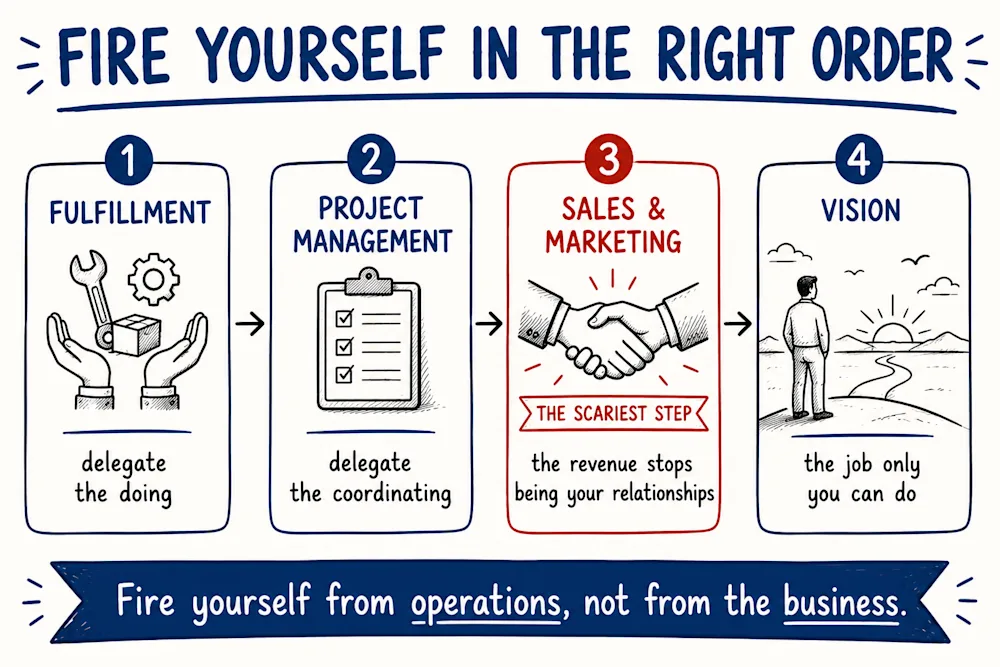
Then reframe what comes next, because this is where most owners panic. The goal is not to remove the founder from the business. It is to promote them to the only job nobody else in the company can do: direction, the next market, the next product, the relationships that genuinely need a founder. Fire yourself from operations, not from the business. The founder does not lose the company. They finally get the job they founded it for.
The prescription: help them fire themselves, in the right order
The fix is a sequence, and the order is the craft. This is the roadmap you build with the client, and it is worth more than any tool you could hand them.
Start with fulfillment. Move the doing off the founder's desk first. It frees the most hours the fastest, and a full-time employee on a task will eventually outperform a founder giving it two hours a day.
Then project management. Hand over the coordinating, so the doing no longer needs the founder's daily steering.
Then sales and marketing. The step your client will resist hardest, because it means the revenue stops being their personal relationships and starts being a system the company owns. This is where most SMEs stall, and where you earn your fee: building the engine that replaces the founder's phone book.
Vision is what you hand back. That is not the leftover. It is the founder's actual job, and the whole sequence exists so they can finally do it.
Underneath the sequence sits the checklist you leave behind: decision rights pushed down, weekly metrics so the founder can see without touching, documentation so knowledge leaves the head, and a leadership layer so the structure holds on its own.
None of this is theory to me. I wrote the full version of the ladder in my book A Journey to Financial Freedom, delegate, standardize, then invest in marketing and sales, and I climbed it at my own company rung by rung before I ever prescribed it to a client.
Now the mirror
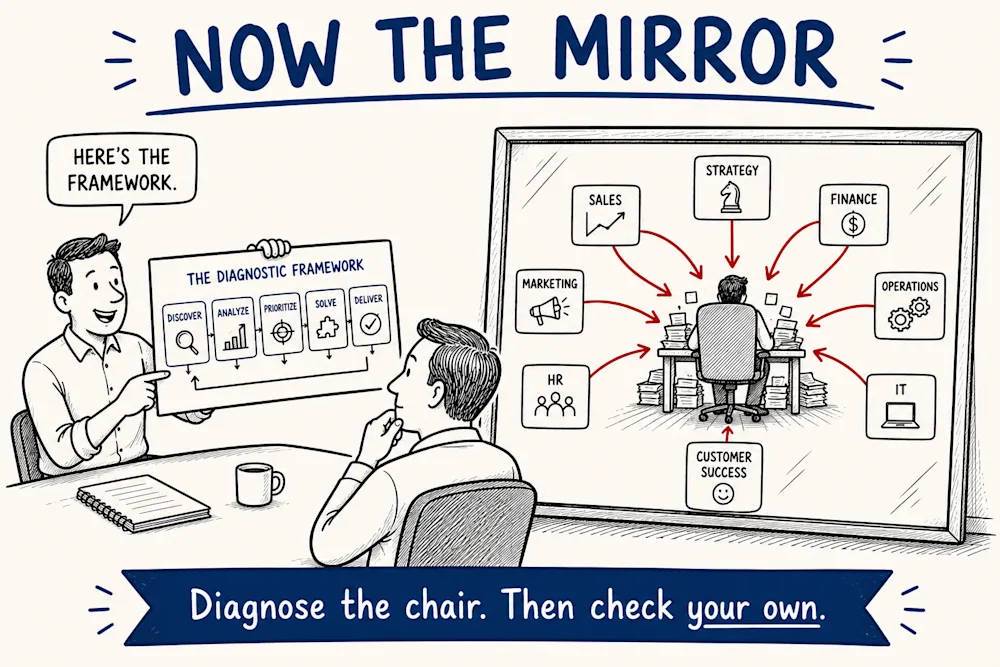
It would be comfortable to stop here, with founder-dependency as a client disease. It is not only a client disease.
A consulting practice is one of the most founder-dependent businesses on earth. The practice usually is the founder: their hours, their brain, their name, their relationships. Strip away the language and many of us are advising clients to build the exact thing we have never built ourselves. So turn the instrument around: does your practice pass the vacation test?
I ask because that second question took me years to answer properly. At BizzBee we promoted from within, Hristina and Nikolina grew into project managers, Natasha grew into COO, and eventually I stepped down as CEO and handed her the company. It kept running. We had even built the principle into hiring long before that: every new person heard the same rule, you have three months to learn to work without my assistance. Independence was the culture, not the exit plan. And the same test now applies to my consulting: the diagnostic methodology I built runs in engagements I am not personally in. That, for a consultant, is what passing the vacation test looks like.
I am not telling you this to take a bow. I am telling you because the advice in this issue is expensive to give and painful to take, and a consultant who has taken it themselves delivers it differently.
Diagnose the chair, not just the company. Then have the honesty to check your own.
Two questions for the comments.
What is the most founder-dependent business you have ever diagnosed, and did you say it out loud or soften it?
And honestly: does your own practice pass the vacation test?
Questions readers ask
What does founder dependency look like in a diagnostic?
Every approval waits for one person. It shows up as slow decisions, a team that escalates everything, and a calendar that is the real bottleneck in the company. It is a more common root cause in small companies than pricing or the funnel.
How do I detect it before anyone admits it?
Follow decisions rather than asking about them. Take five recent ones and find where each stopped and who unblocked it. Nobody has to describe the pattern if the trace shows it.
How do I tell a founder that they are the problem?
Show the trace, not the verdict. Put the five decisions and their wait times in front of them and let them reach it. A founder who concludes it themselves starts fixing it; a founder who is told it defends themselves.
What is the prescription?
Help them fire themselves, in the right order. Not delegation as a principle, a sequence: which decision leaves their desk first, who catches it, and what has to be written down before it can move.
What is the vacation test?
Whether the company runs while the founder is away for two weeks with the phone off. Worth applying to your own practice before you apply it to a client's, because most consultants fail it too.
About the author
Dancho Dimkov writes Anatomy of Consulting, a publication about the practice of business diagnosis. Read more about the publication.
Stages referenced here are links in the diagnostic journey (7 links in total).