
Specialist or Generalist: The Read You Make Before Taking the Engagement
Every owner runs a free diagnostic on their own company, every single day. It has no methodology and no report, but it works. Anything weak that they can see, they fix. A broken process, a wrong price, a supplier who slips. Seen, fixed, forgotten. Owners are smart: if they can see it, they can...
Edition 11first published on LinkedIn
Every owner runs a free diagnostic on their own company, every single day. It has no methodology and no report, but it works. Anything weak that they can see, they fix. A broken process, a wrong price, a supplier who slips. Seen, fixed, forgotten. Owners are smart: if they can see it, they can fix it.
Which leads to an uncomfortable conclusion for every consultant who walks into a small business believing the owner is simple, or worse, stupid. By the time you get the call, every easy problem is already dead. The owner killed those years ago, without you. Whatever is still hurting the company today is, almost by definition, something the owner cannot see from where they sit. The problems that survive are survivors, and survivors survive by hiding.
I run business diagnostics for a living, and after enough of them the pattern is hard to miss. When an owner finally picks up the phone, the problem waiting on the other side is one of two kinds. Either it has gone deep, buried inside one department, below the owner's own expertise. Or it has gone wide, stretched across departments, into spaces that no single person owns. Everything about the engagement follows from which of the two is in front of you: who the client actually needs, where to look first, and what you can honestly charge for. So let me take them one at a time.
When they need a specialist, not a consultant
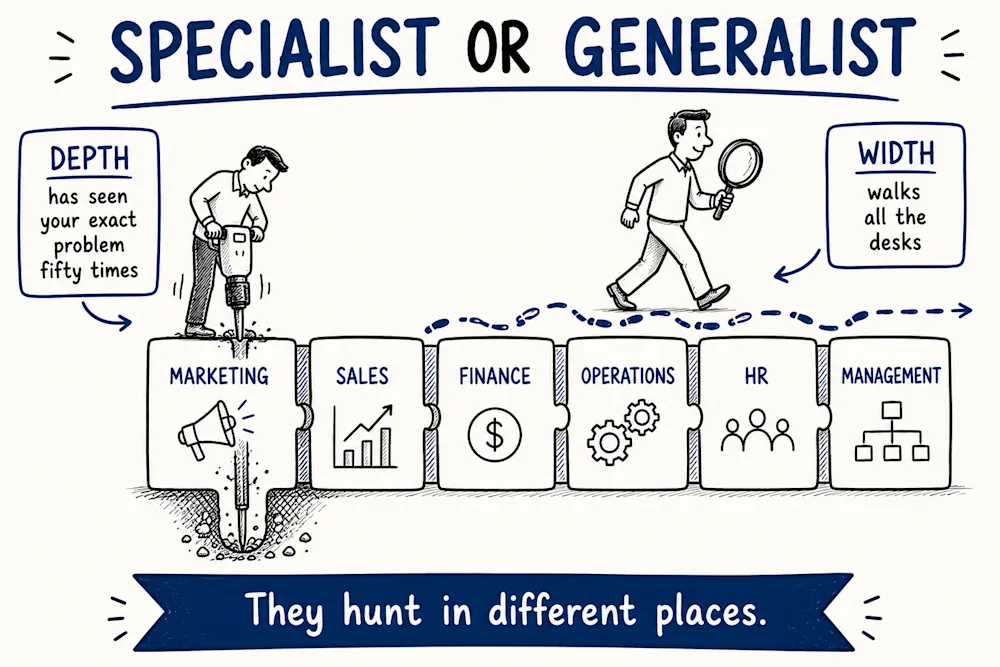
Some problems hide by going deep, down inside one department, below the owner's own expertise.
The company knows exactly where it hurts. The department is named, the metric is named. Conversions in the funnel have dropped and nobody in the building knows why. Scrap on one production line keeps creeping up. The ad account spends more every month for the same result. The owner can point at the problem, they simply cannot reach it, because reaching it takes depth they do not have.
Let me say this plainly, because it is a line consultants like me sometimes blur: this problem does not need a diagnostic. It needs a specialist. A conversion consultant who has seen that exact funnel problem fifty times will find in a week what a generalist would circle for a month. When the problem is deep, depth wins, and the honest move is to say so.
When nobody inside can see it
The other problems hide by going wide. Not down into a department, but across them, into the spaces between desks that no org chart shows and no manager owns.
This is the bigger and quieter danger, because it defeats the owner's own repair instinct entirely. The owner fixes what they can see, and a wide problem is invisible from every seat in the company. Each department, examined on its own, is fine. Each manager, asked about their area, answers honestly that things are under control, and they are right, about their slice. The owner reads the per-department reports, and every report is green. The problem does not live in any report. It lives between them, in the handoffs. There is no chair inside the building from which it can be seen, which is why it can sit there for years, and why it takes a pair of outside eyes, someone standing outside all the boxes at once, to catch it.
I wrote up the cleanest example I know in ICMCI's white paper Navigating the Storm: a wholesale distributor of LED and electrical equipment, with dead inventory quietly piling up on the books. Trace that one symptom and it crosses six desks. Procurement was buying on supplier incentives rather than demand. Sales had no clearance pricing to move old stock. Nobody in HR had tied anyone's KPIs to inventory. Finance was not watching the stock-to-sales ratio. Management had no product lifecycle process. The warehouse ran no ageing reviews. Six departments, six honest "we're fine"s, one company-level problem that had survived for years.
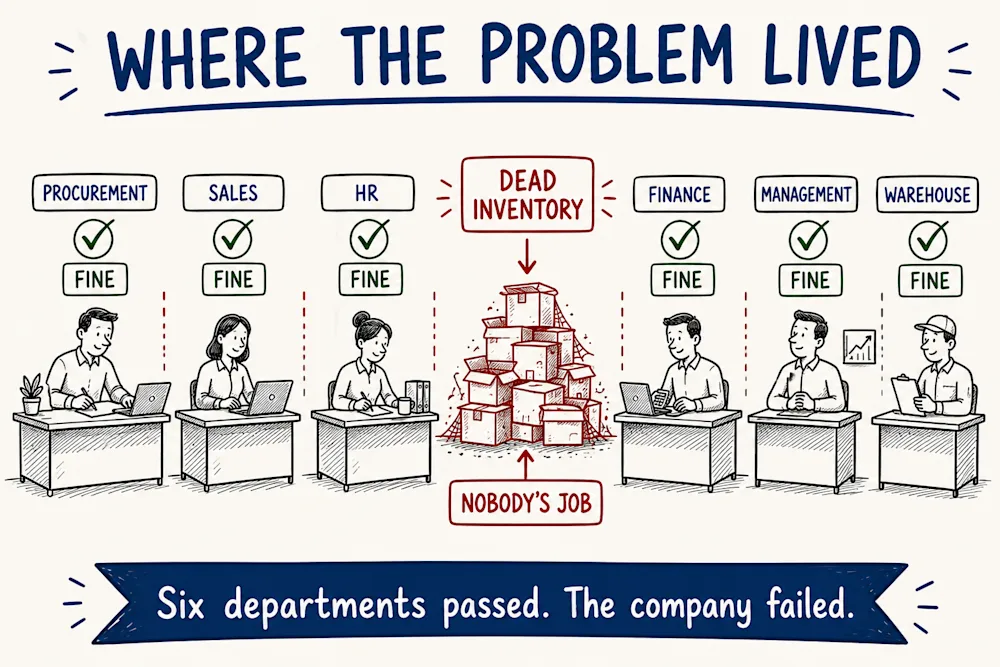
No specialist would have found it, because every specialist looks inside one box, and inside every single box things looked acceptable. And no single fix could kill it, because fixing one desk leaves five causes untouched. The cure had to mirror the disease: coordinated changes across all six.
That is the honest answer to what each one brings to the table. The specialist brings depth: they have seen your exact problem more times than anyone in the country, and inside one box, nobody goes deeper. The generalist brings width: the walk across all the desks, the one move no specialist is hired to make and no one inside the company can make. Neither replaces the other. They hunt in different places.
The first read: follow the trace
So how do you tell, sitting in the first meeting, which of the two is in front of you?
Not by asking the owner. The owner will always hand you a symptom with an address: "sales are down," "stock is piling up," "conversions dropped." That named metric is where the pain shows, not necessarily where the problem lives, and taking it at face value is the oldest mistake in the trade. The address on the symptom tells you where to start digging. It does not tell you what you will find.
The read that works is the trace. Take the symptom the owner named and keep asking one question: what is causing this? Then watch the direction the trail runs.
If the trail runs down, deeper and deeper into the same department, conversions dropped because the landing pages changed, because there is no testing discipline, because nobody owns analytics, then the problem is deep. One box, more depth than the company has. Your read: bring in the specialist with the deepest scar tissue in exactly that area.
If the trail runs sideways, crossing desk after desk, dead stock leads to procurement's buying incentives, which leads to sales' missing clearance pricing, which leads to HR's KPIs and finance's unwatched ratio, then the problem is wide. No specialist will find it and no single fix will kill it. Your read: this is a diagnostic, walked across every desk the trail touches.
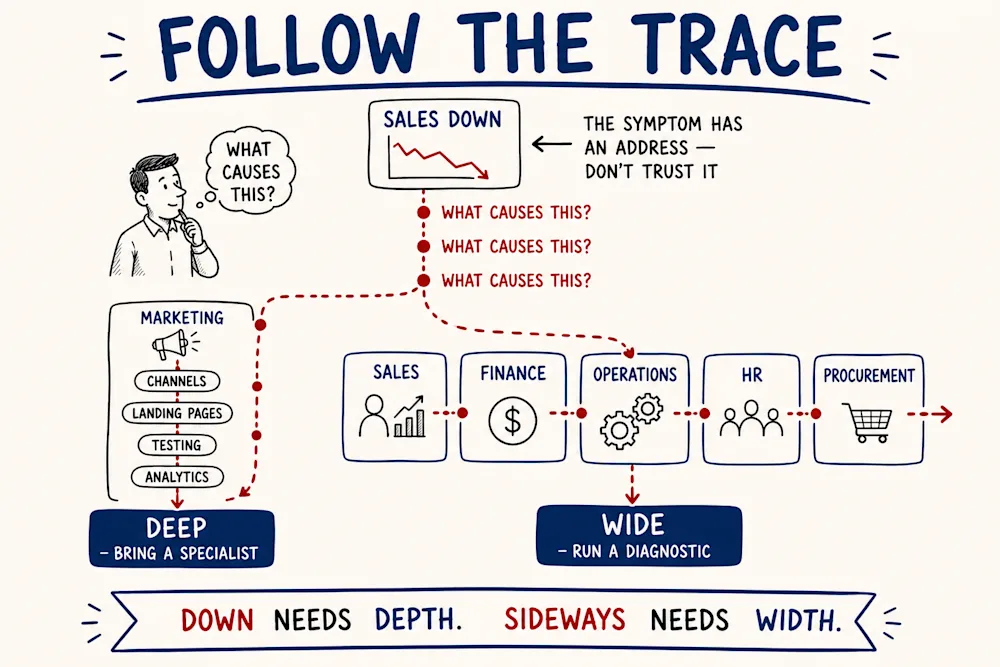
The direction of the trace is the diagnosis of the problem's type. And skipping the trace is where real money gets burned: the symptom shows up at one address, so the owner hires a specialist for that address, an inventory-clearance expert for the warehouse, while five of the six causes sit untouched and the pile quietly grows back. The symptom's address is not the problem's address.
The framework to carry into Monday's meeting
Here it is in the form you can actually use, three moves long.
One. Take the symptom, distrust the address. Whatever the owner names is where it hurts, not where it is broken.
Two. Trace to the root. Keep asking what causes this, and follow the chain wherever it goes, without deciding in advance what kind of problem it is.
Three. Read the direction. Down into one department: deep, hand it to a specialist, and say so honestly. Sideways across departments: wide, and now you know why the owner could not see it, why no specialist would find it, and why the engagement is a diagnostic.
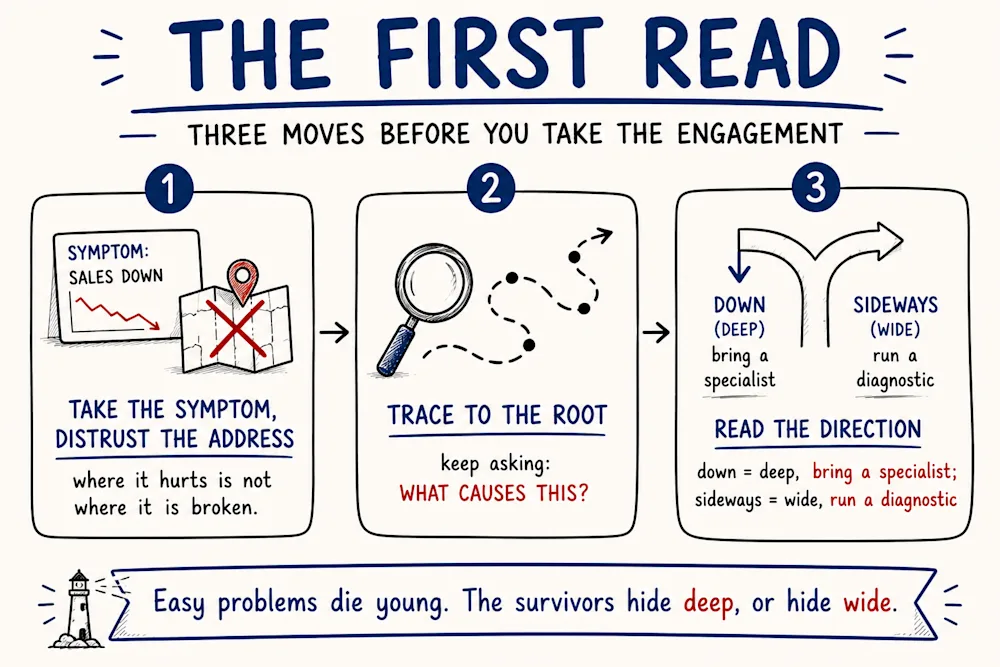
That third move is also where trust is built. The day you tell an owner "you do not need me, you need a conversion specialist, here is one," you become the first advisor who did not sell them their own symptom back. The wide problems, the ones that need everything you have, tend to come from exactly that kind of trust.
Easy problems die young. The ones that survive hide deep, or hide wide. The trace tells you which, before anyone spends money on the wrong cure.
Two questions for the comments.
What is the widest problem you have ever traced, how many desks did one symptom cross before you found all its causes?
And have you ever told a client "you need a specialist, not me", and what did it do for the relationship?
Questions readers ask
How do I tell whether a client needs a specialist or a consultant?
Ask whether anyone inside can already see the problem. If they can name it, they need the specialist who fixes that thing. A consultant is for the problem nobody inside can see, which is a different engagement and a different price.
Why do owners misjudge this about their own company?
Because every owner runs a free diagnostic on themselves every day, and it works. Anything weak they can see, they fix. What is left is precisely the set of problems their own read cannot reach, which is why what remains is always the hard kind.
What does following the trace mean?
Taking the symptom the client presented and tracing it backwards across departments until it stops moving. The problems worth hiring a consultant for hide in the handoffs nobody owns, so the trace crosses desks rather than stopping at one.
Should I turn down work by telling a client they need a specialist?
Yes, when it is true. You lose one engagement and become the person whose read they trust next time. The alternative is running a diagnostic on a problem that was already named, and both of you knowing it by week three.
What do I carry into the first meeting?
One question: can anyone here already name the cause. Then the trace. You do not need a framework to make that read, you need to resist the urge to scope before you have made it.
About the author
Dancho Dimkov writes Anatomy of Consulting, a publication about the practice of business diagnosis. Read more about the publication.
Stages referenced here are links in the diagnostic journey (7 links in total).