
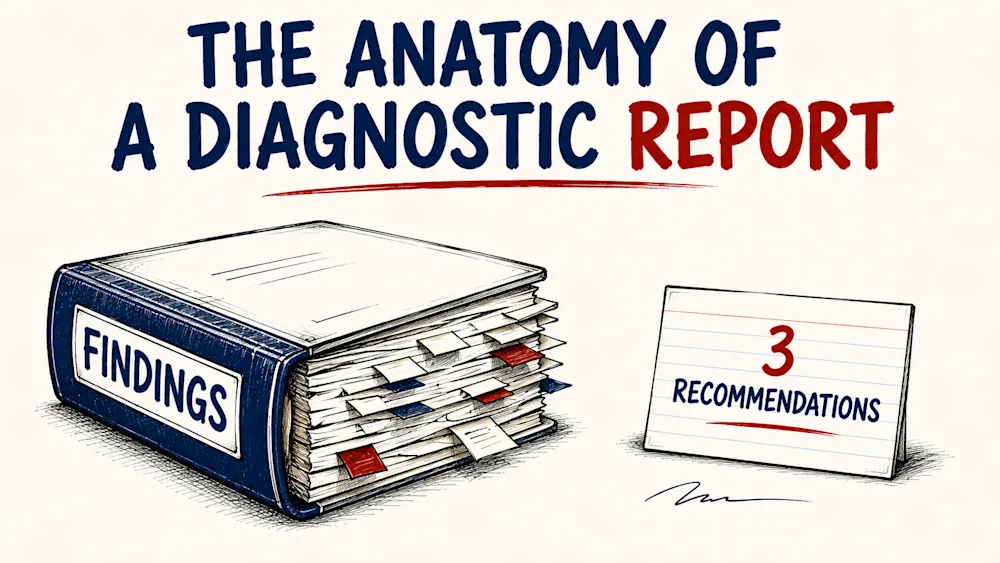
The Diagnostic Report: A Verdict, Not a Binder
You have seen the report. Maybe you have written one. Sixty pages, properly bound, a cover with the client's logo on it, an executive summary that is somehow six pages long. It landed on the founder's desk with a satisfying weight, everyone agreed it was thorough, and then nothing happened. Six...
Edition 16first published on LinkedIn
You have seen the report. Maybe you have written one. Sixty pages, properly bound, a cover with the client's logo on it, an executive summary that is somehow six pages long. It landed on the founder's desk with a satisfying weight, everyone agreed it was thorough, and then nothing happened. Six months later the business is exactly where it was, and the report is holding up a monitor.
We tend to blame the client for that. They did not follow through, they lacked the discipline, they went back to firefighting. Sometimes that is true. But often the report was dead on arrival, and not because it found too little. It found plenty. It died because all that finding never turned into a decision. It was a pile of evidence that never became a verdict.
Findings and recommendations are not the same thing
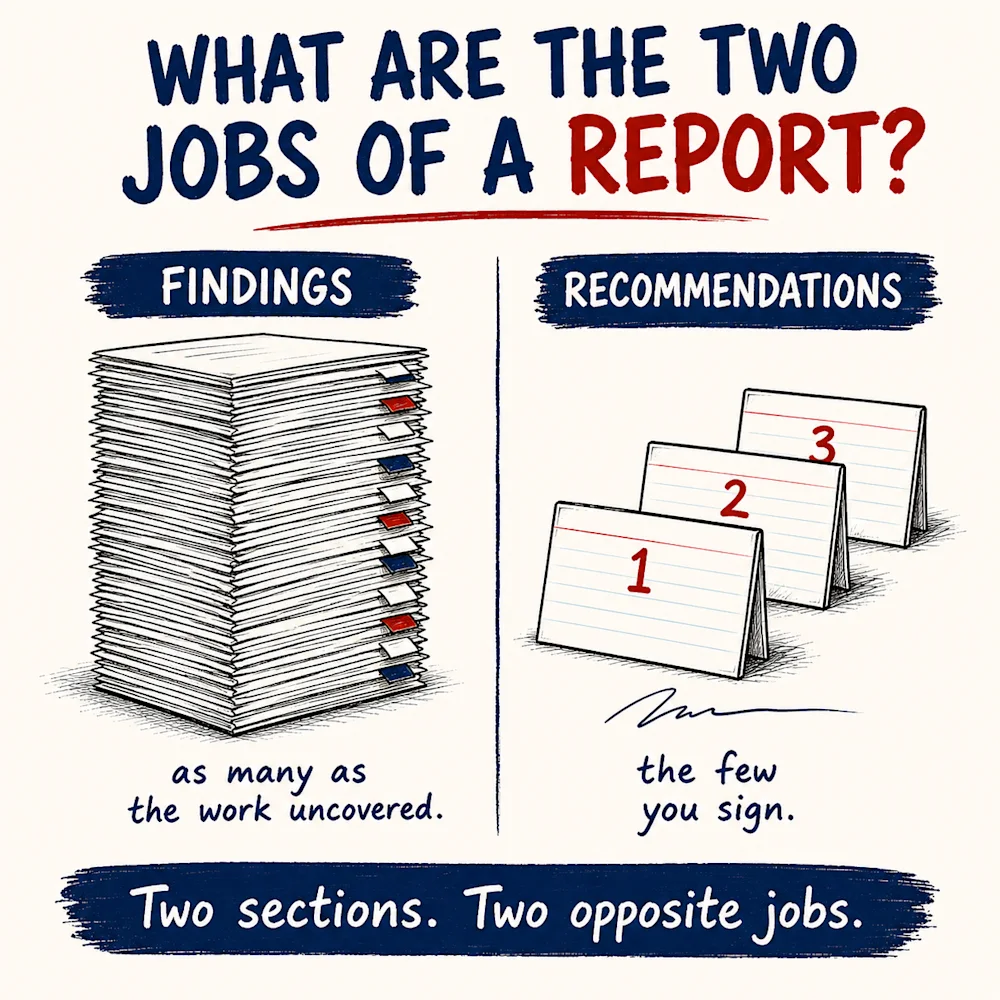
Here is the distinction most reports blur, and blurring it is where they go to die. A diagnostic report has two sections doing two opposite jobs.
The findings are everything you uncovered. And here, more is better. A hundred findings shows the founder how deeply you looked, that you turned over every stone in the business rather than confirming the first thing they told you. This section is the evidence of the work, and it earns trust. Never thin it out. Show the depth you went to; it is half of what they are paying for.
The recommendations are something else entirely. They are the few things you are telling the client to actually do. This is not evidence, it is judgement. It is you looking at everything you found and deciding, on your experience and your name, which handful matters most right now. This is the other half of what they are paying for, and it is the half most reports quietly skip.
Because the fat report that changed nothing usually did the first job and dodged the second. It handed over a hundred observations, or worse, it dressed a hundred observations up as a hundred things to fix, and called that a plan. It did the looking. It skipped the deciding. And the deciding is the whole reason someone hires a consultant instead of reading a checklist.
Show every finding. Commit to three recommendations.
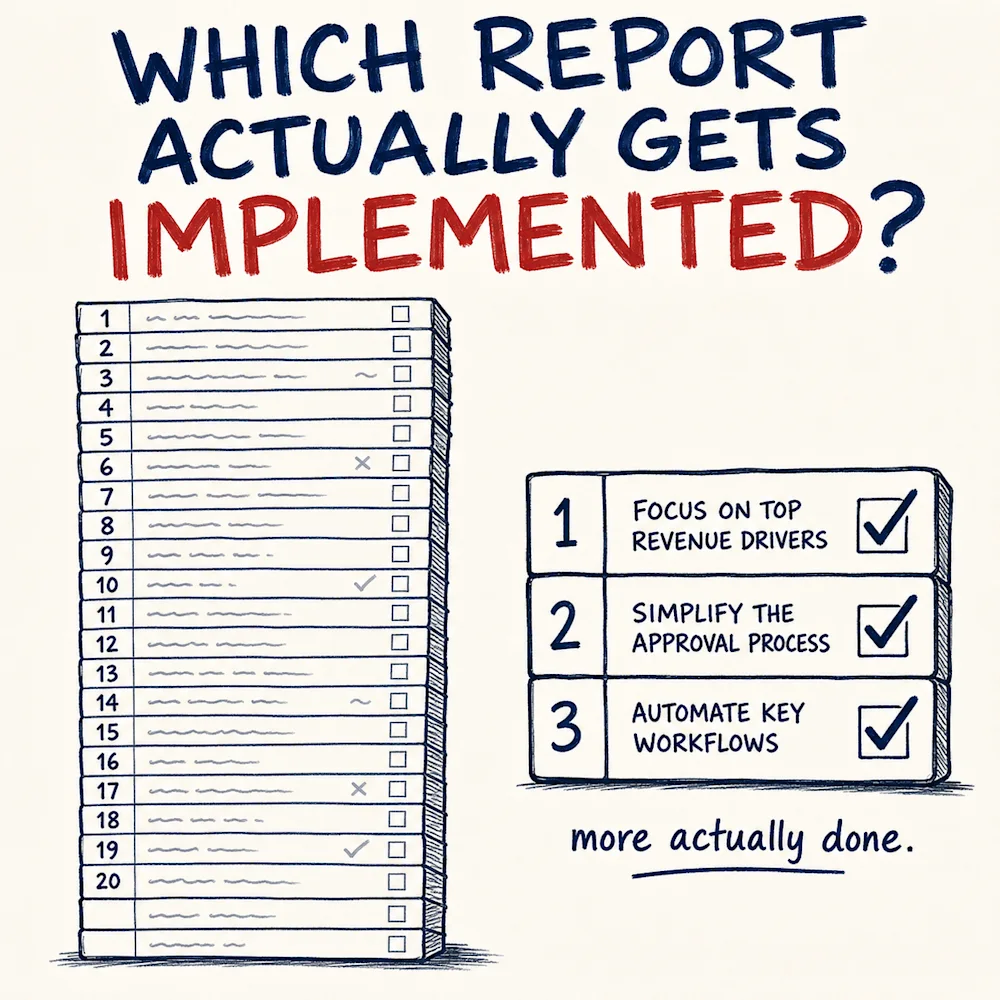
So the discipline is not "write less". It is asymmetric. Keep the findings section as long as the work honestly was. Then, in the recommendations, do the opposite, and cut without mercy. Four to six focus areas at most, and from those, a short list of what to actually do, with an executive version of no more than five actions. If you can name the three that matter most, name three.
This is where the courage lives, and where the fear shows. Twenty recommendations is armour. No one can accuse you of missing anything, and if something goes wrong later you can point to the line where you flagged it. Three recommendations is exposure. If you stake the engagement on three and you chose the wrong three, that is on you, in writing, with your name under it. That is exactly why three is the braver call, and the more useful one. A long list of recommendations is often just a measure of how unwilling the consultant was to decide.
And the client can only act on a few anyway. The counter-intuitive part is that this is not a compromise, it is the point: a company handed three focused recommendations implements far more than a company handed twenty. Fewer recommendations, more actually done.
Then give those few a horizon, so "priority" means something. Not "urgent, important, and also important", but a real timeline: the next six months, the six to eighteen after that, the long horizon out to three years. A priority the client cannot place in time is just an adjective.
Every recommendation has to escalate
Being few is not enough on its own, because you can be brief and still say nothing. Each recommendation also has to actually move the business, and there is a simple ladder for testing whether it does.
Grade each one on how deeply it changes the company. At the bottom is Warn: you tell them a risk exists. Above that, Isolate: you contain it. Above that, Substitute: you replace the broken thing with a working one. At the top, Eliminate: you remove the cause so the problem cannot come back. Warn, Isolate, Substitute, Eliminate.
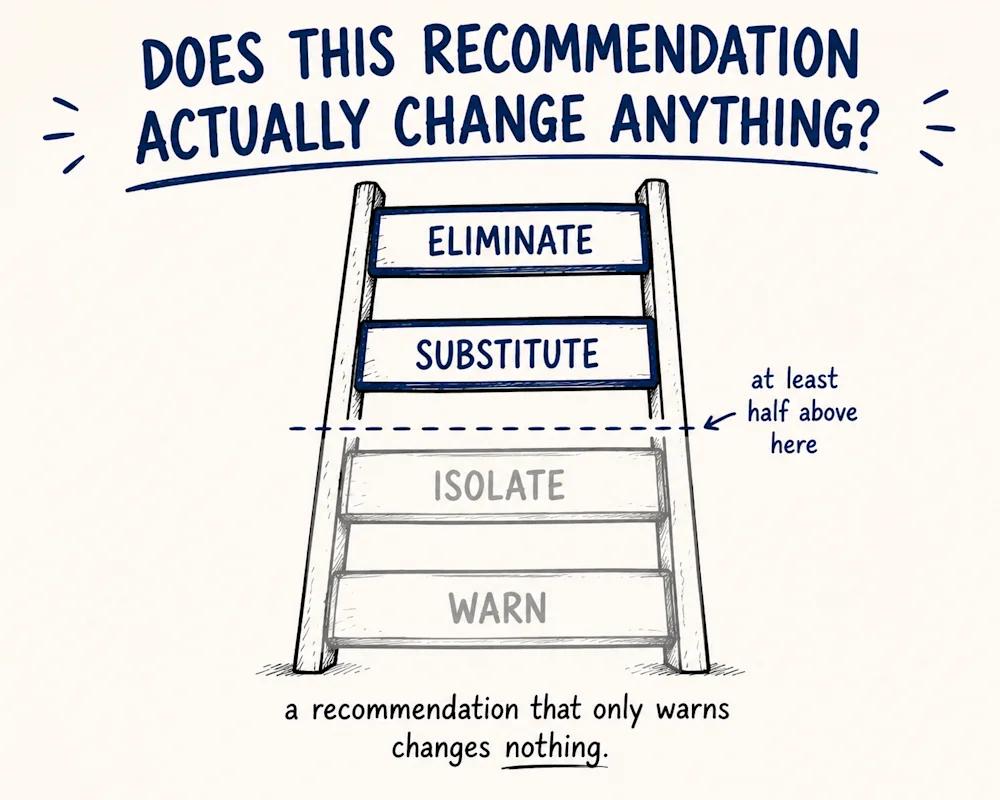
Now run the test on your own recommendations. If most of them sit in the bottom two rungs, if you are mostly warning and containing, you have written a document that changed nothing. A useful diagnostic puts at least half of its recommendations at Substitute or Eliminate. Anything less and you have described the problem beautifully without fixing it. A recommendation that only warns is a worry with a page number.
Deliver the verdict without the flinch
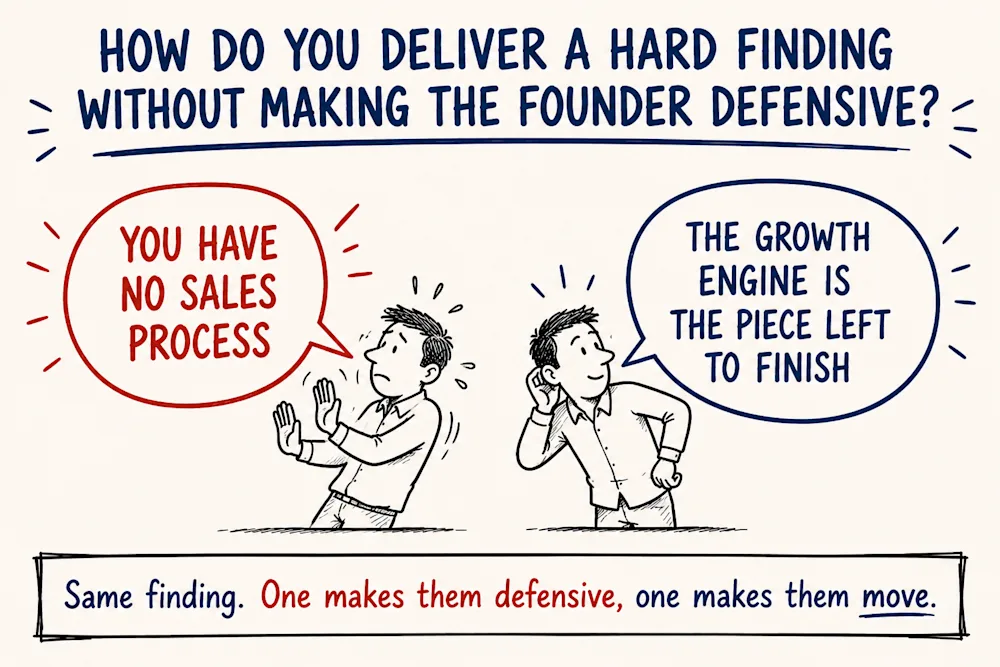
None of this means being brutal. The hardest recommendations are exactly the ones that need the most care in how they land, because a founder who feels attacked stops listening, and then even the correct verdict changes nothing.
So there is a craft to it. Name the constraint, not the failure. "You have no sales process" makes a founder defensive; "the growth engine is the one piece still left to build" says the same thing and makes them lean in. Frame the gap as finishing, not restructuring, because most founders have built something real and the honest story is usually that it is incomplete, not broken. Lead with the strengths before the limitations. Let the colour on the page carry the severity, a red row is serious, so the prose does not have to shout. Calm words, clear stakes.
That is not softening the verdict. It is delivering it precisely enough that the client can hear it. Courage and kindness are not opposites here. The finding lands because it is exact, not because it is loud.
One problem, a hundred findings, three recommendations
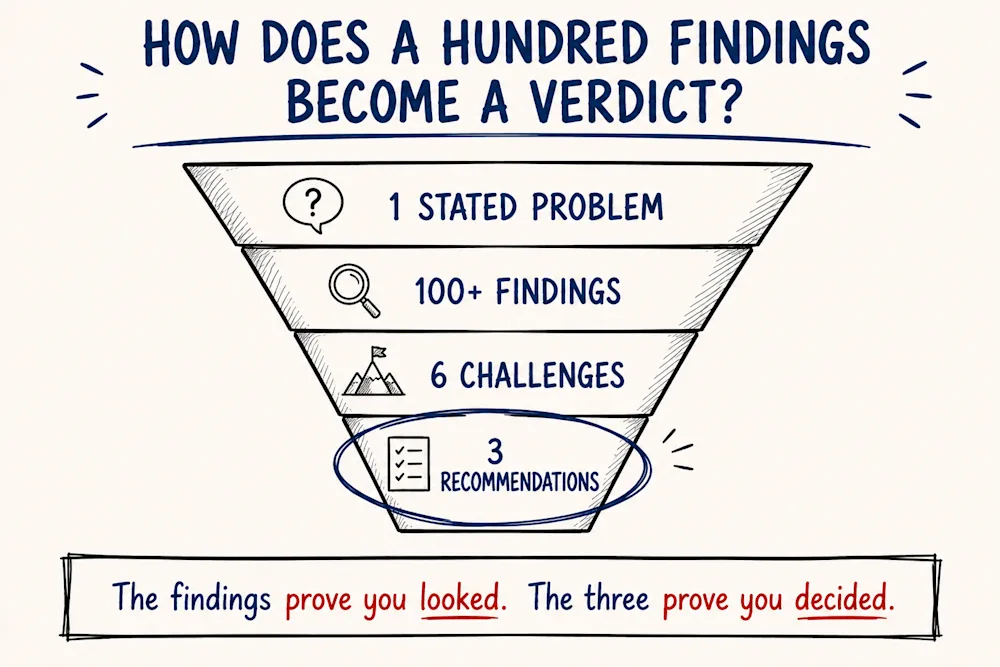
I once diagnosed a software company that came to me certain its problem was a lack of sales. We did not take that at face value. The engagement surfaced more than a hundred findings across the whole business, from how it priced to how it delivered to how the founder spent his week.
Then the real work began, which was narrowing. Those hundred-plus findings distilled into six challenges. And from those six, we wrote three recommendations: build a predictable sales engine, productise the offering, and systematise operations. One stated problem, over a hundred findings, six challenges, three recommendations. Every layer of that funnel matters. The hundred findings prove we looked. The three recommendations are what we put our name on. The other findings were not thrown away, they lived inside the three as the evidence beneath them.
The contrast is a company I think about often. It had received a diagnostic before me, a thorough one, a proper list: no CRM, no utilisation tracking, no forecasting, no clear sales ownership. Every item on that list was a correct finding. And nothing had been done, because a list of correct findings is not a set of recommendations. Nobody had made the decision the report was supposed to make, so the founder was left holding the findings and none of the judgement. They found the real constraint late, and it cost them.
And to be fair, I hold my own company to the same bar. When we ran the diagnostic on ourselves, the recommendations came back as twelve actions, and every single one sat at Substitute or Eliminate, not one comfortable Warn among them. It is easy to prescribe courage. The test is whether you grade your own recommendations by the same ladder.
Two things to take from it
Findings are your depth. Recommendations are your judgement. Show all the findings you can; they prove you looked, and they earn the trust. Then have the nerve to distil them into the few recommendations you are willing to sign. A report that is all findings and no verdict has done half the job and charged for the whole one.
A verdict has your name on it. Cutting a hundred findings down to three recommendations is not editing. It is judgement, and it is the exact thing the client is paying for. The binder is where a consultant hides from that decision. The three recommendations are where a consultant earns the fee.
Show a hundred findings. Then sign three recommendations.
Two questions for the comments. How many recommendations were in your last diagnostic report, and how many did the client actually act on? And if you had to cut them to three, which three would survive, and would you put your name under them?
Questions readers ask
What is the difference between a finding and a recommendation?
A finding is what the evidence shows. A recommendation is what you are telling them to do about it, with your name on it. Consultants blur them because a report full of findings cannot be wrong.
How many recommendations should a diagnostic report contain?
Show every finding and commit to three recommendations. One engagement narrowed one stated problem and roughly a hundred findings down to six challenges and three recommendations. Sixty pages with no verdict is a binder, not a report.
What does it mean for a recommendation to escalate?
Every recommendation has to cost someone something: money, headcount, a remit, a habit. If a recommendation can be adopted without anyone deciding anything, it is an observation in the wrong section.
How do I deliver a verdict without softening it?
Write it in the language the owner would use and do not hedge the sentence that matters. The flinch usually appears as a qualifier in front of the one conclusion the report exists to deliver.
Why do clients act on so few recommendations?
Usually because there were too many to choose from. A list of fifteen is a way of transferring the prioritisation back to the client, who hired you to do exactly that.
About the author
Dancho Dimkov writes Anatomy of Consulting, a publication about the practice of business diagnosis. Read more about the publication.
Stages referenced here are links in the diagnostic journey (7 links in total).