
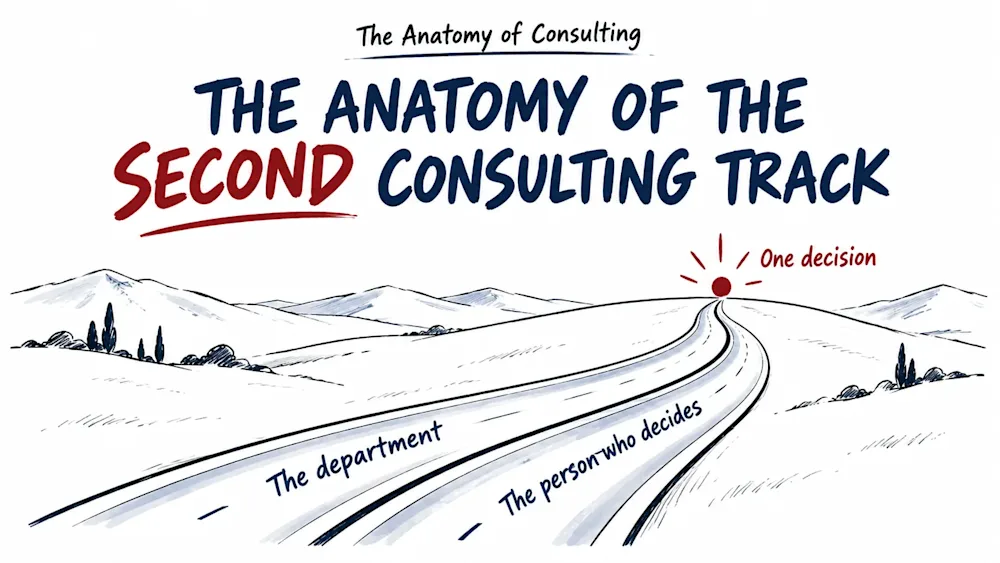
The Missing Piece of a Consulting Engagement: The Second Consulting Track
Edition 23
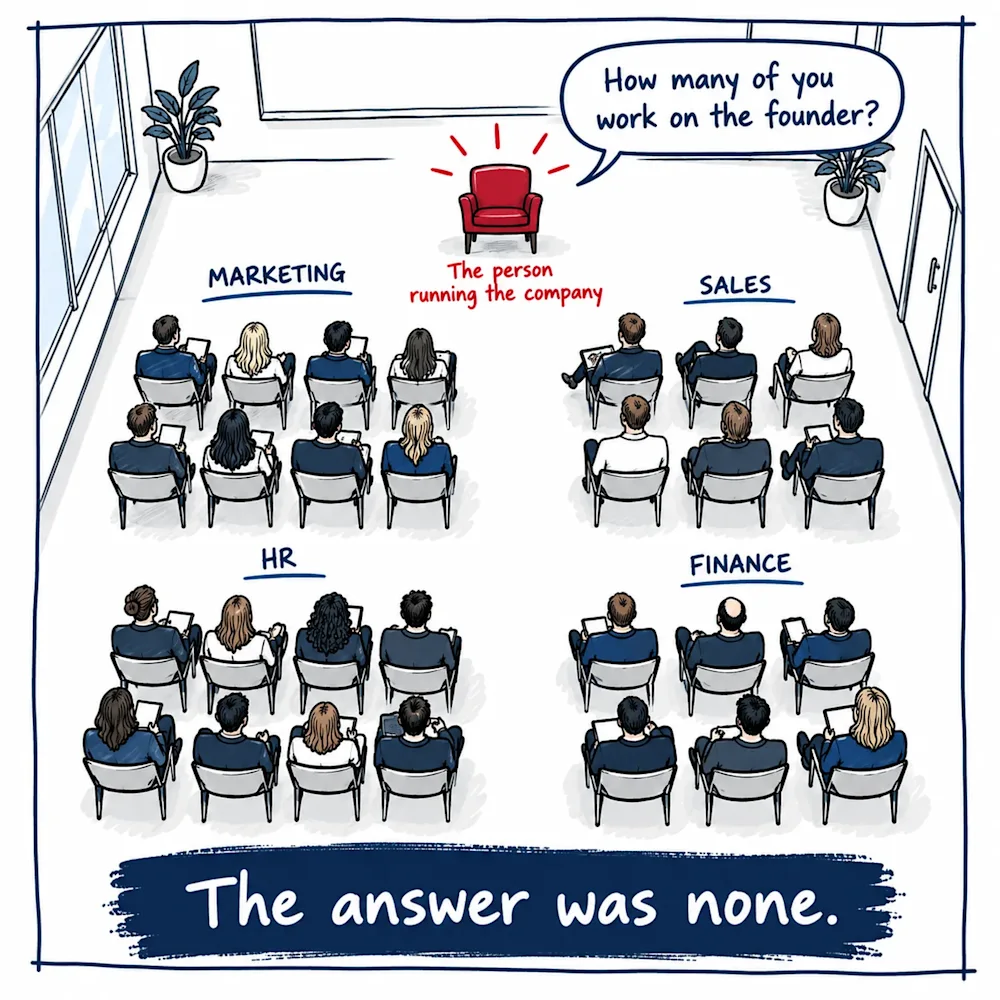
At a consulting event in October I asked more than 20 consultants how many of them work on the founder. The answer was none. Every engagement has two consulting tracks: the department work in the contract, and conversations with the person who decides whether the plan gets used.
In October I was at a consulting event with more than 20 consultants: marketing, sales, HR, finance. One by one they talked about how good they are in their own department, and all of them were working on the business. Then I asked my question: how many of you work on the founder, on how he thinks and how he sees his own company? The answer was none.
I am a management consultant, not a sales consultant. But I've learned that small businesses are not really keen to pay for management advice, so I positioned myself as a sales consultant, because companies love to talk about how they can get more sales. Most people come to me with a sales problem. Most of the time it is not a sales problem, and in most cases it is the founder.
In edition 12 I wrote about the founder's hands: when everything in a company passes through him, the vacation test shows it. That was about what he does. This edition is about his eyes, how he sees his business, his competition and his market. Nobody in that room full of consultants had been hired to work on that, and I think it is the missing piece of a consulting engagement.
Two consulting tracks in every engagement
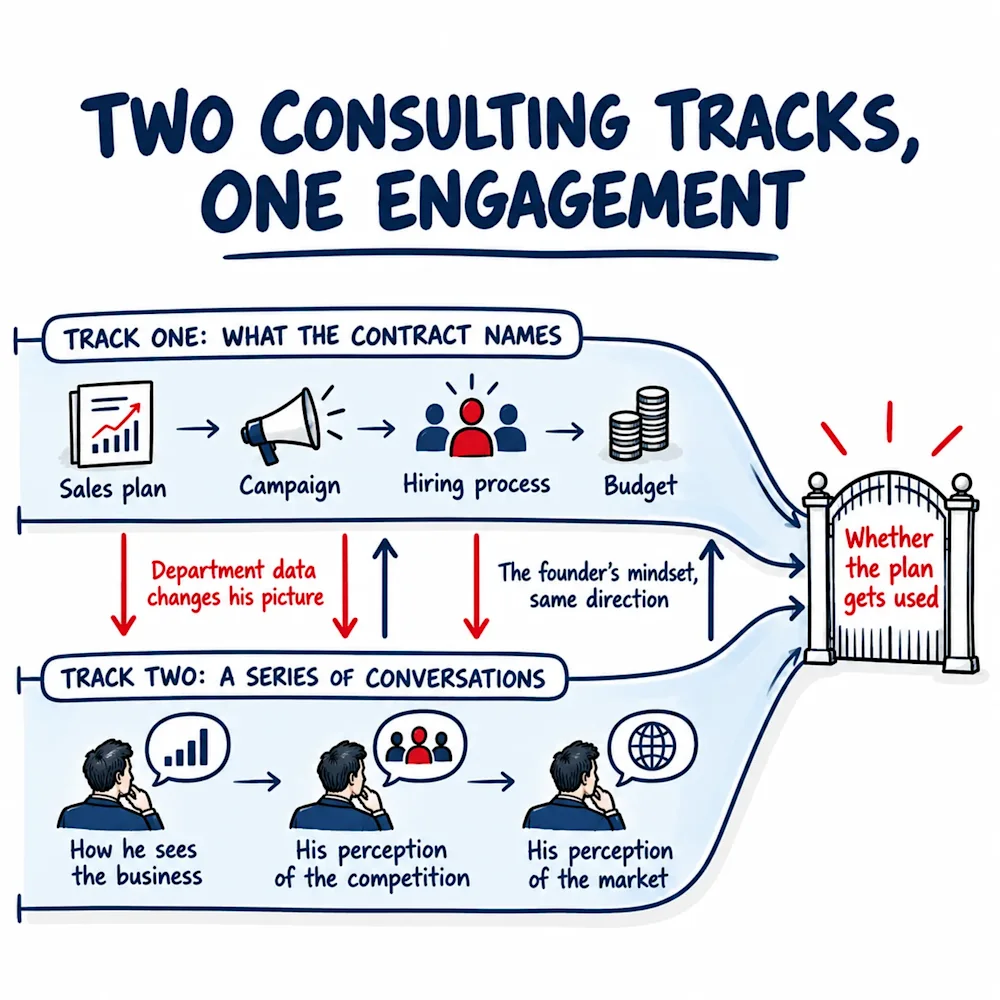
Every engagement has two consulting tracks. Track one is what the contract names: a sales plan, a campaign, a hiring process, a budget. It works on the company's data and ends in a deliverable, most commonly a report, a strategy or an action plan. Track two is what the contract does not name yet: a series of conversations with the person running the company, or with the head of the department, about how he sees the business, and his perception of the competition and the market.
Both are consulting, and both belong to the same engagement. If you work in sales, you work with the founder in parallel. If you work in finance, you work with the founder as well. The second track is not one more department. It is the person whose view decides what happens to your deliverable after you leave. A person on whom the success of the project depends.
So beside the deliverable sits a second question for every engagement: which conversations will I hold with the person running the company, or the department, and about what. The department pays for the plan. Those conversations decide whether the plan gets used.
Here is the claim, in a form you can check on your own clients: every department plan lands on the picture the person running the company holds, and if that picture does not move, the plan gets implemented halfway or not at all. The company is where it is because of how the leadership manages it, and you can't improve a business without improving the leadership. Or, the way I put it: unless you work with the founder as well, on his mindset and his perspectives, your consulting effort will fail.
None of this is the founder's fault. He has worked inside his business for too long, and he can't take a step back from it any more. That is what the second track is for: making him question what he knows, or what he thought he knew. The new perspective helps him with the consulting implementation, and it keeps helping with every decision he takes after the consultant has gone.
When the sales problem is not in sales
When I talk about the second track, I don't mean the symptom and root analysis of where the actual problem sits. That would just give us another department to blame.
In July 2024 the owner of a New York IT field-services company asked me for "a lead generation system that can churn on its own". I stepped back first, the way I do with most sales requests, because most people who say they have a lead generation problem are describing a symptom. We ended up working on his offer, not on his leads.
In April 2024 a team from an SAP consultancy in Sri Lanka came with the same request in other words: how to get new clients. I opened with what I tell most founders: imagine if you have the perfect product, for the right target audience, you wouldn't need sales. The session went to their niche and their website.
Both step backs are still track one, and I wrote about that move in edition 10. A client says the problem is sales, and the consultant shows it sits somewhere else, for example in HR, where the sales team is paid for the wrong things. The problem has moved from one department to another, and it is still department work.
Track two is a completely different move. You change how they perceive their business.
In whichever department I work, in parallel I also work with the person who decides. With the New York owner, while looking at his offer, I noted: "here you're not really an IT guy. You are a recruitment agency". He sends technicians to IT companies that do the same work at a bigger scale, and he still thought of himself as one more IT company. That sentence changed how he saw his own business, and no deliverable of mine could have done it for him.
In October 2024 the head of a small software company in Macedonia filled in our contact form and asked for help with branding and finding clients. We spent most of the call on a question that comes before marketing: where does this company end? I laid out the ways it could end, from a full-time job to his own product, and told him that as a senior developer he would earn more in a remote job than his company paid him. He leaned toward an automated system and a boutique company, not 50 people. His homework was to write each offer down before anyone touched the website.
The anatomy of the second consulting track
Here is how I describe the second track in two sentences: "Most consultants work on the business (marketing, sales, HR, finance); in addition, I also work on the person running it, and how they see their own company decides every choice that follows. Over a series of meetings I ask the questions, and they leave each one knowing what to do next."
The second track is a series of meetings, not a workshop. Sometimes one meeting is enough, sometimes it takes several, and that depends on how open the founder is to change. I ask and the client answers out loud, because an answer he gives himself stays with him and an answer I hand him does not. Between the meetings there is homework, and most of the thinking happens there. The output is a changed picture of the business, and the client is the one who names it.
A meeting runs an hour. As the founder talks, I challenge his assumptions and his logic, and while I challenge them I show him different possibilities, different angles and out-of-the-box opportunities that he has not thought about before, even though he is in the industry. The joke is how they usually leave the meeting. They say: "I am not going to sleep tonight. This new perspective opens so many new opportunities that I need to think about." Then I know that I did a good job.
How the two tracks feed each other
The two tracks work in the same direction, never against each other. I fix the department, and I work on the founder's mindset toward the same end. Sometimes the department work also turns up data that changes how the founder sees his own company, something he was not aware of.
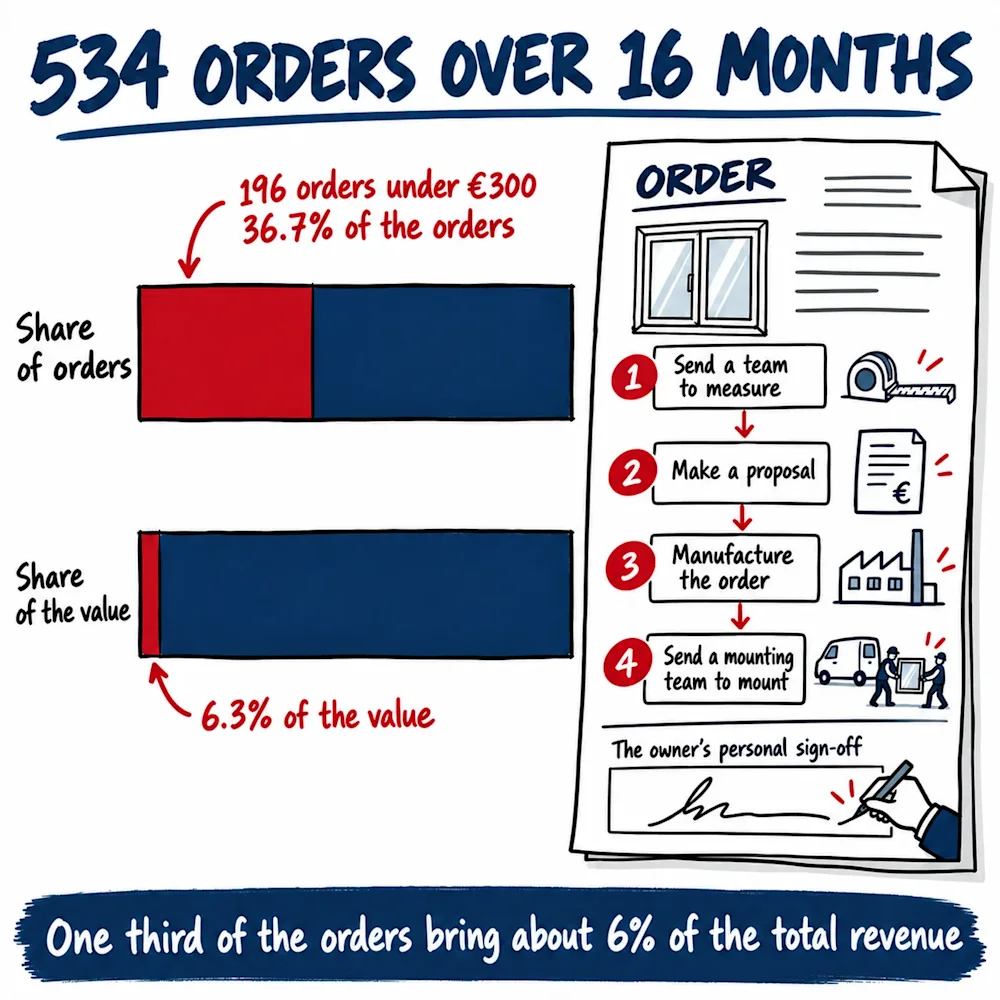
On a diagnostic for a PVC window manufacturer we went through 534 orders over 16 months. 196 of them, more than a third, were under €300, and together they brought in 6.3% of the value. Yeah, you read it right: one third of the orders bring about 6% of the total revenue. Every one of those orders made money on materials, so the report called it a time problem: each one still needed the owner's personal sign-off before production could start. The real cost of small orders is his attention. I watched his face change when he saw it. For under €300, sometimes even €50, he has to send a team to measure, then make a proposal, then manufacture, then send a mounting team to mount it, and that is a third of the orders he works on. And he has to orchestrate all this, in constant communication and scheduling with the client.
Four clients, and the moment the picture moved
From working with a lot of founders I can show what a changed perspective does. Four of them, and the moment it happened.
A founder was building AI accounting intelligence and thinking about which features to add to compete with QuickBooks and a few others. I asked him: "How hard is it to actually convince an accountant that's been using the same software for the last 5 years to actually switch to yours?" Then I asked him to read his own interviews with accountants again, "with a switched mindset". During the call he saw that he does not need to compete against the giants, he needs a solution that sits on top of them. In his words: "I don't need to convince them to switch. I just need to convince them to upgrade."
A founder in the UK had built AI for construction businesses and was focused on the AI angle. He came to me with about 7,000 cold emails and no replies. During our conversations I realised he had run a construction business before, from labourer to about 80 people at one point, and he was shy about it: there was no mention of his construction past on his own website. I told him: "You're sitting on a gold mine, but you're not aware." And about the people he sells to: "It's not about the tenders. It's about the weight on their shoulders." After the conversations he made his past his selling point: what sets his AI agency apart in construction is that he understands their problems from the inside.
I had three calls with the two founders of a Swiss health platform. On the first one they described their own situation: "there is a lot of turning plates", an ecosystem where every choice linked to another one, "but then the complexity increases and we are not there yet". They had three products designed, a website built and never launched, a questionnaire of up to 30 questions as their research, and no audience chosen. I was very direct: "unless you set up any hypothesis, you don't know in which direction to continue." Pick an audience, put two or three pages online and see what sticks. Their questionnaire would not tell them much, because in the end "you count only the people that swipe their credit card". My proposal after the calls put it in one line: landing pages before products, subscribers before stock, evidence before investment.
Two people behind an online fitness platform sent me their plan: workout programmes half made, influencers on commission, brand ambassadors, affiliates, and a question about selling subscriptions to companies for their staff. The one piece they said was missing was market research. I answered none of the questions. I asked them to put everything on one board first, because without a map they would keep jumping from one thing to another. Two months later one of them wrote to me that "the ability to extract us from our personal point of view and see our business from a bird's perspective was a game-changer".
As you can see, sometimes one conversation is enough to open the founder's eyes. If you were hired for one department, that conversation is still part of your job, because the plan you deliver lands on the picture the founder holds. Open his eyes, and the department work has someone ready to carry it.
The deliverable is no longer only a report
In edition 20 I wrote that the report no longer sells the consultant, and the first meeting does, because there you can show your thinking process, something AI can't do for you. The same holds after the sale. AI can write the plan, but it cannot sit across from the person who decides and ask the question whose answer changes how he sees his company. That will make you stand out from the crowd.
So here are a few questions, this time for you:
- How many times have you had a perfect consulting deliverable, but the company still lacks (or becomes sloppy) in implementation?
- How many times are your department findings amazing, but the management still resists the change?
- Have you ever considered adding a new deliverable to your consulting work, conversations with the decision maker, in order to work with the leader, not just the department?
- In your last engagement, how many hours did you spend with the department, and how many with the person who decides?
- When did you last ask the person who signs your invoice how he sees his own competition?
If one of them stayed with you, you have just experienced the second track. I did not hand you a report. I asked, and you answered in your own head, with your own clients in mind. And if after reading this article you start seeing consulting engagements differently, that is a change of perspective and mindset. That is the whole method: ask the client questions whose answers make him realize something, and what he realizes stays with him for good.
So the deliverable of a consulting engagement is no longer only a consulting report. It is also a series of conversations with the person who decides.
If this was useful, follow Anatomy of Consulting on LinkedIn, and the next edition comes to you.
Questions readers ask
What is the second consulting track?
It is the part of an engagement that runs beside the department work: a series of conversations with the person running the company, or with the head of the department, about how he sees his business, and his perception of the competition and the market. Track one is what the contract names, and it usually ends in a report, a strategy or an action plan. Track two is the work with the person on whom the success of that deliverable depends. Both are consulting, and both sit in the same engagement.
Is the second track the same as finding the root cause in another department?
No, it is not. A client asks for sales help, and the consultant shows that the cause sits in HR, where the sales team is paid for the wrong things: that is a symptom and root analysis, and it only gives the client another department to blame. The second track changes how the person running the company perceives his business. For example, the owner of a New York IT field-services company came for lead generation; the step to his offer was track one, and the sentence "here you're not really an IT guy. You are a recruitment agency" was track two.
How many meetings does the second consulting track take?
There is no fixed number. Sometimes one meeting is enough, sometimes it takes several, and it depends on how open the founder is to change. A meeting runs about an hour: the founder talks, the consultant challenges his assumptions and his logic and shows him angles and opportunities he has not thought about before, even inside his own industry. Between meetings there is homework, and the output is a changed picture of the business that the founder names himself.
How do the department work and the second track feed each other?
They work in the same direction. The consultant fixes the department and works on the founder's mindset toward the same end, and the department work often turns up data that changes how the founder sees his company. For example, on a diagnostic for a PVC window manufacturer, 196 of 534 orders over 16 months were under €300 and brought in 6.3% of the value; each one still needed the owner's personal sign-off, so the real cost of small orders was his attention.
How do I add the second track to an engagement I already sell?
Name it beside the deliverable: which conversations you will hold with the person running the company or the department, and about what. Then ask him the questions a report cannot ask for him, for example how he sees his own competition, and leave him homework between the meetings. The deliverable of the engagement then is a consulting report and a series of conversations with the person who decides.
About the author
Dancho Dimkov writes Anatomy of Consulting, a publication about the practice of business diagnosis. Read more about the publication.
Stages referenced here are links in the diagnostic journey (7 links in total).