
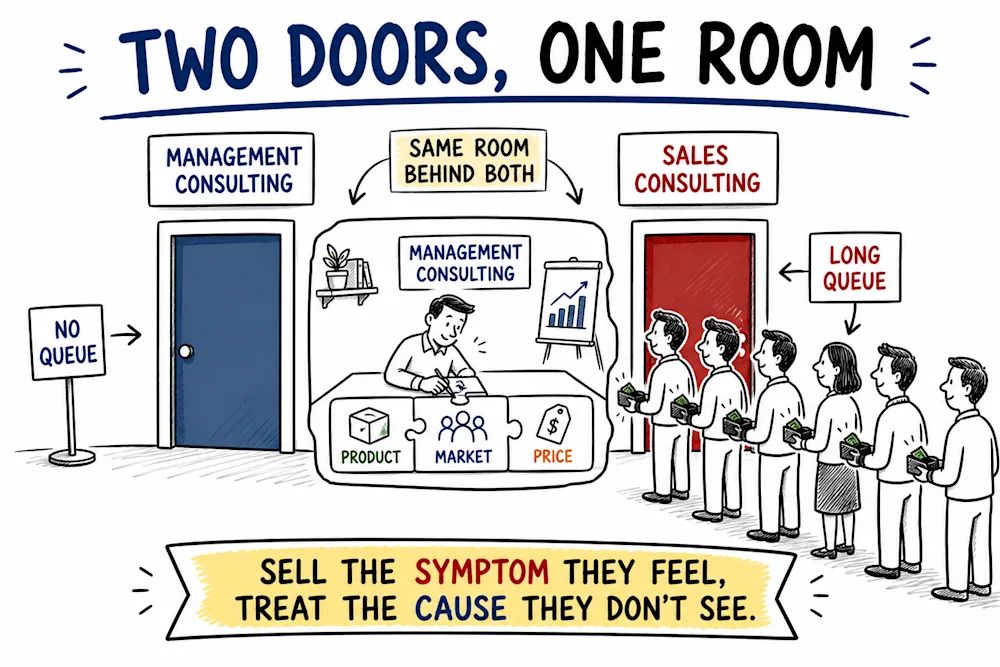
Small Businesses Won't Pay for a Management Consultant
Not long ago I was sitting with the owner of a marketing agency, and he asked me to help him with his sales. They were soft, or at least not where he wanted them, and he wanted to know what to do.
Edition 10first published on LinkedIn
Not long ago I was sitting with the owner of a marketing agency, and he asked me to help him with his sales. They were soft, or at least not where he wanted them, and he wanted to know what to do.
I could see where his mind was going, because it is where every owner's mind goes. More sales means one of two things: more outreach, or a salesperson to do it. Push harder on the thing that is not working.
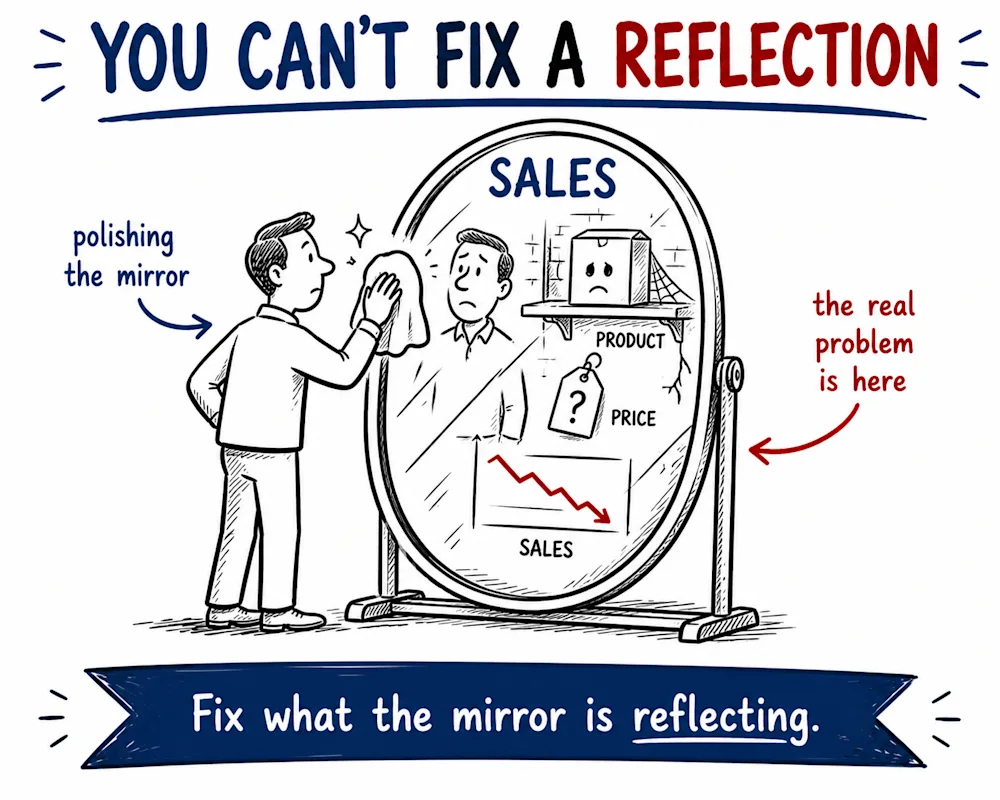
But sales is a mirror. It reflects the health of everything standing behind it, the product, the price, the market, the offer. When the number in the mirror looks wrong, hiring a stronger salesperson is polishing the glass and wondering why the reflection did not change. So before I said a word about outreach or salespeople, I did something else.
The four questions I actually asked
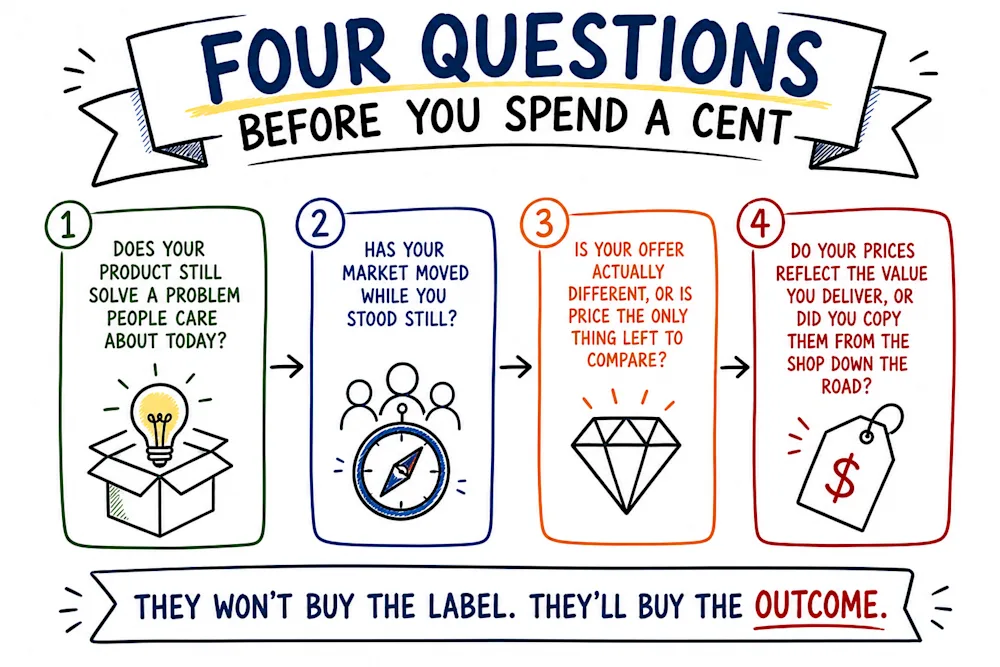
I asked him four questions. Not sales questions. Business questions.
One. Does your product still solve a problem people care about today? The must-have of three years ago quietly slides into a nice-to-have, and no customer writes to tell you the day it happens. If your best customers are all your oldest customers, you have your answer.
Two. Has your market moved while you stood still? Customers change, a competitor reframes what the category even means, and suddenly you are aimed at a person who no longer exists. The real question is who is actually buying now, and whether that is still who you built the business for.
Three. Is your offer actually different, or is price the only thing left to compare? When a buyer cannot tell you apart from the next option, the only lever left is price, and that is a war most small businesses cannot win. If your sales keep ending in a discount, the market is telling you it cannot see a difference.
Four. Do your prices reflect the value you deliver, or did you copy them from the shop down the road? Most owners never set a price on purpose. But a price is a signal and a filter, not just a number, and one of the biggest strategic decisions an owner makes, wearing the disguise of a small arithmetic one.
Somewhere in the middle of asking them, I noticed something about myself. Not one of those questions was about sales. Every single one was about how the business was run: what it sells, to whom, against whom, and at what price. He had asked me for sales help, and I was quietly running a management diagnostic. The sign on the door said sales. The work behind it was consulting.
The thing I worked out years ago
That was not a coincidence, and it is not new to me. I worked it out a long time ago, and it changed how I sell.
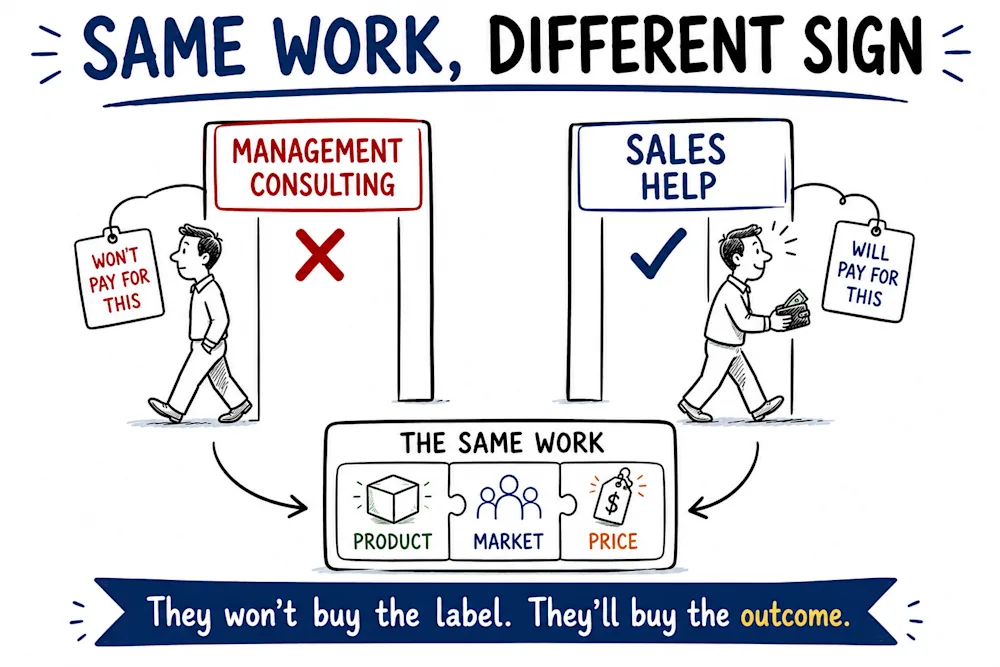
A small business owner will almost never pay for "management consulting." Ask him and he will tell you, kindly, that he knows his business. It is all in his head. A stranger with a framework is the last thing he needs and the last thing he will spend money on. The value of consulting is invisible to the person who needs it most.
Be clear that this is a small-business truth, not a universal one. A corporation has a board, a budget line, and a long habit of hiring consultants, so it will happily pay for management consulting by its proper name. The small owner has none of that. He has his own gut, a tight budget, and a deep suspicion of paying someone to tell him things he feels he already knows.
But sales? He will talk about sales all day. He will pay to fix sales. Every small business on earth wants more of it, and nobody has to be convinced they do.
So I made a decision
So years ago I made a deliberate choice about how I package what I do. I stopped leading with "management consulting," the thing SMEs will not buy, and started leading with sales, the thing they will. I promote the sales help, because that is the door that actually opens. And once I am inside, the work I do is management consulting, because that is what fixing their sales genuinely requires.
Isn't that a trick?
You might feel a small itch there. Sell him "sales," deliver him "consulting". Isn't that a bait-and-switch?
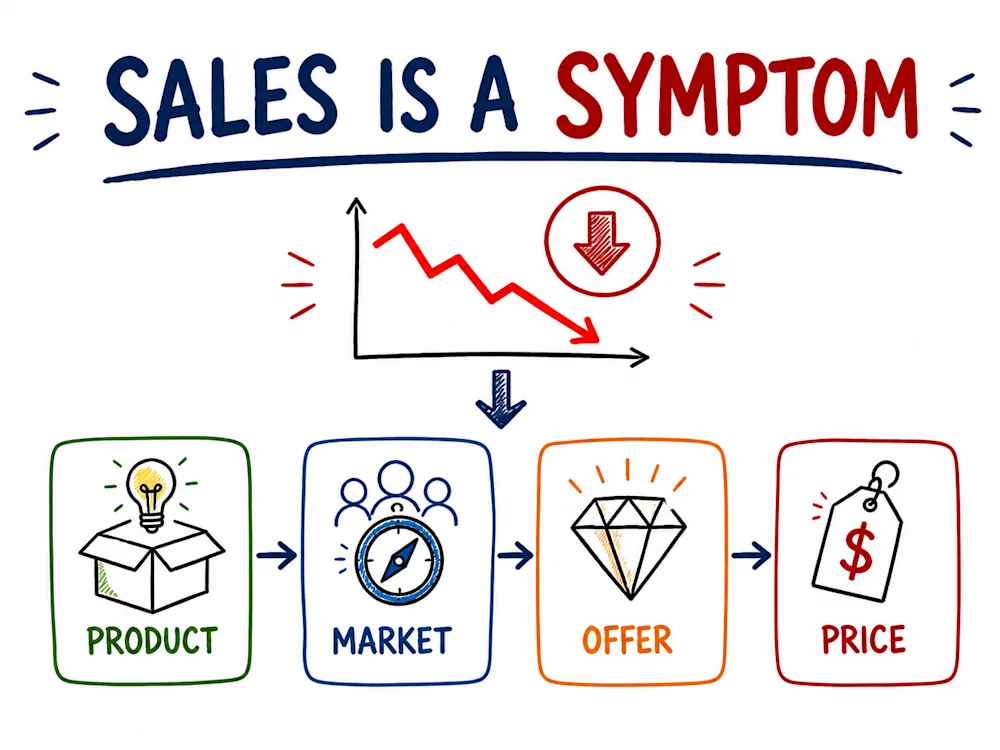
No, and the difference is the whole point. His sales were the symptom, not the disease. He felt the symptom, so that is what he brought me. I do not work on the symptom. I find what is actually stuck underneath, the offer, the price, the market, and I fix that. When the root is fixed, the sales move on their own. He gets exactly the result he came for, better sales, and he gets there the only way anyone really does, by fixing the thing that was actually broken. Leading with the symptom he can feel is not a trick. It is how you reach the cause he cannot see.
The lesson is not about sales
And that is the real lesson, the one that has nothing to do with sales.
If you sell advice to small businesses, your problem is rarely your skill. It is the label on your door. "Management consulting", "strategy", "business optimisation", words that mean everything to us and nothing to an owner staring at a number that will not move. Get out of the general field. Stop selling the category your SME clients will not buy. Find the one pain they feel so plainly that they will pay to fix it without being sold, pre-package your offer around exactly that, and then deliver, underneath it, the real work they needed all along.
Sell the symptom they feel. Treat the cause they cannot see.
Two questions to leave you with.
What is the "sales" of your niche, the one pain your SME clients will always pay to fix without being convinced?
And where have you been selling the category, the label on the door, when you should have been selling the outcome they already want?
Questions readers ask
What are the four questions to ask when a client says sales are soft?
Does your product still solve a problem people care about today. Has your market moved while you stood still. Is your offer actually different, or is price the only thing left to compare. Do your prices reflect the value you deliver, or did you copy them from the shop down the road.
None of those questions are about sales. Why not?
Because soft sales are usually the symptom. Every one of the four asks how the business is run, and the answer to the sales question is almost always upstream of the sales team.
Why won't small businesses pay for a management consultant?
Because "management consulting" is a category, and nobody wakes up wanting to buy a category. They want the outcome they can already feel the absence of. Sell the label and you are asking them to fund your job title.
Isn't selling the outcome instead of the category a trick?
It would be if the work changed. It does not. You still run the diagnostic and still find the root cause. What changes is which sentence you open with, and whether the owner recognises their own problem in it.
How do I tell whether I am selling the category or the outcome?
Read your own offer page and count how many sentences describe what you do versus what the client gets back. If the first three are about your method, you are selling the label on the door.
About the author
Dancho Dimkov writes Anatomy of Consulting, a publication about the practice of business diagnosis. Read more about the publication.
Stages referenced here are links in the diagnostic journey (7 links in total).