
Your Report No Longer Sells You. Your First Meeting Does.
Edition 20
Imagine you are recruiting. You interview someone and you like them right away. They are positive, enthusiastic, full of energy, and you can already see them in the team. None of that is what you hire on, but you leave the call with a good feeling.
Then you send the test assignment, the one you designed so you can see how they think. What comes back is clean, well structured and complete. Then you put it next to the assignments from the other candidates, and they are all the same. Same headings, same three recommendations, same confident tone. Obviously all of them were written with AI. The assignment was supposed to show you how this person thinks, and it told you nothing about them.
I think everyone who hires has lived this by now.
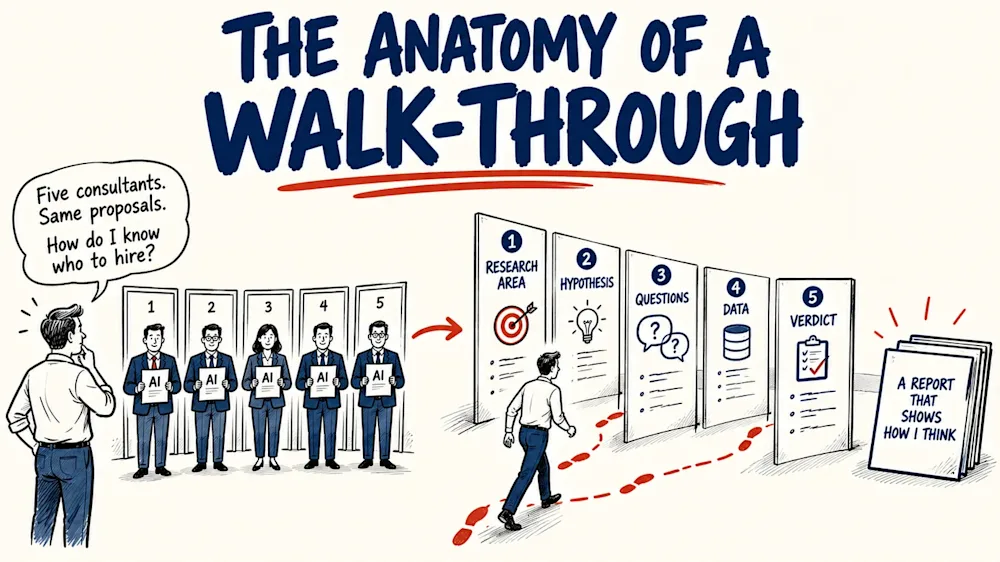
Now switch chairs. You are a founder. Something in your company is not working, you decided you need outside help, and you have met five consultants. All five were pleasant. All five sent a proposal and a sample report from a past client, and they all read the same. When you asked how they work, all five said the same sentence: "We use AI for efficiency." How do you know who to hire?
For you it is worse than for the recruiter, and the reason is timing. The recruiter finds out in a week, and the cost is one candidate. You will only learn if the advice was right when you execute it, and by then the fee is paid and the months are gone. There is no second interview.
Now switch chairs again, this time for real. You are the consultant, one of those five. How can the founder tell you apart from the other four? How do you differentiate, and show them that you are the one to choose?
"I use AI" is not what makes you different
I have to be honest here, because it would be easy to write this as "AI bad, experience good". In our diagnostics AI writes the first draft of the report. We built it that way on purpose: every fact goes into a register first, with its source, and the report is written from that register and then checked by a consultant.
So using AI does not separate you from anyone, and hiding it does not either. In How to Run a Diagnostic Properly I wrote that AI takes over the middle of a diagnostic, the gathering and the first cut of the findings, and that the job lives at the two ends: naming the hypothesis and committing to the verdict.
What changed since then is what the client can see. A junior with one prompt and a senior who worked the problem for three weeks now hand over documents that look the same. The junior may not even understand what his own report says. With a wrong thought process AI is rubbish in, rubbish out, and the rubbish comes nicely formatted.
With the right thought process, the decisions are made before AI writes anything. You take the founder's own words from the first meeting and translate them into a research area. From that area you build hypotheses, accept some and reject some, until one stands. Then from that one hypothesis you write the research questions, and every question is there because its answer will accept or reject the hypothesis. AI helps at every one of those steps. It proposes a long list of questions and we shortlist them. But which area, which one hypothesis and which question stays are decisions, and none of them shows in the finished report.
So your report no longer sells you. The founder is in the recruiter's position: the paper tells them nothing, and what is left is the conversation.
What your report has behind it, and a one-prompt report does not
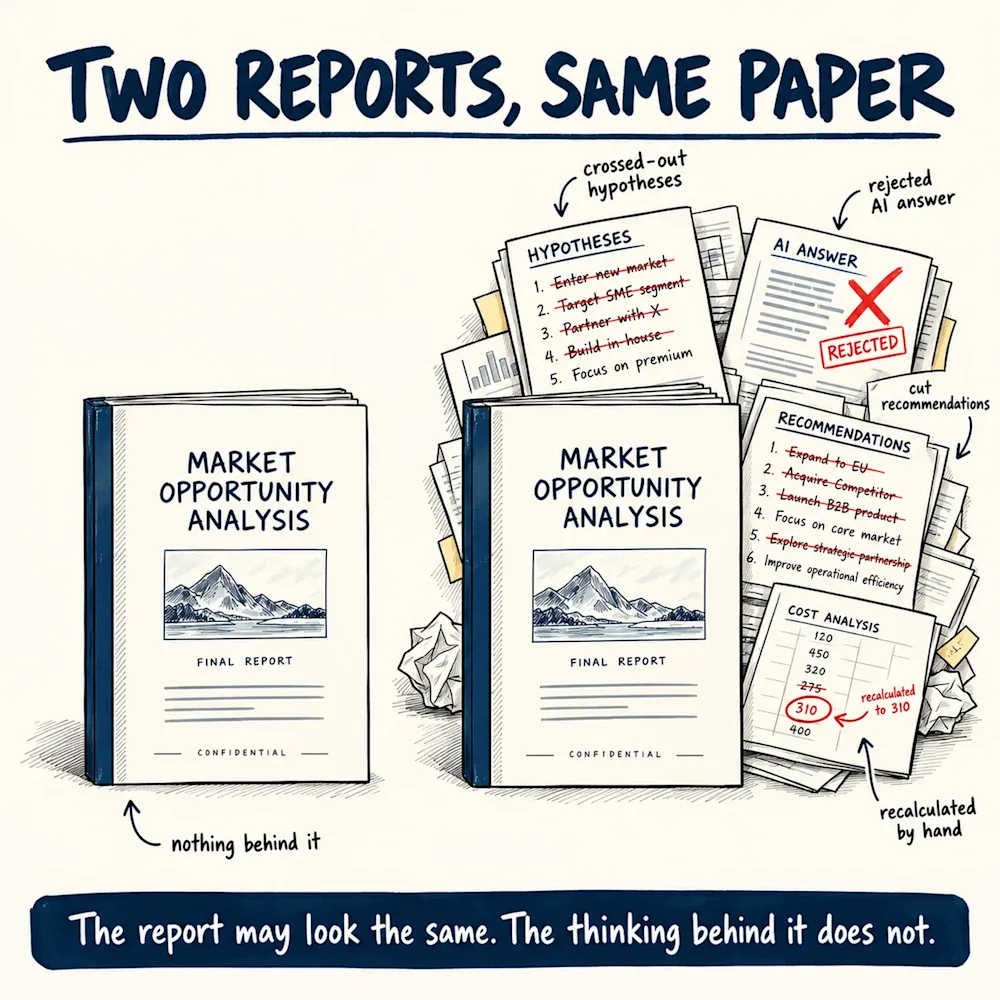
A report that came from one prompt has no history. Nothing was dropped on the way, because there was no way.
A report that you worked on leaves a pile behind it. A hypothesis that looked right in week one and was dead by week two. An AI answer that sounded fine and got thrown out because it did not match what the owner said. Eight recommendations cut down to three. One number redone by hand because it felt wrong.
None of that is in the report. All of it is in your head, and a consultant with one prompt does not have it. So that is what you show.
The anatomy of a walk-through
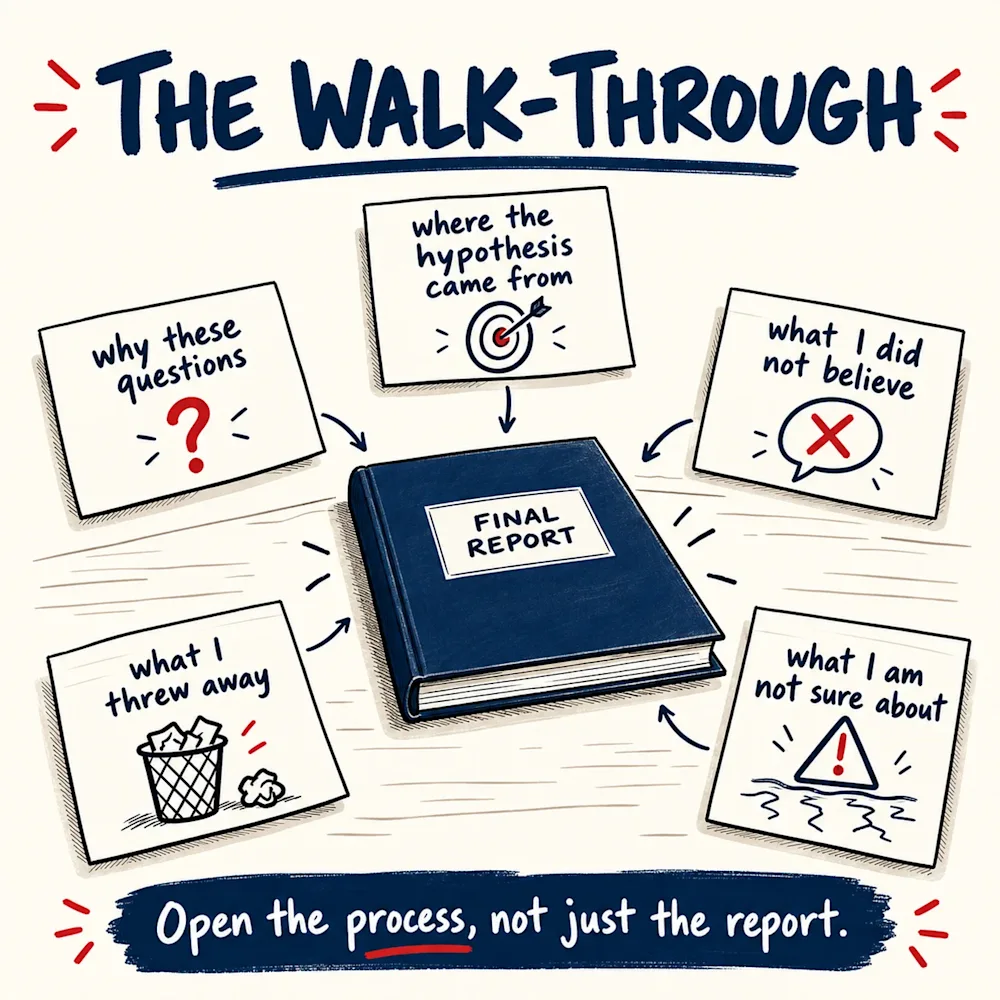
"I know you will talk to several consultants, and they will show you reports that look like this one. So I want to show you the process, rather than just the end result." That is how I would open.
Bring one finished report to the first meeting, with the client's name removed, put it on the table closed, and say it. Most founders will not know what to ask, so you answer these five without being asked. Twenty minutes is enough.
1. Where the hypothesis came from
Why this one and not another. Which other explanations were on the table, and what killed them.
Start one step earlier, with the owner's own sentence from the first meeting that became the research area, and show how it was narrowed to one hypothesis. The founder can follow the line from the owner's words to that hypothesis and see whether it holds.
"The owner said sales. We also looked at pricing and at delivery times, and delivery dropped out after we saw the order book." That is what it sounds like when a choice was made. The one-prompt consultant can only repeat the hypothesis from page two, slower. I wrote about the choice itself in Hypothesis or Framework.
2. Why these questions
Every diagnostic asks the client for some things and not for others. Tell the founder why you asked for these, what you decided not to ask, and which questions turned out to be a waste.
Then show where they came from: each one was worked backwards from the hypothesis, every factor behind the owner's problem has a question of its own, and part of them look outside, at how comparable businesses do it. The founder can check the last part in a minute. If every question looks only inside his own company, the report can tell him what it found, but not whether that is good or bad, because there is nothing to compare it with.
Someone who designed the questions knows which ones were wasted. Someone who got the questions from a model thinks they were all good.
3. What the client told you that you did not believe
This is my favourite one. In a first meeting with a window and door manufacturer, the owner told me the glass step was his bottleneck and he wanted to buy a machine for it. The notes from that meeting say: "We need to compare the PVC production versus the glass capacity to understand if this really is a bottleneck."
That sentence is the thought process, written down. The owner's claim became something to check before it became a finding. The way we plan today, a claim like that opens a research question, and a research question is one the owner cannot answer on the spot, because it needs the production data worked through. Asking him again would only give you his answer again. Tell the founder which claims in your report were checked this way and which were taken as given. When you tell a founder a story like this, they hear that you will not simply type up what they tell you. A consultant who believed everything the client said does not have a hypothesis. He has the client's hypothesis, nicely formatted.
4. What you threw away
One thing AI gave you that you rejected, and why. One recommendation that was in the draft and is not in the report. One number you checked yourself.
The pile starts before the report. On the restaurant business one area started with nine hypotheses. One stayed, and the other eight turned out to be ways of proving it, so they became questions. The pile also held two drafts of the question form we rejected. The first draft was statements with no question mark. You cannot answer a statement, so none of them could prove or deny the hypothesis. The second draft had question marks, but the owner could answer each one on the spot with a yes or one fact. That is an interview question. A research question needs data collected and worked through before it has an answer, otherwise the diagnostic is the owner's opinion written down by someone else. Show the founder one discarded version for every step.
If nothing was thrown away, nothing was judged.
5. What you are still not sure about
In that same first meeting the owner said his cost overview "probably won't be 100% accurate". That went into the notes on day one, before I had seen a single cost figure.
In our diagnostics every question opens gaps in a register, one for each piece of data it needs, and a gap that cannot be filled is marked Not available and goes into the report as a limitation. Before any data comes in, each area also says what would confirm its hypothesis and what would deny it. The founder can read both and see where the report could be wrong.
You know exactly where the ice is thin in your own report, so say it. It feels like a risk in a sales meeting. I think it is the opposite: a report from one prompt is equally confident on every page, and so is the person who hands it over.
What the founder hears
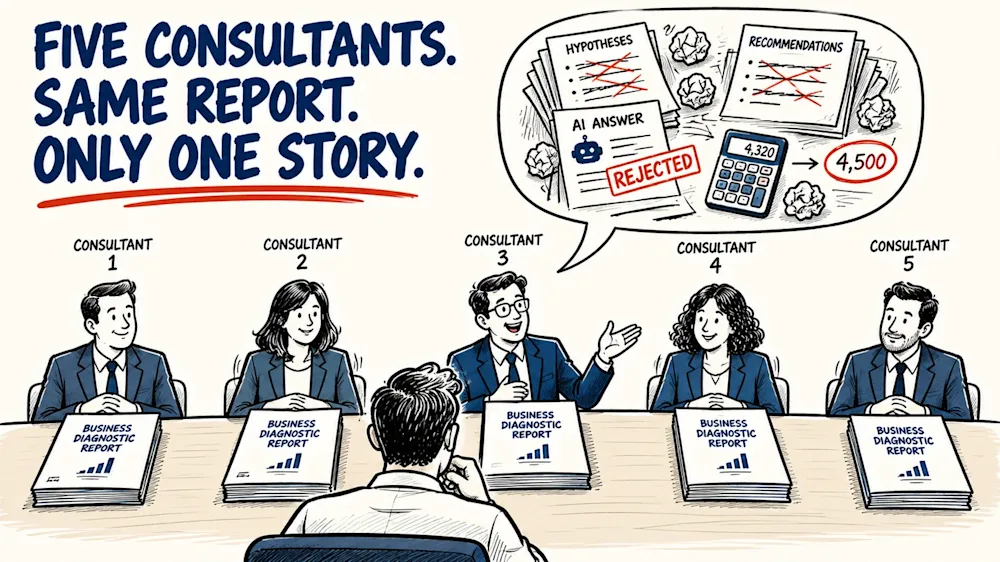
The founder cannot judge your method. But anyone can hear where an answer comes from. It comes from the work: a meeting, a file, a person, a moment where you changed your mind. Or it comes from the page: the report, said again in other words.
Can the other four fake this with AI? I honestly don't think so, not live and not for twenty minutes. To invent a convincing pile of dropped hypotheses and rejected answers, you have to understand the problem well enough to know what a wrong answer looks like. At that point you are not faking any more.
When you cannot bring a report
Sometimes you cannot share a past report, or the founder wants to talk about his problem and not about somebody else's. Then do the same thing live, on his problem.
A strong consultant can scope on the spot. Ask before you answer. Give two or three possibilities for what is going on, and say which one you would bet on and why. Say what data you will need, who in the company probably has it, and what that data will not be able to show. No laptop.
Most of us hide the thinking
We were taught not to give the diagnosis away in the sales meeting. I think that made sense when the report was the scarce thing. Today the report is the cheap thing, and a consultant who holds back his thinking in the first meeting looks the same as one who has none.
Three habits I would take from this:
- Keep the pile. When you drop a hypothesis, reject an AI answer or cut a recommendation, write one line about why. It takes a minute, and it is the only proof of your work that a prompt cannot produce.
- Offer the walk-through before they ask. The founder does not know these five questions exist. You do.
- Review your juniors the same way. Ask them the five before you read their draft. If the answers come from the page, reading the draft will not help you, and you just found out in twenty minutes what a client would find out in six months.
Two questions for the comments. Which of the five would you find hardest to answer about your own last report? And what do you do in a first meeting so the founder can tell you apart from the other four?
Questions readers ask
How does a consultant stand out when every competitor uses AI?
Not with the report, because a proposal, a sample report and a final report now look the same from everyone. Bring a finished report with the client's name removed and walk the founder through how you got there: what you dropped, what you doubted and what you are still not sure about. A consultant who used one prompt has none of that to tell.
Why does a test assignment no longer work for hiring?
A written assignment was meant to show how a person thinks. Today most candidates answer it with AI, so the assignments come back with the same structure, the same recommendations and the same tone. The document shows what AI can produce, which you already knew, and nothing about the person who sent it.
What is a walk-through of a consulting report?
A twenty-minute conversation with the report closed on the table. Five questions: where the hypothesis came from, why these questions were asked, what the client said that the consultant did not believe, what was thrown away, and what is still uncertain. Answers that come from the work name meetings, files and changed minds. Answers that come from the page repeat the report.
Can someone fake a thought process with AI?
On paper, yes. Live, for twenty minutes, it is very hard. To invent a convincing set of dropped hypotheses and rejected answers, a person has to understand the problem well enough to know what a wrong answer looks like, and that understanding is the thing the walk-through tests for.
How should a consultant prepare for a first meeting now?
Expect the client to have met other consultants who promised the same report and also said they use AI. Bring one anonymised report and offer to be questioned on it. Keep short notes during every engagement on what you dropped, rejected and cut, because that record is the one proof of your work a prompt cannot produce. Be ready to scope the client's problem on the spot: the data you would need, who holds it, and what it will not show.
About the author
Dancho Dimkov writes Anatomy of Consulting, a publication about the practice of business diagnosis. Read more about the publication.
Stages referenced here are links in the diagnostic journey (7 links in total).