
Your Client Has ChatGPT. Here Is What He Still Needs You For.
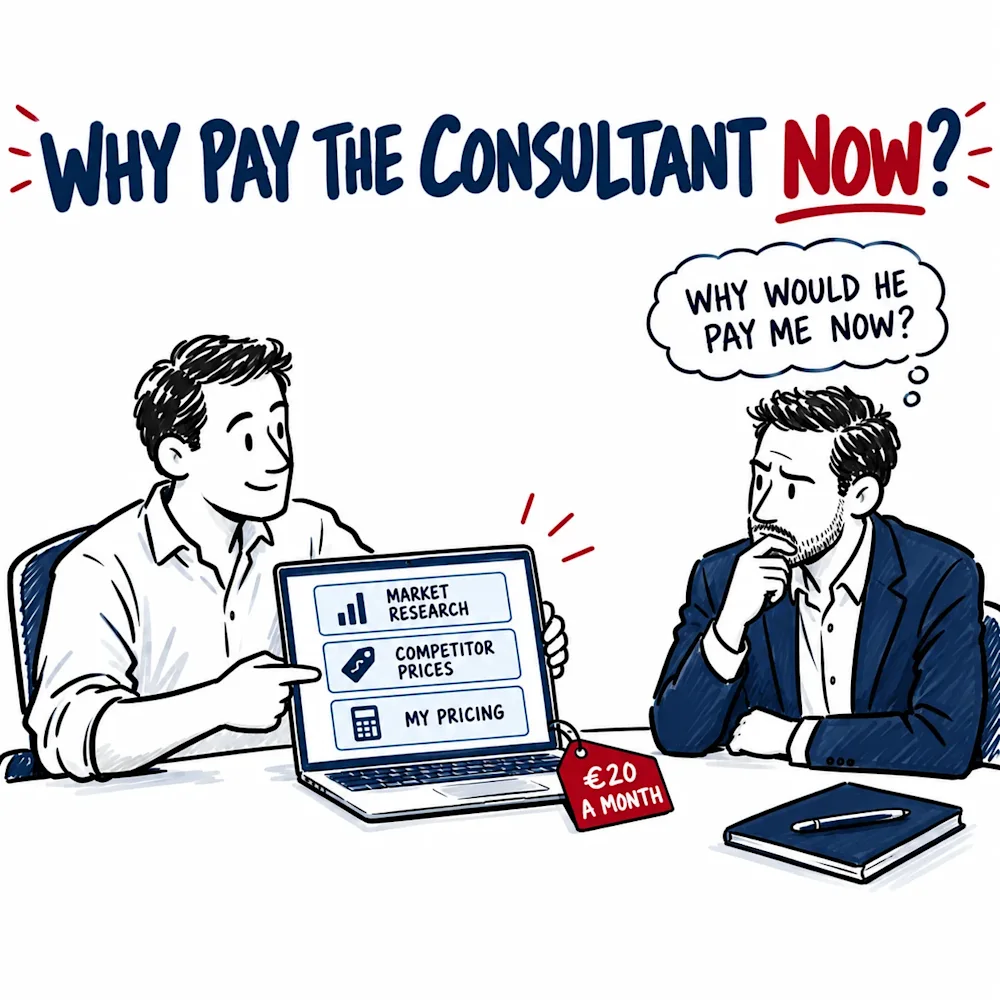
The second meeting with the owner of a small company goes like this. Before you open your notes, he turns his laptop toward you and shows you ChatGPT: the market research he did last night, his competitors and their prices, and a page of advice on his own pricing. The subscription cost him €20 for the month. As far as he is concerned, his company is already an AI company.
And the question every one of us has asked in that chair comes back: if ChatGPT does his research and advises him on his prices, why would he pay me now?
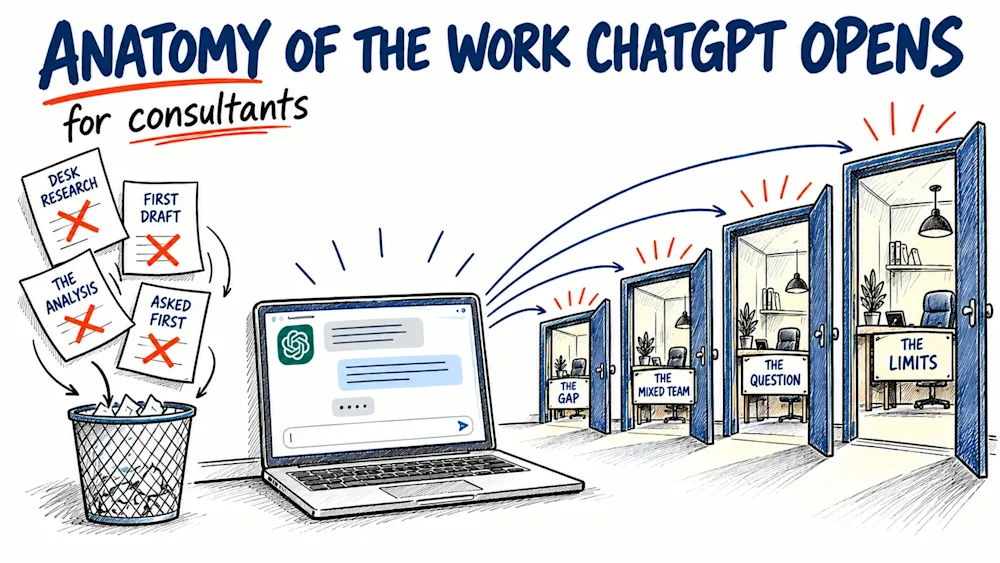
He is right about the research, and wrong about the conclusion. His ChatGPT took the part of our work that was already getting cheap. Behind it, every new way the owner applies AI opens a problem that nobody in his company is paid to solve, and ChatGPT cannot solve it for him either. That problem is consulting work, and it is how we still help an owner who says his company is already AI. The cases here are from my own firm and from one client engagement; the roadmap under them is in edition 18, and I told the cases at length in edition 22 and edition 24. Here each gets only the one or two facts this piece needs.
Four ways owners apply AI in their business
I gave owners the roadmap for AI-sation in an earlier edition, and I will not walk it again here. When 144 owners of small companies from Macedonia filled in a self-assessment of their own business, AI came out as the area where they score themselves weakest. They do not lack access: there are dozens of AI tools, free or at €20 a month. What they lack is guidance. A small firm has the owner, and the consultant, if the consultant takes the chair.
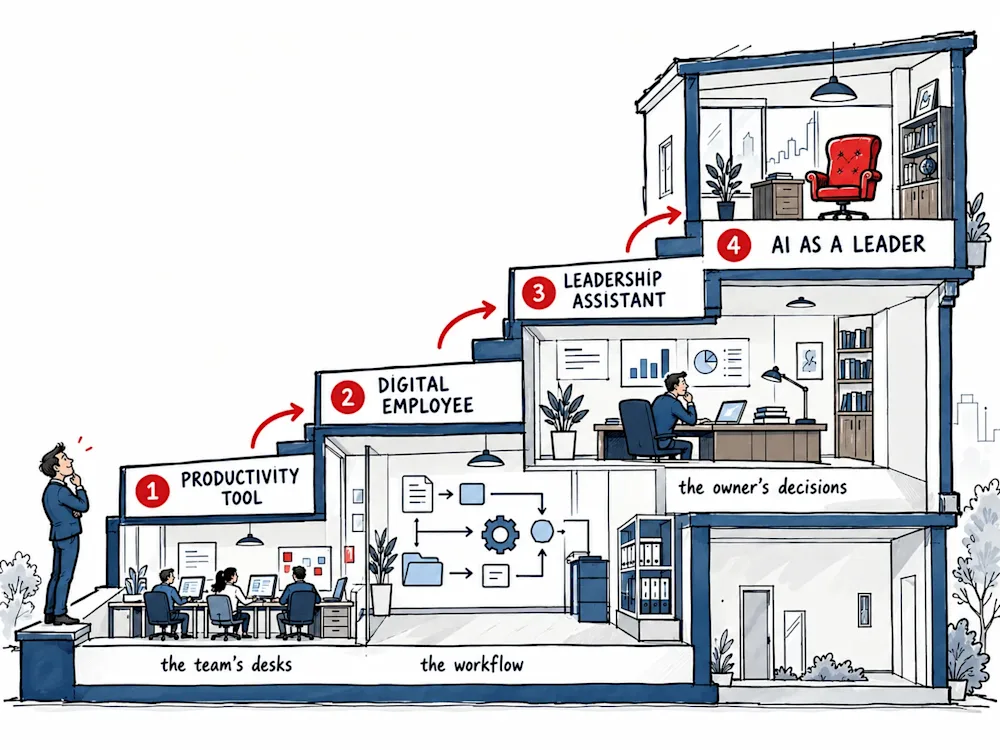
I see four ways owners of small firms apply AI in their business: as a productivity tool, as a digital employee, as a leadership assistant, and as a leader. My talk on AI-sation of SMEs called them AI in leadership. Here I call each one a stage, because each goes one level deeper into the business than the one before.
Stage 1. The owner uses AI as a productivity tool
The first way an owner applies AI is the simplest one: he tells everyone to use ChatGPT. He pays for the accounts, asks the team to use AI for everything and builds an AI-first productivity culture. Then he calls AI done, because everyone in the company has it open on the screen.
Our fear at this stage is about price. Our own reports are now expected faster and cheaper, because the client has ChatGPT too.
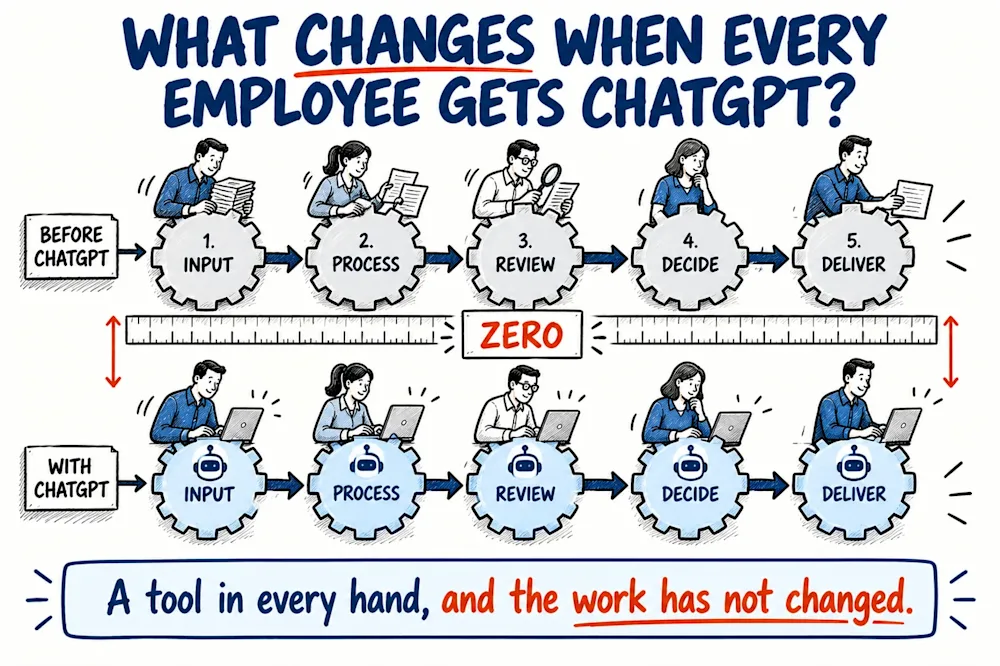
What breaks is harder to see. A tool sits in every hand, and the work under it has not changed. The salesperson writes the same follow-up email, only faster, and the bookkeeper still copies the same invoice from one system into the other, now with a summary from ChatGPT on top. It is the same process with faster typing, and from the owner's chair it looks like progress, because the screens are busier.
What arrives on our desk is the gap between using a tool and changing the work. Closing it needs someone who has seen the work itself: where the hours go, which steps exist only because two systems do not talk to each other, which report nobody reads. ChatGPT cannot see that for the owner, because it only knows what he types into it.
I saw this in my own firm. When I mapped one of our sales channels the way the team really works, our old document of six or seven steps came out as ten steps holding 113 separate activities. Eight of those activities died on the table before any code or AI touched them. The work changed first, and the tools came after.
Stage 2. The owner takes on AI as a digital employee
The second way goes one level deeper, into the work itself: the owner hears about agents. An agent is an AI that does a piece of the work on its own, instead of waiting for a question, and a digital employee is an agent with a place in the team: routine tasks, data processing, follow-ups, monitoring and alerts. The picture he likes is 25 people and 25 agents in one company, where the owner moves from managing tasks to orchestrating a system. He wants his own 25 agents.
Our fear here is about staffing. The agents do the junior work we used to staff: the research, the data cleaning, the first drafts, the follow-up lists.
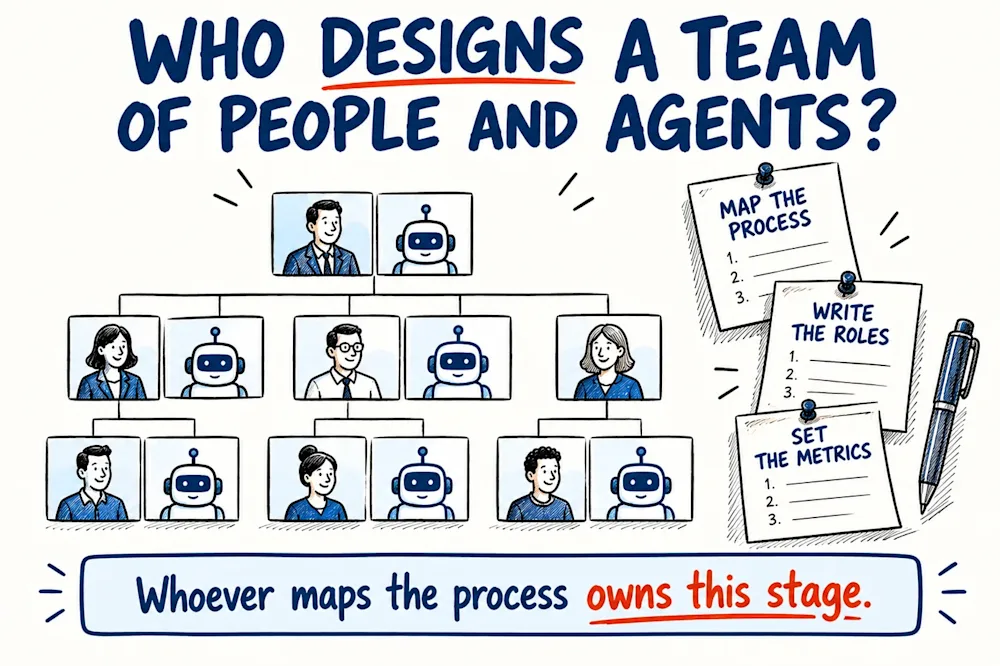
What breaks is the team. Somebody has to decide which part of a workflow the agent takes, who it hands over to, who checks it and how anyone knows it did a good job. In a small firm nobody maps the process, nobody writes the roles and nobody sets the metrics for an agent, and no HR framework covers one. To be fair to the owner, nobody trained us to design a mixed team either.
So what arrives on our desk is the design of a mixed team. Whoever maps the process, writes the roles and sets the metrics owns this stage. In an SME that is nobody, so it is us.
My own firm has one documented digital employee, on that same sales channel. Every morning AI helpers read the new job posts and write a verdict on each one, apply or leave it, and a second helper reads the ones left behind a second time, without seeing the first verdict. The AI writes the application and the reply to a prospect, and code sends them. Of the 105 activities left after the map, a person is needed at four: the discovery call, the approval of the proposal, the kick-off call and the approval of the contract. The AI did not pick those four places. I found them on the last walk through the map, by asking where a person still has to be.
Stage 3. The owner thinks with AI as a leadership assistant
AI changes the owner's job as much as his team's work, and the third way is where that starts. It moves AI up, from the team's work to the owner's own decisions. A leadership assistant is an AI the owner thinks with: it analyses the data, models scenarios, flags the risks and recommends what to do, and it is always available. Call it a second brain: better questions, better decisions.
This is the sharpest fear of the four, because that is our chair. The assistant does what we used to bill for: the analysis, the scenarios, the recommendation.
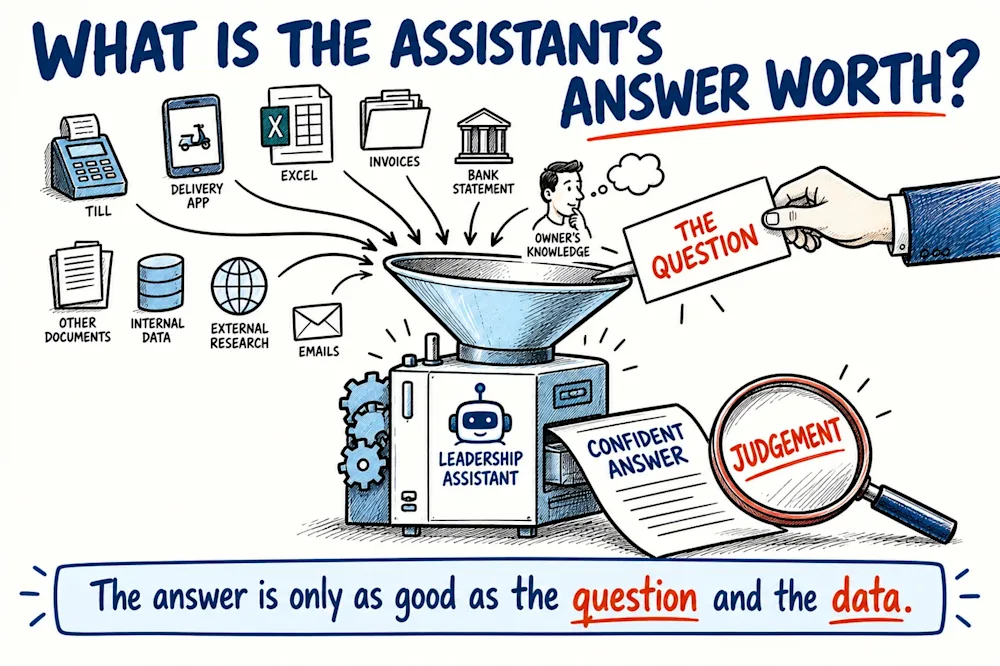
What breaks is what goes in. The assistant is only as good as the question it is asked and the data it is fed. Ask it why sales are down, and it answers that question, even when the real question is why the best clients stopped coming back. Give it one export from the accounting software, and it reasons on one export. In an SME the data sits in ten places, from the till and the delivery apps to the Excel files and the owner's head, and the assistant is useless until someone builds its base.
So our value moves to the question we ask, the data we feed it, and the judgement on the answer. Building the base is work in its own right. Someone has to find the files, make them readable for an AI and check that the same files give the same numbers every time. The judgement stays with us as well, because the assistant writes a confident answer to a weak question as easily as to a good one.
In the previous edition I told you how our diagnostics work now: the AI does the analysis and drafts the report, and the consultant turns the owner's claims into hypotheses and research questions. One engagement from it fits this stage. A food business on delivery platforms gave us 580 files, and before the AI could answer anything useful, we had to make the same files give the same numbers. When it then wrote nine hypotheses for one area, eight of the nine turned out to be evidence for the first one rather than hypotheses of their own, and the shortlist was ours to make.
Stage 4. The owner lets AI act as a leader
The fourth way puts AI in the leader's chair, at least in the owner's head. He reads that a robot was named CEO, and he starts asking the machine before he asks anyone. At this level the machine watches the operation while it runs and plans ahead of it. It recommends from scenarios and executes on its own inside limits that people set, while people keep ethics, culture and vision. None of that runs in a small firm yet, but the owner already reads about it.
The headlines he reads are real, and two of them are worth naming. NetDragon Websoft, a gaming company in China, named a humanoid robot, Ms Tang Yu, the rotating CEO of a subsidiary. Dictador, a spirits brand, named the humanoid robot Mika its CEO, and the decisions on hiring and firing stayed with people.
Our fear at this stage is the last one: the owner asks the machine before he asks us.
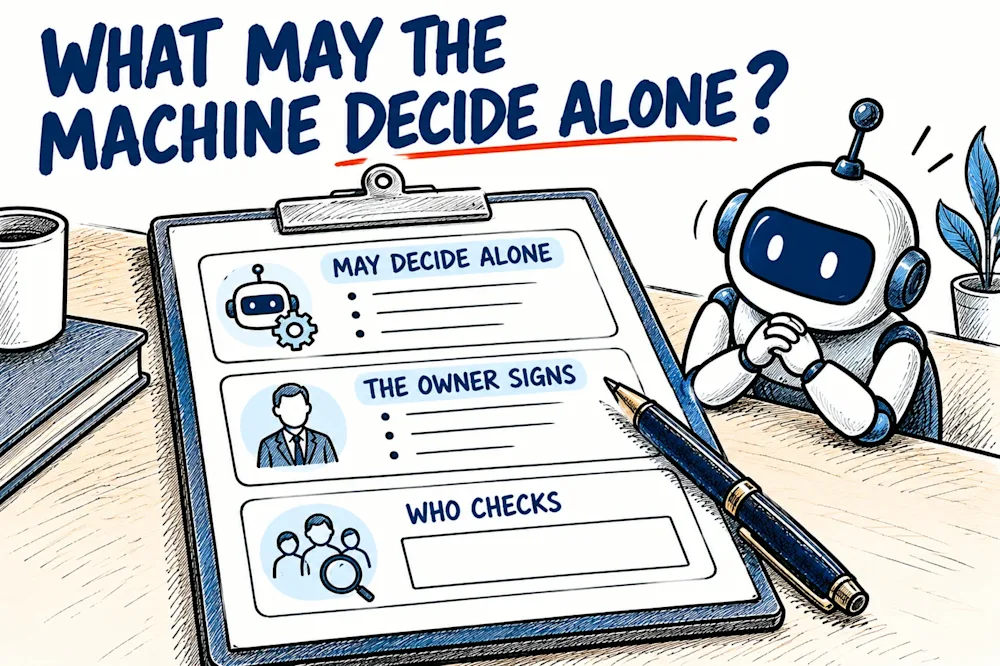
What breaks is that nobody has written the limits. What may the machine decide alone? Where does the owner sign? Who checks what it did? A corporation answers those questions with a board, a compliance team and a policy for almost everything. A small firm has never had a governance document, the written rules for who decides what, and now it needs one for a member of the team that never sleeps.
That is the work that arrives on our desk: someone writes the limits. In a small firm, governance is a page the owner can read: what the machine may decide alone, where the owner signs and who checks. If we do not write them, the owner asks the machine before us.
In my own firm two of those limits are written down. On our sales channel, code and AI prepare the proposal and the contract, and neither goes out before the person who signs for the firm approves it, because both are commitments. My personal assistant agent reads and drafts but never sends, so every draft waits for me. Those are two short rules, and someone had to sit down and write them.
They have the tools and miss the guide
The owner with the laptop was right about his research. In a corporation each problem the four ways open has a department of its own: IT for the tools, HR for the mixed team, strategy for the assistant, legal and compliance for the limits. In a small firm all four land on the owner, and on whoever he trusts to sit beside him. So the fear points the wrong way.
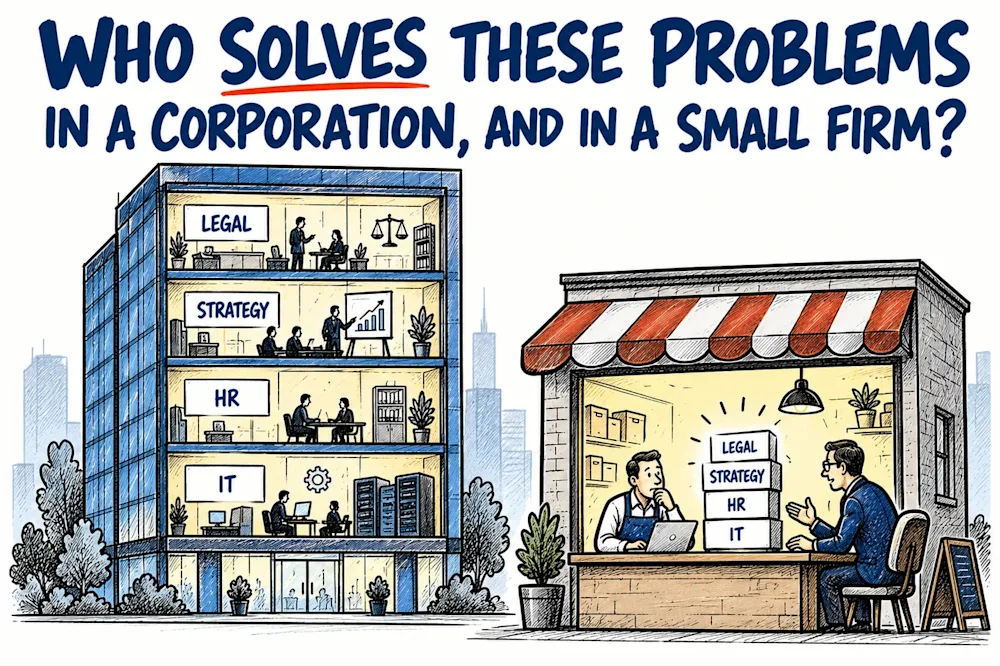
Corporations had decades and a department. SMEs have you.
So which way is your last client applying AI, and what did you sell him: the thing his ChatGPT now does, or the thing it opened?
If this was useful, subscribe to Anatomy of Consulting on LinkedIn, and the next edition will come to you.
Questions readers ask
What are the four ways business owners apply AI?
<span class="v5">As a productivity tool, when everyone in the company uses ChatGPT. As a digital employee, when agents take parts of real workflows beside the people. As a leadership assistant, when the owner thinks with it before a decision. As a leader, when the machine acts on its own inside limits that people set. Each way goes one level deeper into the business than the one before.</span>
Will ChatGPT replace consultants who work with small businesses?
<span class="v5">It takes the part that was already getting cheap: the desk research and the first draft of a report. It does not take the problem that each new way of applying AI opens, because nobody in a small firm is paid to solve that one. That problem is the consultant's, and an owner who says his company is already AI still has it.</span>
What does a consultant do when an owner wants an AI digital employee?
<span class="v5">He maps the process first, then writes the roles and sets the metrics: which part of the workflow the agent takes, who it hands over to, who checks it and how its work is measured. No HR framework covers an agent, and in a small firm nobody has that job, so it is the consultant's.</span>
What does an AI leadership assistant need before it is useful?
<span class="v5">A good question, a base of clean data and someone to judge the answer. The assistant answers the question it is asked, so a weak question gets a confident weak answer. In a small firm the data sits in ten places, and someone has to find the files, make them readable for an AI and check that the same files give the same numbers every time.</span>
When an owner lets AI act as a leader, who writes the limits of what it may decide?
<span class="v5">In a corporation a board, a compliance team and written policies do it. A small firm has no governance document, so the consultant writes the limits with the owner on one page: what the machine may decide alone, where the owner signs and who checks its work.</span>
About the author
Dancho Dimkov writes Anatomy of Consulting, a publication about the practice of business diagnosis. Read more about the publication.
Stages referenced here are links in the diagnostic journey (7 links in total).