
Nobody Built It for SMEs, So I Did
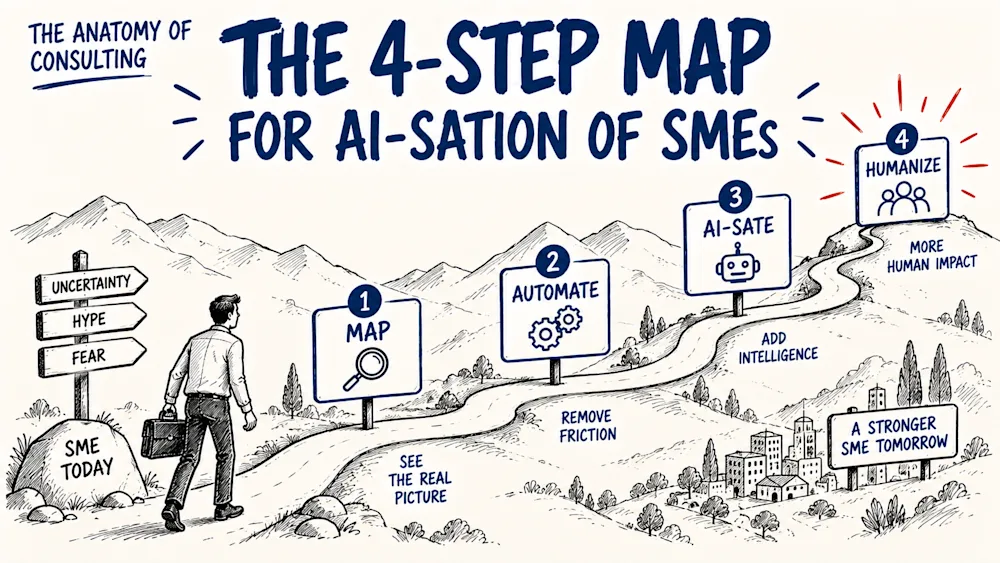
Most AI maturity frameworks were built for corporations. This is the four-stage roadmap for small companies: map the work, automate the rules, AI-sate what rules cannot do, and put people on what is left. The order is the method.
Edition 18
Ten years ago, AI was not a topic for small companies. It needed data centres, data scientists and teams of engineers, and only corporations could pay for that. They hired the big consulting firms, ran multi-year transformation programmes, and SMEs watched from the side. In every market it was the same fight, the small company against the big one, and the big one owned the technology.
Then came ChatGPT and the no-code automation tools, for $20 to $50 a month, at least for now. AI came down to street level. A five-person company can write like a marketing agency and read its numbers like a business analyst. For the first time, the small company has the same technology as the big one, and it keeps the one thing the big one never had: an owner who decides today and has it running tomorrow.
Access is not the problem any more. Knowing how to use it is. Corporations still have the big firms and their frameworks. SMEs have themselves, and a framework built for a company of 20,000 employees does not work for a company of 20. I am on the side of the 20.
If you consult for small and mid-sized companies, you have had this conversation. The client leans in at the end of the meeting and asks: what should we do about AI? They have heard the promises and the threats, they have seen the demos. And the loudest advice around them, from the market, from the news, sometimes from our own profession, is the worst one: put AI on everything. Buy the subscriptions, plug them in, done.
So the client does what any sensible buyer does when advice is loud and contradictory. They freeze. And a frozen client is where consulting engagements go to die.
I can show you that freeze in numbers, from our own funnel. On the BusinessPulse site, owners take a sixteen-question check across four areas of their business. In less than two months, since 23 July, 144 owners have completed it, and AI is the weakest area by a distance. Most of them run companies of one to ten people, exactly the segment everyone claims AI is not for.
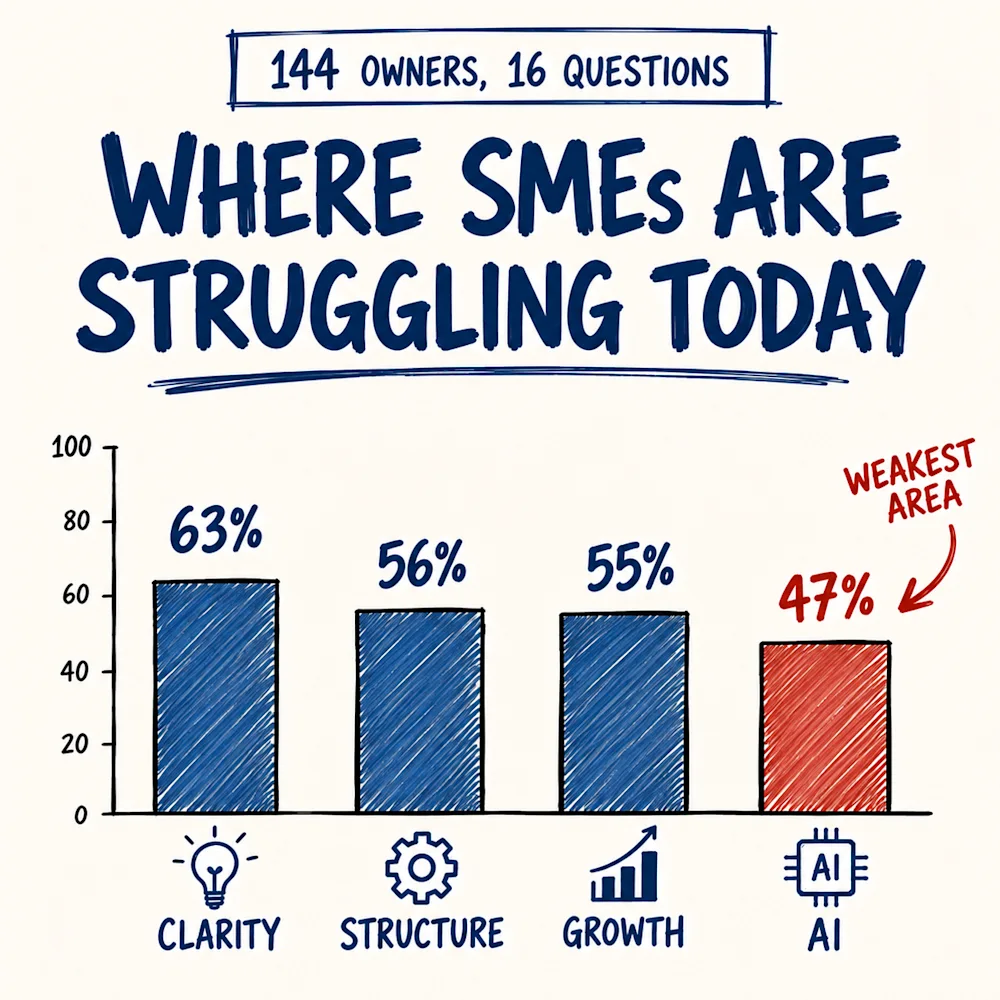
Read that as a consultant for a moment. 144 owners of small companies from Macedonia sat down, scored their own business, and told us AI is where they are weakest. That is not a technology statistic. That is unserved demand, sitting at the bottom of the market, frozen between hype and fear because nobody has handed them a plan. "Use AI" is not a plan. A plan has stages, an order, and a reason for the order. That is what this issue takes apart: the roadmap I had to build from scratch, because the one SMEs needed did not exist. It is what my doctoral research is built around, I trust it enough to run it on my own company, and I believe every SME consultant will need something like it on the table within a year. In the last edition I argued that AI finally makes it affordable for us consultants to take real risk. This is the instrument for taking it.
The roadmap, and why the order is the whole method
When I started my doctoral research on how SMEs adopt AI, I went looking for a maturity framework to build on. I reviewed thirty of them. Most of them were built for corporations. The ones built for small companies barely mentioned AI, and the ones built for AI assumed an IT department and a transformation budget. A few had started to close the gap, but none was built for a service company of ten people where the owner answers the phone. Nobody had built it for SMEs. So I did.
The instrument is the AI-isation roadmap. Four stages, in a fixed order: MAP, then AUTOMATE, then AI-SATE, then HUMANIZE.
Yes, AI-sate is a made-up word, and I made it up on purpose: the way you automate with automation, you AI-sate with AI. It says exactly what the stage does, so it stays.
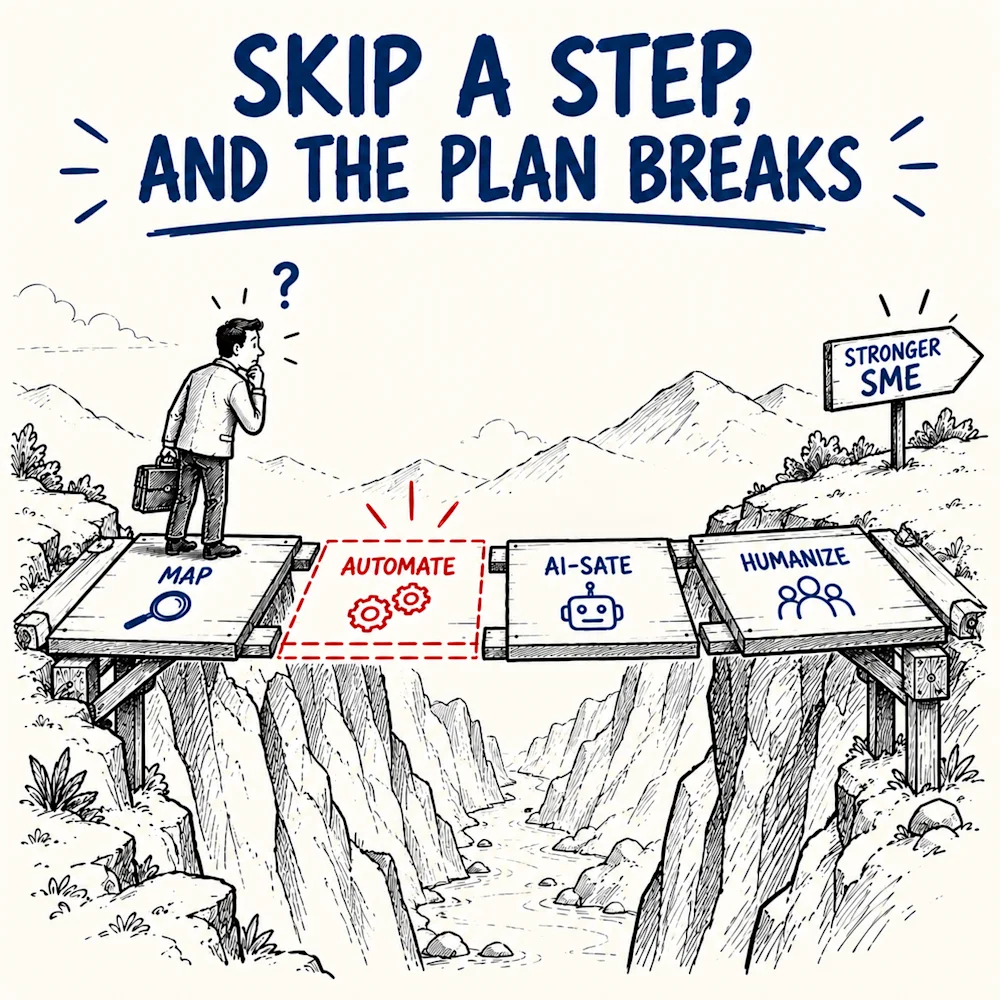
Plenty of frameworks have four boxes. What makes this one an instrument you can charge for is that the order is load-bearing. Each stage answers one design question, each stage stands on the one before it, and skipping a stage collapses the next. Your client cannot see that order; the tool vendors will never show it to them, because the sequence starts with work no tool can sell. That gap between what the client can see and what the work requires is, as always, where the consultant lives.
MAP: you cannot aim AI at a process you cannot see
The design question: how does the work actually flow? Where do the hours, the attention and the decisions really go?
Nobody wants to start here. Mapping is unglamorous, there is no demo to show anyone, and to the client it feels like delay. It is also the stage everything else stands on, for one reason: AI amplifies whatever it touches. Aim it at a clear process and it multiplies the output. Aim it at a hidden, tangled process and it multiplies the tangle, faster than any human ever could.
Mapping is exploration. You sketch the work on paper or a whiteboard with the people who actually do it, step by step, handover by handover, and the business starts showing you things. Processes the owner did not know existed. Processes that are outdated and still running, because nobody ever stopped to ask whether they are needed. At WITCON last year I told the room they would be shocked how much becomes visible before any AI is involved.
Skip MAP and the collapse looks like this: the client buys tools for problems they do not have, automates a step that was never the bottleneck, and concludes six months later that "AI does not work for us".
The consultant's role: this stage IS consulting. Mapping where time, money and decisions actually go is diagnostic work, the thing we were doing before AI existed, and it is the natural entry point of the whole engagement. The owners scoring lowest on our AI check are not behind on tools. They are behind on this stage, and this stage is not sold in any app store.
AUTOMATE: remove friction before adding intelligence
The design question: which repetitive, rule-based steps can rules take over first?
Notice: no AI yet. This stage is plain automation, the if-this-then-that work: data retyped from one system into another, the reminder someone sends every Monday, the report assembled by hand from three exports. Rules, not intelligence.
Skip it and the collapse is financial: the client pays AI prices for rule work. A language model doing what an if-statement could do is the most expensive employee they will ever hire, and the easiest one to blame when the bill arrives.
The consultant's role: this stage is where the engagement earns trust. Cheap, visible, fast wins, and the first proof that the map was right. Deliver two of these and the client stops asking whether any of this works and starts asking what is next.
AI-SATE: intelligence on top of a clean process
The design question: looking at the mapped process and the automation already on it, which steps need interpretation, analysis or writing that a rule cannot do?
Only now does AI enter, and it enters on top of a mapped, automated process: drafting text, analysing numbers, sorting and prioritising, preparing a decision. Notice what this stage does not look at: people. It looks at the work. Automation is the skeleton, AI is the nervous system, and the question of who does what comes after, once you can see what is left.
Skip the first two stages and jump straight here, which is what most "AI transformations" do, and the collapse is the ugliest of the three: intelligence amplifying a process nobody understands, confidently, at scale. Not insight. Chaos with good grammar.
The consultant's role: routing, not coding. Deciding which work goes to the machine and which never goes near AI is a judgement call about the client's business, not a technical one. You do not need to build any of it. You need to decide where it belongs.
HUMANIZE: what is left is where people belong
The design question: after the map, the automation and the AI, what work is left? That is the human layer.
I have to be honest here, because our profession is often too polite about it. AI will replace people. So does automation. If four people spend their days copying data from one system into another, one automation makes all four of those jobs obsolete, and nobody pretends otherwise.
So HUMANIZE is not a promise that nobody loses a job. It is arithmetic. You start with 100% of the work on the map. You take out what can be automated. You take out what AI can carry. What is left is the work neither of them can do, and that is where you put people.
And it is never black and white. One process can be 99% automated, with a person only checking the result. Another can be 10% automated, 10% AI-sated and 80% human. The map decides the mix, not the hype.
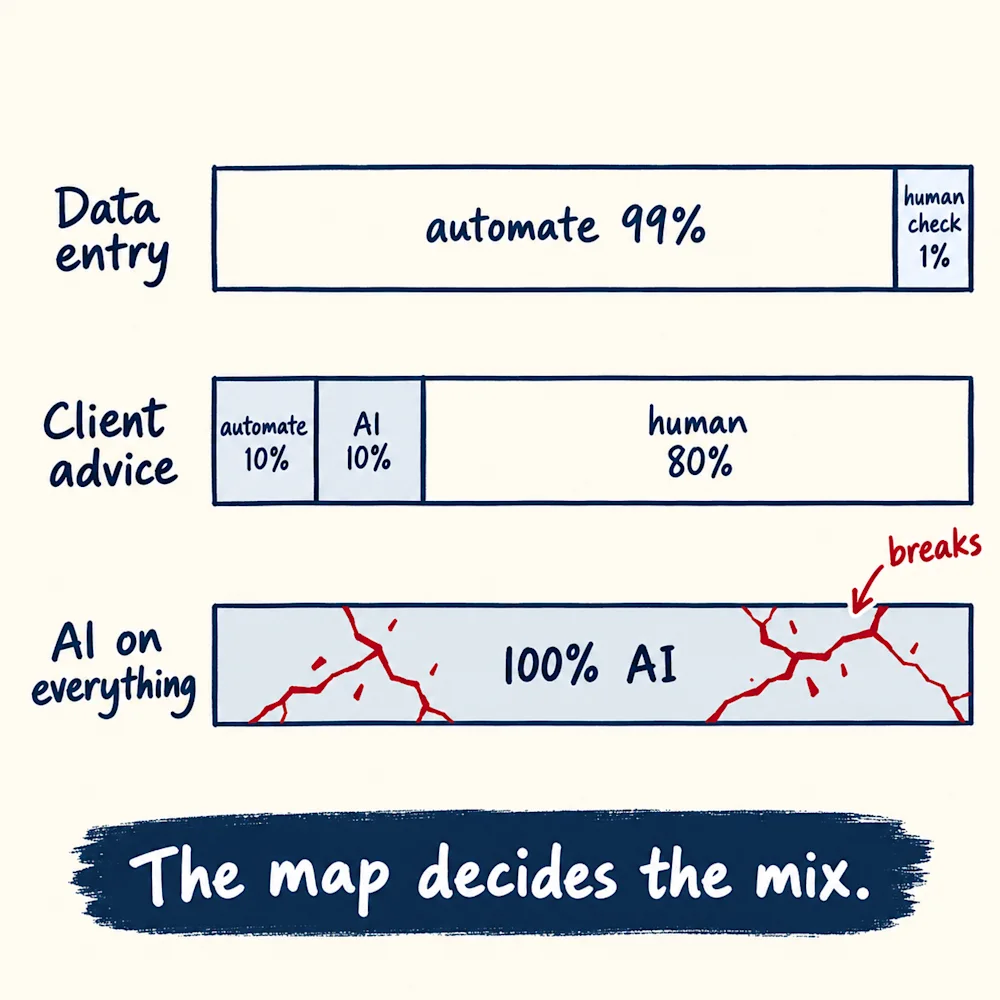
The consultant's role: this is what we are hired for. We look at the health of the whole company, not at a technology. We map what is going on, then we decide what is for automation, what is for AI, and what has to stay human. The wrong way is to put AI on everything. Some processes are critical, and a business that hands them fully to AI can ruin itself. Knowing which ones they are does not come with any tool. It comes from understanding the business.
I ran it on myself first
An honest framing before the proof: this comes out of doctoral research, and the first client I ran it on was me. Not a client's company. Mine.
The diagnostic I sell is AI-isated end to end. We mapped the seventeen steps of the work, automated the mechanical ones, and put AI on the data layer: the cataloguing, the cross-checks, the first-pass analysis. The data step that used to take weeks now runs in hours, and the three places where judgement decides, the hypothesis, the conclusion, the recommendation, are exactly the three places that stayed human. That split is not an accident. It is the roadmap.
At BizzBee, the agency, we have Linda, our internal AI agent. She supports our outreach process, the part of the work where lists of prospects get built.
And the newest one is our Upwork machine. We mapped first: how we screen job posts and how we write an application, written down as one rule book. Then we automated the obvious: the saved searches are read and the clear no's are dropped by rules. Then AI: it reads every post that survives, in full, and drafts the application. In the last measured run it went through about 350 posts across twelve searches in 27 minutes, and each application took about seven minutes. The human part stays human. When a client answers, that conversation is ours.
The lesson: the order is the method
The four stages are sequential, and that is the whole point.
You cannot AI-sate a process you have not mapped. And some of what the map shows does not need AI or automation at all. It needs to be deleted.
AI-sate before you automate, and you get expensive AI. A good part of what the client wants AI for could be done by a simple rule that costs almost nothing.
And the human comes last, on purpose. Only after you know what can go, what can be automated and what AI can carry, can you see what is left: the critical points on the map, the decisions and relationships where a mistake costs real money. That is where you keep the human in the loop.
For the client, that means one workflow at a time, in this order. For us consultants, it is also the shape of an engagement: pick the workflow where the pain is loudest, run the four stages on it, then move to the next.
The demand is already standing in line: the smallest companies, scoring lowest exactly where the noise is loudest, waiting for someone to arrive with a sequence instead of a subscription.
Automate the predictable, AI-sate the scalable, humanize the strategic.
Questions readers ask
What is the AI-isation roadmap for SMEs?
A four-stage method Dancho Dimkov built for small and mid-sized companies: map the work, automate the rule-based steps, AI-sate the steps that need interpretation, analysis or writing, and humanize, which puts people on the work that is left. The stages run in a fixed order, and skipping one makes the next one fail.
Why should a small business automate before it adds AI?
Because a large part of what clients want AI for can be done by a simple rule that costs almost nothing. Data retyped between systems, a weekly reminder or a report built from three exports is rule work. Paying AI prices for it is the most expensive way to do it.
What does process mapping find before any AI is involved?
The real flow of work, step by step and handover by handover, drawn with the people who do it. It usually shows processes the owner did not know existed and outdated processes that keep running because nobody asked whether they are still needed. Some of that work should be deleted, not automated.
Will AI replace people in small businesses?
Some work, yes, the same way automation does: if four people copy data between systems, one automation makes those jobs obsolete. The roadmap treats it as arithmetic. Take the mapped work, remove what automation and AI can do, and put people on what is left. The mix differs per process, from 99% automated with a human check to 80% human.
What is the consultant's role when an SME adopts AI?
To understand the business and decide the mix: what goes to automation, what goes to AI and what has to stay human. Putting AI on everything breaks critical processes. Mapping is diagnostic work, and deciding where each step belongs is a judgement about the client's business, not a technical task.
About the author
Dancho Dimkov writes Anatomy of Consulting, a publication about the practice of business diagnosis. Read more about the publication.
Stages referenced here are links in the diagnostic journey (7 links in total).