
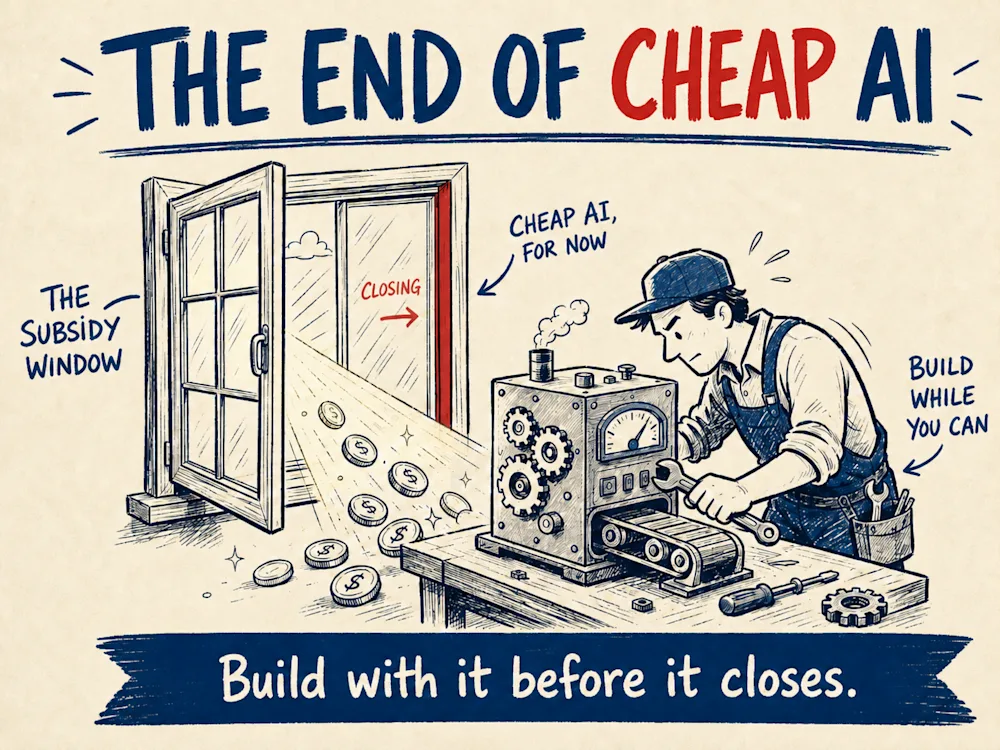
The End of Cheap AI
In December, Uber gave around five thousand of its engineers access to AI coding tools. By April, four months later, the company had burned through its entire AI budget for the year. Not the quarter. The year. Fortune reported that Uber's own operations chief was left asking, out loud, whether...
Edition 9first published on LinkedIn
In December, Uber gave around five thousand of its engineers access to AI coding tools. By April, four months later, the company had burned through its entire AI budget for the year. Not the quarter. The year. Fortune reported that Uber's own operations chief was left asking, out loud, whether the productivity was even worth the bill.
Sit with that, because the irony is almost too neat. Uber is the company that taught a generation of startups how to use a low price as a weapon: subsidised rides, paid for by investors, kept cheap until the competition was gone and the habit was formed. And here it is, more than a decade later, on the other side of the same trick, watching a tool it cannot stop using empty a year's budget in a third of a year.
I am not telling you this because of Uber. I am telling you because there is an instrument hidden in this story, and naming it is one of the more valuable things a consultant can do this year.
The instrument: the Subsidy Window
Every so often, an entire market is sold to us for less than it costs to produce. Investors fund the gap on purpose, to buy adoption and a habit, and for a while the input feels almost free. Then the funding logic changes and the price climbs back to its real level. We have lived through a decade of these: Uber rides, Amazon's free shipping, WeWork desks, money itself at near-zero interest. AI is simply the current one.
Call the cheap stretch the Subsidy Window. It opens when someone decides to buy a market, and it closes when they finally have to make money from it. While it is open, a business has a once-only chance to turn the cheap input into something that still pays off after the price turns. There are three moves, and consultants are unusually well placed to run them.
- Identify the subsidy. Recognise the input is priced below cost, and that the window will close. Pattern recognition, the consultant's oldest edge.
- Capture the window. Spend the cheap input building something you own, not renting something you will keep paying for. The move that decides everything.
- Plan the wean. Bring the dependence down to the level the job actually needs, deliberately, before the price forces it.
Build with the subsidy. Don't build on it.
The rest of this issue runs the play on AI, because the window is open right now and most of your clients are standing in it without looking up.
Move one: identify the subsidy
I spend my days close to this question, since my doctoral research is on how service-based SMEs actually adopt AI. So let me start with the uncomfortable part, then the evidence: the AI your clients are using today is being sold to them for less than it costs to make.
This is not a conspiracy theory, it is the stated strategy. The model labs used artificially low pricing to drive adoption, burning investor capital to manufacture dependency on the bet that they could monetise a captive base later. ChatGPT alone is estimated to cost in the region of seventeen billion dollars a year to run, serving hundreds of millions of weekly users of whom only a few tens of millions pay anything at all. And the funding logic is about to change in the most concrete way there is: the model labs are heading for the public markets. A private company burning investor money can hold prices below cost for years. A public one answers to shareholders who want the gap closed. Sequoia's David Cahn named the size of that gap "AI's 600 billion dollar question" - the distance between what has been spent building AI infrastructure and the revenue that would justify it. Gaps that size do not close by cutting prices.
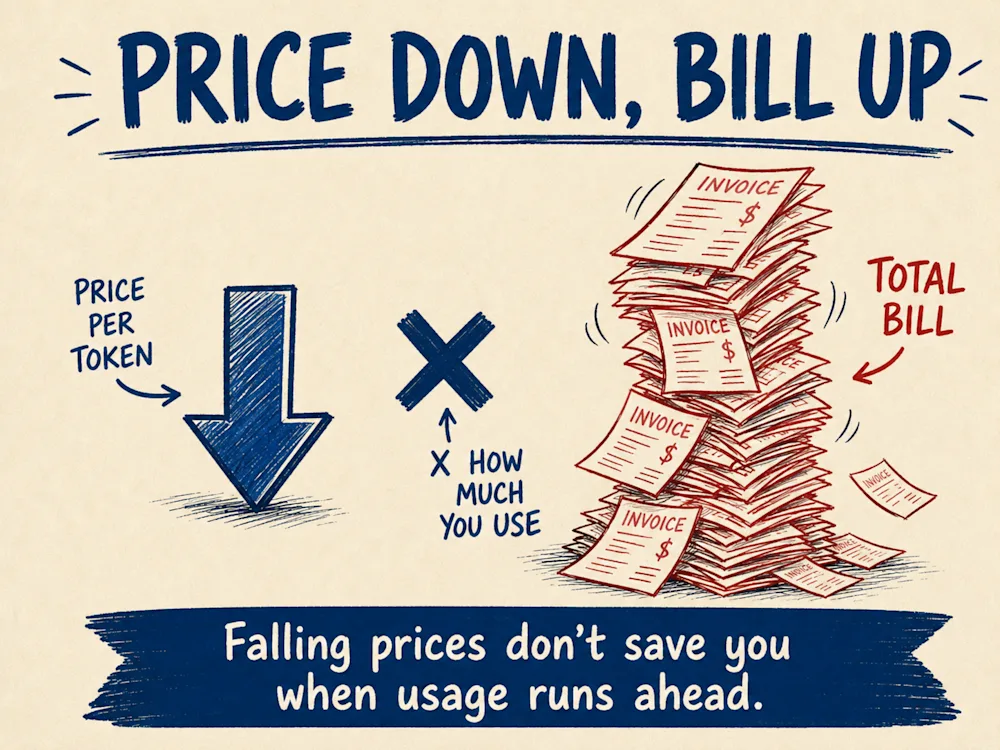
Now the part that fools people, and the reason most of your clients will not see the window closing until it is shut. Look at the price of a single unit of AI, the cost per token, and it is not rising. It is collapsing. a16z reckons the cost of a given amount of inference has fallen somewhere between ten and a hundred times in eighteen months. On paper, AI gets cheaper every month. So why did Uber's budget evaporate? Because the bill is not the unit price. The bill is the unit price times how much you use, and usage is exploding faster than price is falling. The blended cost per token halves in a year and the total invoice still climbs, because the new agentic tools make ten or fifty model calls where the old ones made one. UBS found that roughly sixty percent of companies actively watching their AI spend have already started pulling back: capping usage, routing simple work to cheaper models, and reaching for cheap open-source models out of China, Qwen and DeepSeek among them, to hold the bill down. One firm in their analysis cut its internal AI tools from five to two. These are not AI sceptics. They are AI believers who got the invoice.
The falling unit price is the trap, not the comfort. It lulls a business into building everything on tokens, right up until the bill arrives anyway.
That is move one. The subsidy is real, the window is open, and the thing that hides it is the very price drop that feels like good news.
Move two: capture the window
This is the heart of the matter, and the part to take to every client standing in the window.
The window forces one question, and almost everyone answers it without noticing they were asked: when the price turns, will you be renting, or will you have built? It shows up as two kinds of company that look identical at the start.
The first builds AI as the service. The model is the product. This is where nearly everyone begins, and for good reason: it is the fastest thing in the world to ship. Cheap tokens make it feel almost free, you can stand up a working "AI that does X" in a weekend, and it demos beautifully. The whole offer is the model with a little branding around it. A hundred percent of the value is the model, which is the same as saying a hundred percent of the cost is tokens and a hundred percent of the exposure is the supplier's. These companies do not set their own margin, their provider does. Cursor, one of the most successful AI tools in the world, had to raise its prices in mid-2025 to pass through an increase from its model provider. Founders across that category describe their margins, openly, as abysmal. When the model is the product, the business is a line item in someone else's pricing decision.
The second kind builds a product that uses AI. The value lives in something they own - a method, proprietary data, a workflow, logic encoded in their own system - and the model sits on top as a thin layer. When tokens get expensive, they route to a cheaper model, run a smaller one, or do the parts that never needed a model without one. The AI makes the product better. It is not the product.
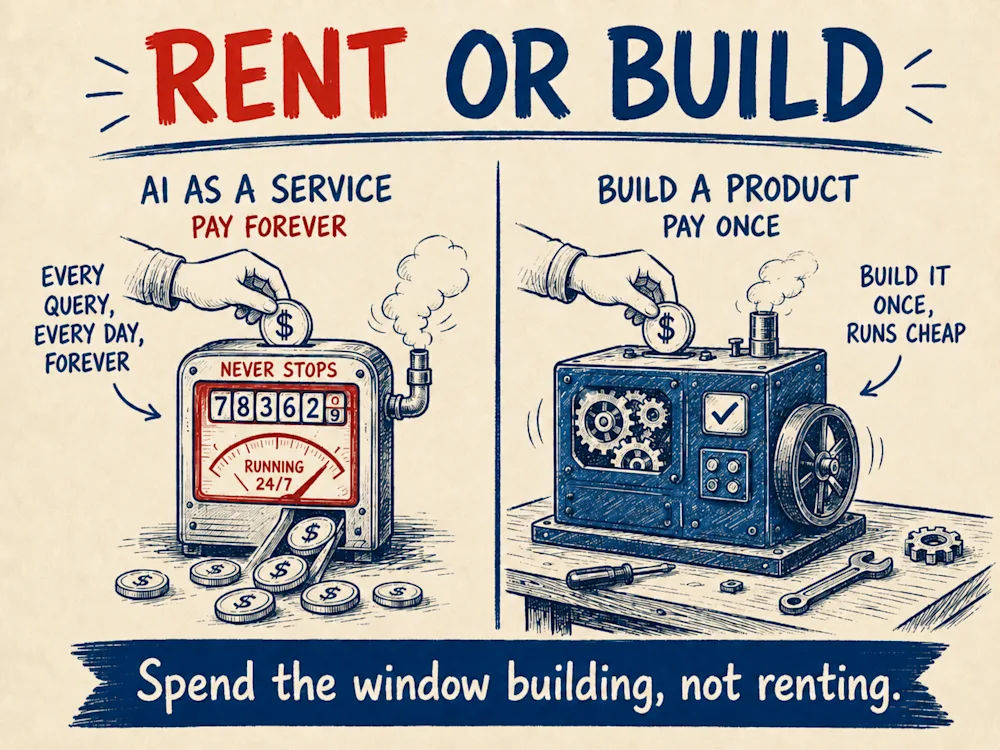
Here is the sharpest way I know to put the choice, and the one I would write on the wall of any client conversation. There are two things a company can spend AI tokens on. It can spend them running a service - every customer, every query, every day, forever - in which case the token bill scales with success and rises with the provider's price. Or it can spend them building a product - using cheap AI now, during development, to design the logic, write the deterministic code, and work out the hard parts - and then ship something that runs cheaply on its own and barely touches the model again. Same tokens, opposite bets. One turns AI into a permanent cost that grows as you grow. The other turns today's cheap AI into a durable asset that keeps paying after the cheap years end. The subsidy is not only a discount to enjoy. It is a build window, and build windows close.
I can be concrete, because we are living it. We are building a consulting engine - the thing that takes a client's messy spreadsheets and turns them into answers - and we got the first version wrong in the most useful way. It leaned hard on the model: let the AI ingest everything and answer. Quick to build, lovely to demo. Then we asked it for a number that had to be calculated rather than found, and it did not refuse. It invented one. Confident, formatted, sourced-looking, and completely wrong. I have told that story in full before. What matters here is what we did with it.
We deleted that version, around nine and a half thousand lines of it, and rebuilt the whole thing on one rule we now treat as law: the language model never does the math. Every number comes from a specific stored figure, or a plain deterministic calculation over stored figures. The model understands the question and explains the answer. Ordinary, boring code does the arithmetic in the middle. Now notice where the AI went. We did not stop using it, we used it harder than ever, but to build. The cheap tokens went into designing and writing that deterministic engine, not into running it. So the finished engine barely calls a model: the expensive, fragile part became owned code that costs almost nothing per run and cannot hallucinate, and the model was demoted to a thin layer at the edges. The day a provider doubles its prices, the core does not care. We spent the window building, instead of renting a service that would have billed us forever.
Spend the cheap tokens building the product, not running the service. Then the day the model gets expensive, your core does not even notice.
Move three: plan the wean
Capturing the window is not a single decision, it is a direction you steer in. The instrument for move three is a simple one: a dial.
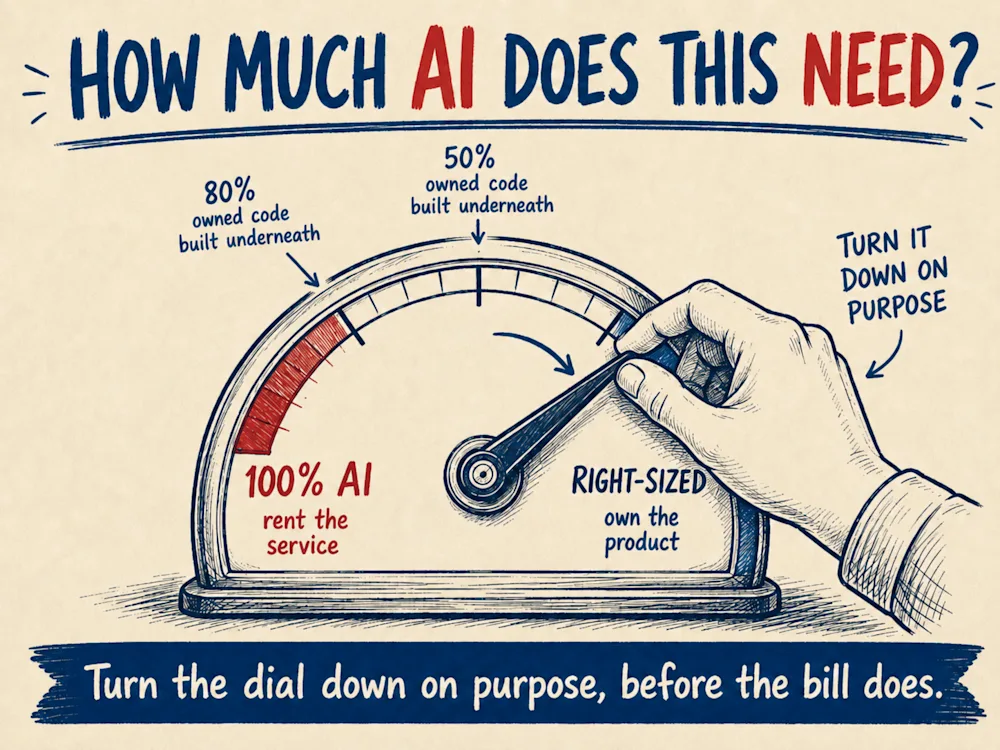
These two kinds of company are not really two boxes, they are two ends of a dial, and the only honest question to keep asking is: how much AI does this actually need? Almost everyone starts the needle at a hundred percent, because at today's prices nobody has to ask. As the bill climbs they are forced into the question they skipped at the start. Do we really need a model call for this step, or can owned code do it? That answer takes them to eighty percent. Then they look harder and find fifty. Then they realise most of the value never needed the model at all, and they reach the right level, the minimum the job actually requires - rarely zero, often something like ten. Every notch down that dial is a piece of real product built underneath the AI.
This is not only instinct, it is what the research keeps showing. The roadmap that comes out of my work on SME adoption puts AI third, not first: map the work, automate the friction, add AI, then humanise. You automate the boring middle with ordinary code before you reach for a model, which is the dial in another form - use as little AI as the job actually needs.
The planning is in the word "deliberately." The companies that survive do not wait for the invoice to turn the dial for them in a panic. They turn it down on purpose, now, while it is still a strategy and not an emergency, and they sequence it: the most expensive and most repeated calls come off the model first. That is a roadmap a consultant can build with a client in an afternoon, and it is worth more than any tool you could hand them.
A caution for your own practice
It is tempting to read all of this as a client problem and stop there. It is not only a client problem.
A great many consultants are racing to "AI-ise" their own practice, and a fair number are quietly building wrappers without using the word. If your new "AI offer" is really ChatGPT with your logo and a clever prompt, you are renting your practice on subsidised tokens exactly as your clients are, and you are just as exposed when the subsidy ends. Worse, you have handed your defensibility to your supplier, because anyone can rent the same model. The scarce thing was never access to AI, because everyone can reach the same models now. It is guidance: a method of your own that the model serves rather than replaces. The durable thing in consulting was never the tool. It is the framing and the synthesis, the read you make before any tool runs, which is exactly the part the model cannot do for you.
The honest objection
I want to be fair to the other side, because the strongest version of this argument admits where it is weak. a16z, who back a lot of these companies, argue reasonably that gross margin is not what makes a company great, defensibility is. A thin wrapper can still win if it owns the workflow, accumulates proprietary data, or composes several models into something no single one offers. That is true. Plenty of today's wrappers will grow into real products precisely by building owned value underneath the model over time, which is exactly the move this whole piece argues for, just done deliberately instead of under duress. So this is not "never touch the model," and it is not "AI is doomed." Use the model, it is the most capable tool any of us has been handed. The line is narrower: do not let the model be the business. Let it be the best-rented part of a business whose value you own.
See it, name it, act in the window
So here is where it leaves us. We have seen this pattern before. We recognised it from Uber and from every subsidised market that came before it, and the evidence says AI will run the same course: cheap to capture us, expensive once we depend on it. Knowing that is not idle prediction. It is the raw material of good advice.
The most useful thing you can do for a client this year is to help them make a decision they cannot see they are making: not to build a wrapper around AI, but to use this window to build a real product that happens to have an AI layer. Identify the subsidy, capture the window, plan the wean. Build with it, do not build on it. That is consulting in its oldest form - seeing the constraint before it bites, and naming it while there is still time to act. The tools are new. The job is the same.
Two questions for the comments. Which of your clients is quietly building a hundred-percent-AI service right now, and what would it take to turn that dial down before the bill does it for them? And where else do you see an open Subsidy Window today, an input still being sold below cost, that your clients should be building with before it closes?
Questions readers ask
What is the subsidy window?
The period where a capability is priced below what it costs to provide, because someone is paying to acquire the market. It is not a discount and it does not last. In December Uber gave around five thousand engineers access to AI coding tools, and by April the company had spent its entire AI budget for the year.
How do I identify a subsidy my client is living on?
Look for a cost line that fell sharply without anyone renegotiating anything, and ask who is absorbing the difference. If the answer is a vendor buying market share, the price is a decision someone else can reverse.
What does capturing the window mean in practice?
Building the thing that stays valuable after the price rises: the process, the data, the trained people. Consumption that produces nothing durable is not capture, it is just cheap consumption.
What is the wean, and when do I plan it?
The plan for what happens when the price goes up, written while the price is still low. The honest version includes which parts you would drop, which you would pay full price for, and the number at which the maths stops working.
Does this apply to my own consulting practice?
Directly. If your delivery now depends on tools priced below cost, your margin belongs to a vendor's pricing committee. Worth knowing which of your clients is quietly building a service that only works at today's prices.
About the author
Dancho Dimkov writes Anatomy of Consulting, a publication about the practice of business diagnosis. Read more about the publication.
Stages referenced here are links in the diagnostic journey (7 links in total).