
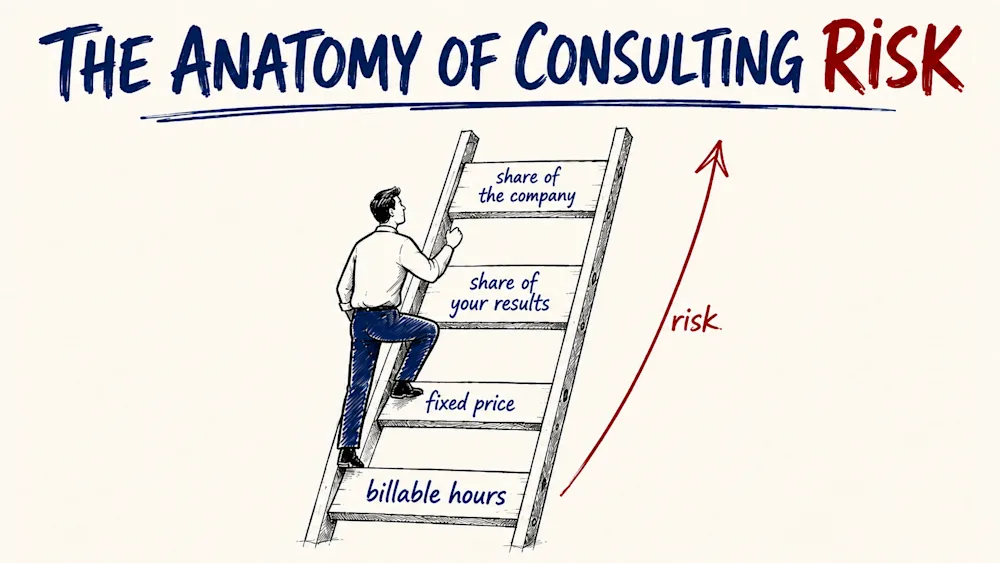
The 4 Stages of the Entrepreneurial Consultant
Consultants price their work differently, and not only because of different expertise. A big part of any consulting price is the risk the consultant is willing to undertake. You can see it on my own practice: if you ever decide to work with me and open my website, you will find three depths:...
Edition 17first published on LinkedIn
Consultants price their work differently, and not only because of different expertise. A big part of any consulting price is the risk the consultant is willing to undertake. You can see it on my own practice: if you ever decide to work with me and open my website, you will find three depths: coaching when you need a conversation, consulting when you need research and a plan, and fractional when you need someone in the trenches with you. Three depths, priced three different ways: an hour, a fixed price, a share of the result.
For a long time I thought of that page as a menu of services. This summer I realised it is something else entirely. It is a ladder of risk, and every stage of it changes who carries how much.
Because here is the thing I want you to sit with today, and I will say it as plainly as I can: a consultant does not choose how hard to work. The fee model chooses for them. Charlie Munger put it in six words: show me the incentive, and I will show you the outcome. Pay a consultant by the hour, and the hour is what they will protect. Pay them for a result, and the result is what they will chase. Same person, same skill, different behaviour. The only thing that changed is one line at the bottom of the proposal.
Two questions nobody writes into the proposal
Those who follow me know I take the craft side of this profession seriously. In May I went through ICMCI's training on ISO 20700, the international guideline for how a management consulting engagement should be run, and I have taken that standard apart in an earlier issue. The standard puts contracting first: agree the scope, the objectives, the deliverables, the roles and the risks before the work starts.
What the standard does not say, because it is not its job, is that the fee line you agree in that same contract quietly decides how you will behave for the rest of the engagement.
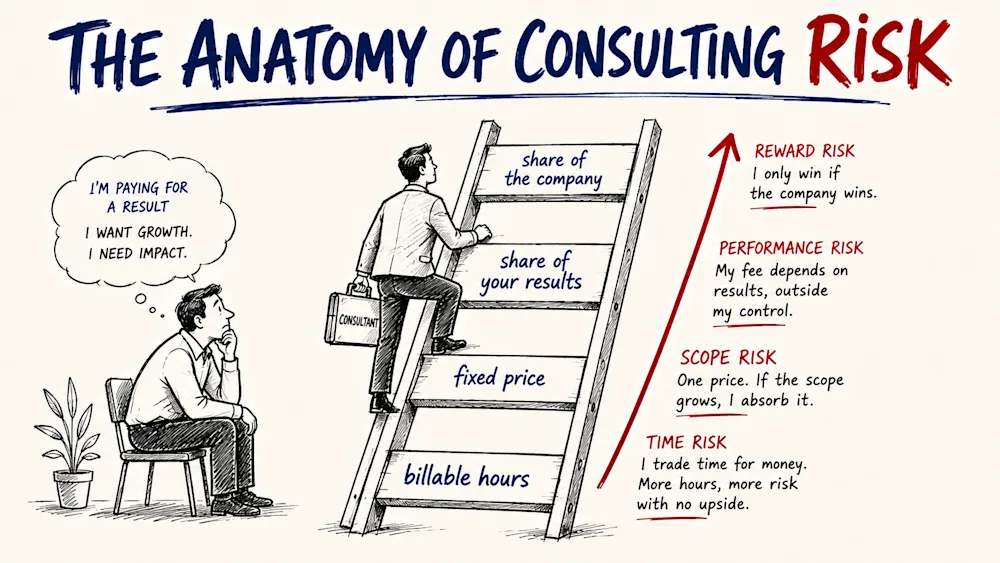
So this week's instrument is the four stages of the entrepreneurial consultant: four ways to get paid, ordered by how much risk you take. At Risk Stage #1 you are paid regardless of what happens; the money is certain, and capped. Every stage up, you hand back some certainty, take on more of the client's risk, and open the door to a bigger reward. At every stage, ask two questions. What is the client actually buying? And what does the consultant now want? The first question goes into every proposal. The second one never does, and it is the one that decides how the engagement goes.
Risk Stage #1: the hour
The client is buying your attention, live. Nothing more, and that is fine when nothing more is needed.
My coaching depth is priced this way: €200/h. One session, one problem, one way forward. No programme, no lock-in. Think about what that really is: people hire my brain for one hour. No preparation before, no reporting after. The hour is the product, the conversation is the deliverable, and it ends when the call ends.
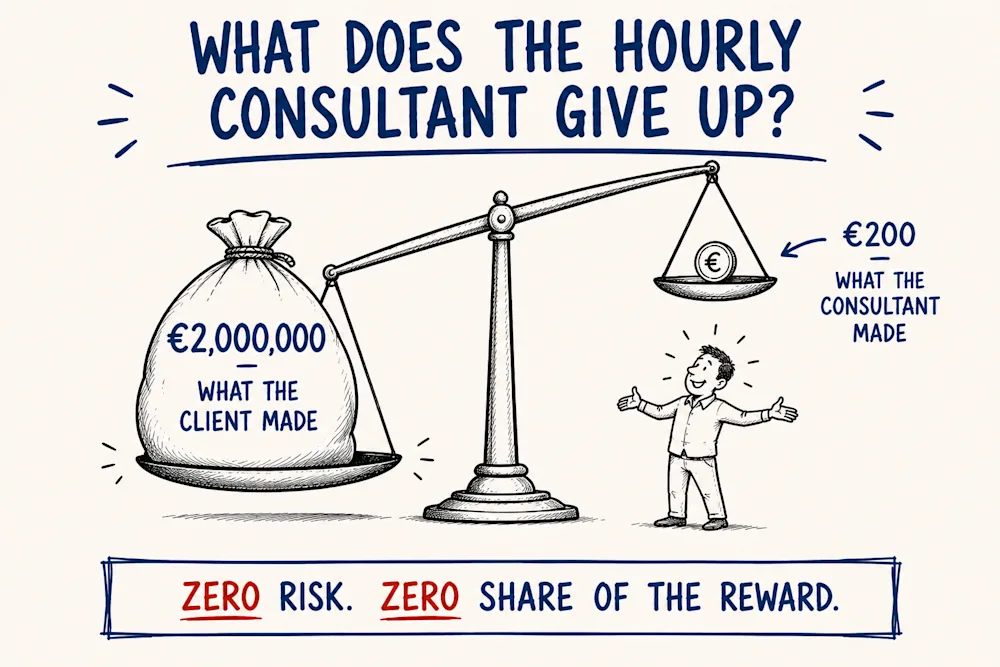
And let me be clear about something: when somebody pays me €200 for an hour, they get everything I have in that hour. This stage is not about effort. It is about the shape of the deal. My risk is zero: I am paid the moment the call ends, whatever happens next. But my reward is capped in exactly the same place. If a client takes my advice and makes two million with it, I am genuinely happy for them, and I still get paid the same €200. Zero risk, zero share of the reward. Remember that trade. The whole ladder is built on it.
Risk Stage #2: the fixed price
The next stage up is to get more involved in the work itself. Not just talking about the client's problem for an hour, but working on it: doing the research for them, digging through their numbers, coming back with a report and a plan. That is far more input, and you could still charge it by the hour. Many consultants do. But if you want skin in the game, this is where you stop selling hours and put a fixed price on a defined piece of work.
My consulting depth works exactly this way, and the business diagnostic is the cleanest example: a fixed number of days, a documented method, and a verdict at the end, at a price agreed before I start. And it works: in the last twelve months I have delivered eight-plus business diagnostics on exactly these terms, to owners who said yes precisely because the price and the end date were fixed before we started.
Notice what just happened to the risk. The client's risk dropped: they know exactly what they will pay and what they will hold at the end. Mine went up: if the work takes longer than I estimated, that is my problem, not theirs. And that changes what I want. I am paid a fixed amount, so I now want to reach the verdict in as few days as possible. Not fewer deliverables. Fewer wasted hours. Efficiency stopped being a virtue and became my margin.
Earlier this year we signed a kids-education centre that wants to franchise. Phase one was exactly this shape: a fixed fee, four weeks, a named list of deliverables. A review of their programme, a competitor map, persona research, one proposal per persona. Not once in those four weeks did we count billable hours. We hunted for every way to be more efficient, because delivering in four weeks was the only way to make money on the fixed price. The client got speed without ever asking for it. The fee model asked on their behalf.
There is a second reason the fixed price beats the hour for a diagnostic. Under one of my earlier issues, Egzona Rizmani, an entrepreneur in construction and real estate, put it better than I could: owners rarely walk through the door asking for structural change, they want the immediate pain to stop. A client who undervalues the diagnostic will never buy it by the hour, because every hour looks like homework. A fixed scope with a fixed end is the only shape they can say yes to.
Risk Stage #3: a share of the results you achieve
And then there is the third depth of working with me, the one my website calls fractional. Someone in the trenches with you, working the pipeline, coaching the team, pushing until the system produces.
There are consultants who sell exactly this work by the hour, and an hourly retainer is a comfortable thing to have. But skin in the game is what the client actually wants here. They are not buying your presence. They are asking you to be part of the results you achieve together. And mark that word, you: at this stage the bet is on the results of your own work. The stage above raises it higher.
Let me show you how I applied this in the same kids-education engagement. When phase one ended, the client did not need more documents; phase one had produced them all. They needed franchise partners signed. So phase two carries a fixed base plus a percentage of every partnership closed, and I wrote one line into that proposal that I have been quoting ever since: our role is no longer advisory, it is operational.
What do I want now? Signed partners. Not a prospectus, not a workshop, not a report. If a document does not move a partner closer to signing, I do not write it. My motivation is results now, nothing else. And my risk climbed again: if nothing closes, most of my money never arrives. That is precisely why the client agreed to share the upside. I had agreed to share the downside first.
Risk Stage #4: a share of what the company achieves
There is a fourth stage, and you will not find it on my website.
So far I have identified exactly two businesses where I was ready to take the ultimate version of skin in the game. Not the hour. Not a fixed price. Not even a share of the results I deliver myself. Equity. I chose them, and I signed: my consulting work is paid in ownership, because I trust the product, and the people behind it, enough to bet my time on the whole company.
Sit with what my motivation is now. Not billed hours. Not an accepted deliverable. Not even the outcome of my own project. My motivation is that the company succeeds. That is it. Everything I know has one job: making the whole business worth more. If it does not, my time was free. Maximum risk, and the only reward that counts.
I will be honest with you: I am still not sure I would recommend this stage to anyone, myself included. It is not for every consultant and not for every company. But when a consultant truly believes in a business, going all in stops being reckless and becomes the most honest fee there is. And standing on this stage taught me what the ladder actually measures. Every stage down protects the consultant. Every stage up serves the client.
Why take the risk now?
So why am I writing this in 2026 and not in 1996?
Because until recently, staying at Risk Stage #1 had a perfectly good excuse. Serious analysis was expensive. A proper diagnostic meant weeks of data work before the first insight appeared, and somebody had to pay for those weeks no matter how the project ended. Billable hours were never only a pricing model. They were insurance. A consultant who did not want to carry risk, and most of us were trained not to, had the perfect shelter: bill the input, promise nothing about the output. The biggest consulting firms built an industry on that shelter, a pyramid where one partner thinks and a floor of analysts bills the hours. There is nothing entrepreneurial about it, and that is by design.
AI has torn the shelter down. The data pull, the benchmark, the first draft of the deck, the model in the spreadsheet: in my own diagnostic, the data step that used to take weeks now runs in hours. I was never motivated to bill those hours. Now there are no hours to bill.
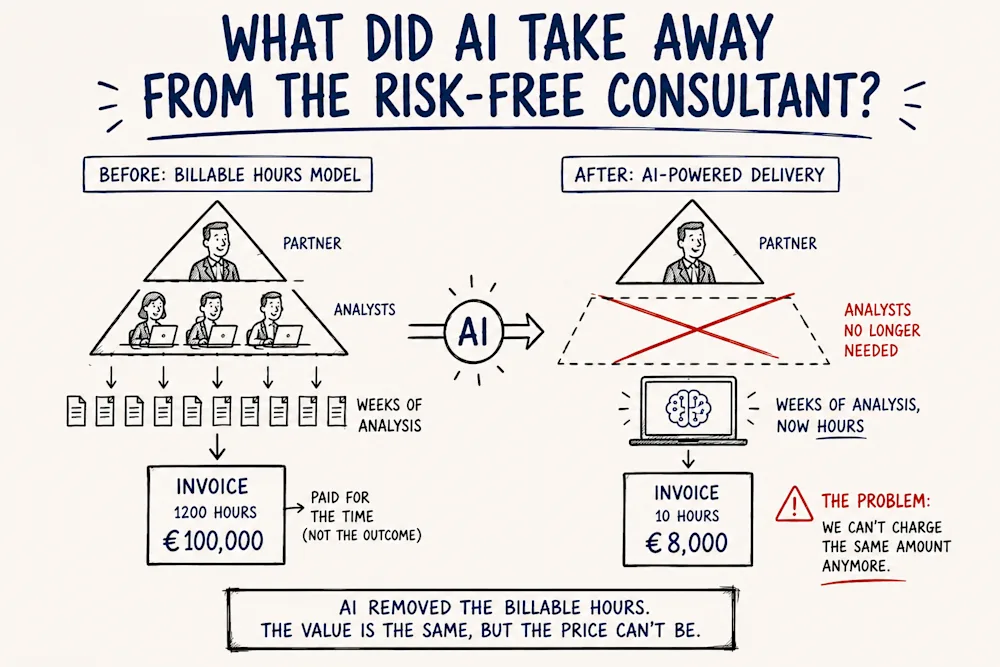
For the consultant who wants to stay risk-free, this is a genuine problem. The input they were billing is evaporating, and nothing about their model tells them what to sell instead.
For the entrepreneurial consultant, it is the opposite. When the analysis costs almost nothing to produce, I can afford to put my fee at risk on the result, and not for one client, but across several at once. Some of those bets will fail and pay me little. Some will pay me multiples of any day rate. That arithmetic has a name, and the name is not consulting. It is entrepreneurship.
So read the moment correctly. AI is a problem for consultants who refuse to take risk. For those willing to climb, it is a subsidy. There has never been a cheaper time to move up a stage: from the hour to the fixed price, from the fixed price to a share of your results, from your results to the company's. That is the moment the consultant becomes an entrepreneur: paid less for showing up, paid more for being right, carrying risk on purpose, because carrying risk has finally become affordable.
The lesson
For decades, our profession sold advice while carrying none of the risk, and clients could feel it. It is one reason the owner of a small company hesitates at your door. The four stages were always standing there. Climbing was simply too expensive.
Not anymore. AI took the cost out of analysis, and with it, the excuse.
The fee model decides what the consultant optimises for. Choose it like an entrepreneur, not like an employee of your own practice.
Two questions for the comments. Which stage does your main offer stand on? And now that the climb is cheaper than it has ever been, which stage would you dare next?
Questions readers ask
What are the four risk stages of a consulting fee?
The hour, the fixed price, a share of the results you achieve, and a share of what the company achieves. Each stage down protects the consultant. Each stage up serves the client.
What risk am I taking at each stage?
By the hour, the client carries everything and you carry time risk with no upside. On a fixed price you absorb scope risk. On a share of results you take performance risk on things partly outside your control. On equity you only win if the company wins.
When is charging by the hour the honest choice?
When the client is buying your attention live and nothing more. Coaching is priced that way in my own practice at €200/h: one session, one problem, one way forward, no programme and no lock-in.
Isn't a retainer different from hourly?
Only if it is tied to a result. A retainer with no outcome attached is hourly in monthly clothing, and it produces the same behaviour, which is protecting the hours rather than reaching the result.
Why take more risk now rather than a year ago?
Because AI removed the floor under the billable pyramid. The analyst hours that used to be the revenue now take a fraction of the time, which makes climbing a stage cheaper than it has ever been. The fee model chooses the consultant's behaviour, so it is worth choosing on purpose.
About the author
Dancho Dimkov writes Anatomy of Consulting, a publication about the practice of business diagnosis. Read more about the publication.
Stages referenced here are links in the diagnostic journey (7 links in total).