
How to Respond When a Client Asks What Is the ROI on AI?
The founder asks what it gave him
A founder put ChatGPT into his company a year ago. Half the team uses it, he pays for it every month, and now he sits across the table and asks: what is the ROI on AI, was it worth it? Or he is a week away from buying more, and asks the same question forward: what will it give us?
Most of us answer the way we were taught. We count the hours the tool saved, multiply by an hourly rate, and put the figure on the table. The founder nods at that. It is the nod of a man who does not believe the number, and he is right. I will come back to why under route 1.
The answer is a question
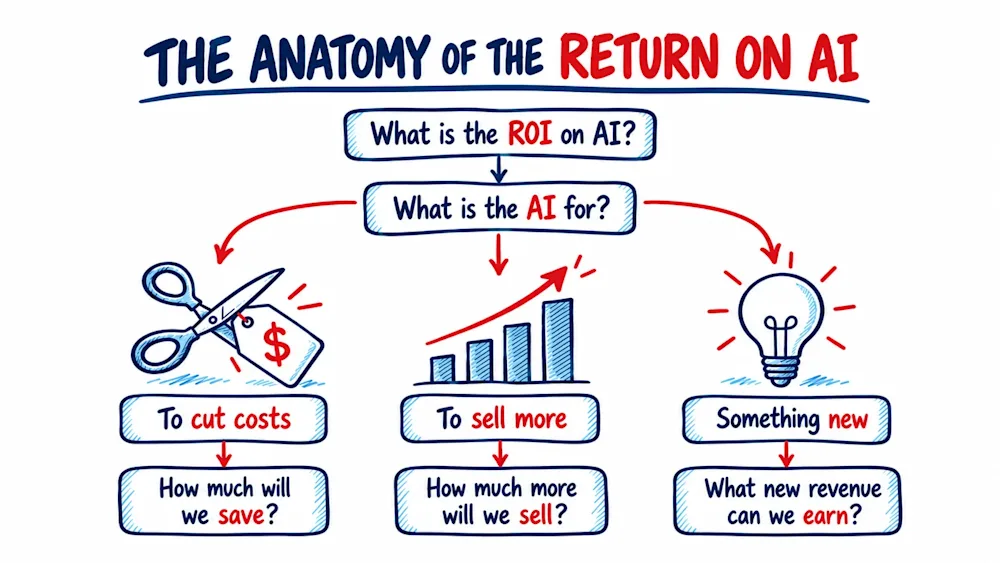
I answer with a question: what is the AI for? A founder puts money into AI for one of three things, and I call each one a route, because each pays back in a different figure, against a different baseline, on a different clock. The first and most obvious route is cost cutting, how much we can save by applying AI. The second, a bit less obvious, is more revenue from the same work: better customer support, better marketing, better sales. The third, the least obvious, is new business: a new service, a new product or a new business model that was not possible before AI.
The routes are a different thing from the four stages in the last edition: the stages say how deep AI goes into a company, from a tool on every desk to a machine that acts on its own, and the routes say what the money is for. A founder on any stage can be on any route.
In my doctoral research at UACS Skopje, on how small firms adopt AI and automation, these three are the value tracks, efficiency, service enhancement and business model innovation, and they run side by side: a firm can be far along on one and at the start of another at the same time. His answer to what the AI is for picks the route, and the return is measured on that route and on no other.
Route 1. Cost cutting
If he answers that the AI is there to cut costs, to save money, the ROI question becomes: how much will we save? And I count the saving with one question of my own: which hire did you not make?
The return is the headcount the firm did not have to add. The Economist's Bartleby column of August 2026, "How to measure returns on AI", gave that as the cleaner measure, cleaner than cutting people on the back of time saved.
The measure is that salary against what the AI cost in the same year: the subscription, the set-up, and the team's hours to learn it. The baseline is the hiring plan, who was going to be hired and when.
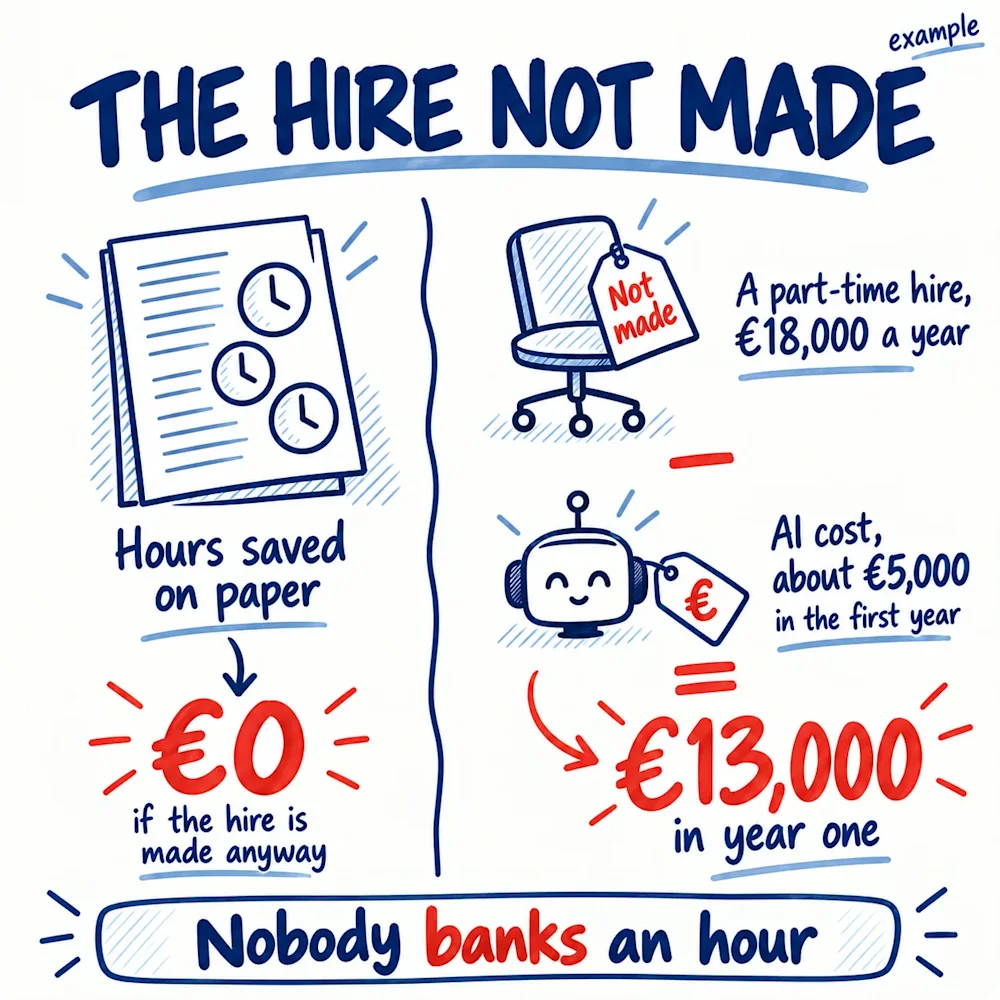
Here is an example. A small firm was going to hire a part-time support person at €18,000 a year. Instead it puts AI on the support desk, and the tool, the set-up and the team's hours to learn it cost about €5,000 in the first year. The hire not made is the return: €18,000 less €5,000, €13,000 in year one.
The clock runs in months, and the first ones show a loss, because the set-up is paid at the start and the salary not paid comes in month by month. The column cites a J-curve in AI adoption, productivity dips before it rises, and a founder who checks in month 2 is looking at that dip.
The trap is the hours. On paper the same AI frees about half a person's year, and counted at an hourly rate, that looks bigger than the €18,000 salary. But nobody banks an hour. Hours are a return only when a hire is not made or the people are moved to paid work. If the hire is made anyway, the return is €0, whatever the hours say. And if there was no hiring plan at all, route 1 has no return to show yet, and the consultant says so.
That is why the founder in the opening did not believe our figure. We handed him the paper one. The question he should have been asked is which hire he did not make.
Route 2. More revenue from the same work
If he answers that the AI is there to sell more, through better support, better marketing, better sales, the ROI question becomes: how much more will we sell? Before anything changes, I ask for the baseline: what is the number today, on this channel?
The return is revenue, or margin, on the same work: the same list, the same support desk, the same shop, earning more.
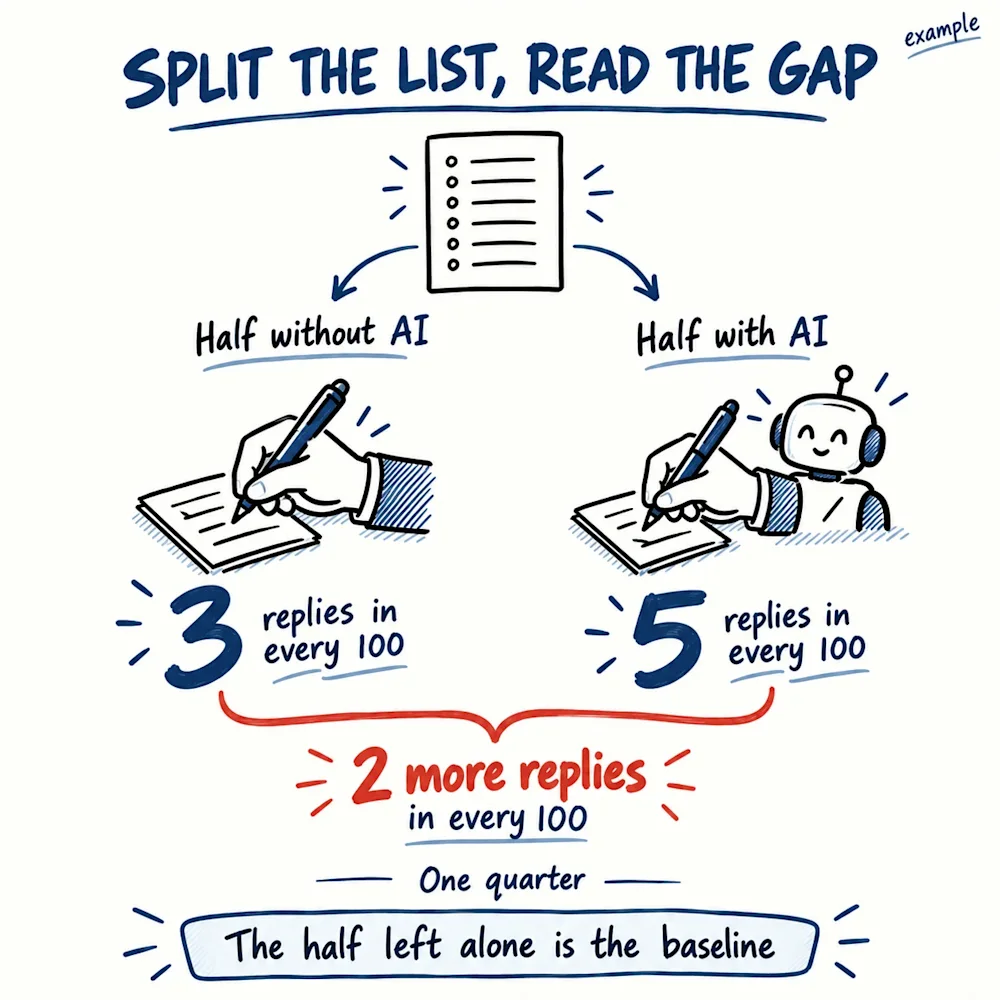
The measure is a baseline and a comparison. The column calls revenue attributed to AI "even more of an art" and asks for baseline data and A/B testing before anyone claims it. In a small firm that means one thing: split the list, half with AI and half without, for the same quarter, and read the gap.
Here is an example. Half the list gets the AI-written emails for one quarter, and half gets the old ones. The half without AI replies as before, 3 in every 100. The half with AI replies 5 in every 100. The gap, 2 more replies in every 100, is what the AI brought, and the clients those replies turn into are the return.
The clock is at least one sales cycle, and for most of the firms we work with that is a quarter; that is my rule. The first weeks of it carry route 1's dip, the team learning the tool before the replies move.
The trap is no baseline, so no attribution. Without the half left alone as the baseline, the 2 extra replies in every 100 could be the season, the new website, or a competitor closing down, and the founder will hear whichever story suits the person telling it. The split reads the direction, and a larger list reads it better.
Route 3. A new business model
If he answers that the AI is there for something new, a service, a product or a business model the firm could not offer before AI, the ROI question becomes: what new revenue can we earn? New is the key word here: revenue we could not earn before, because we had nothing like it to sell.
The return is a new revenue line, counted on its own and never mixed into the existing business.
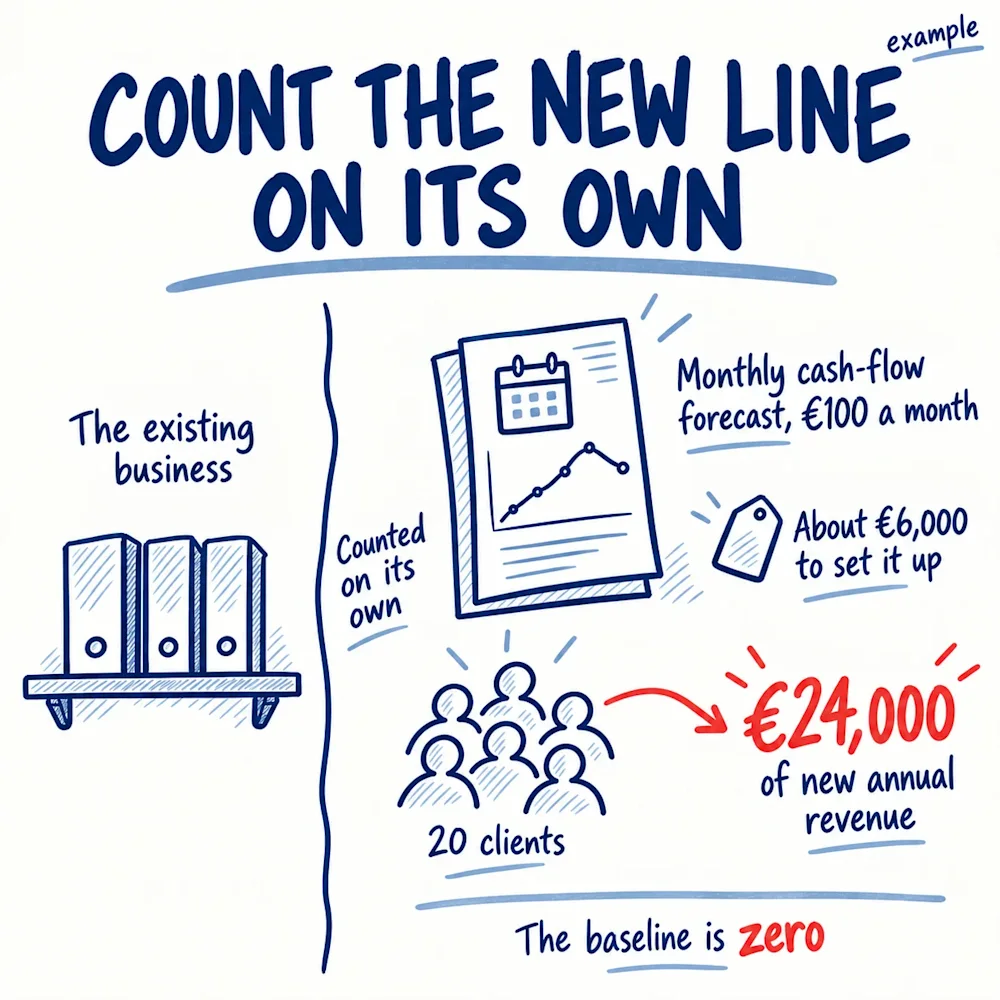
The measure is the new line's revenue against what it cost to launch. The baseline is zero, because nothing like it was sold before. An investor asks the same thing in his own words: if I give you €100K, can you get it back a million, and when?
Here is an example. A bookkeeping firm launches a monthly cash-flow forecast for its clients at €100 a month, a service it could not staff before AI. In year one 20 clients take it: €24,000 of new revenue, against about €6,000 to set it up.
The clock is longer than on the other two routes, months to a year, because a new line has to find its buyers. The first test it passes is the rule I give founders who want to build something new on AI: "Sell it to five clients and let them pay for the build."
The trap is judging the new line with the old business's numbers. Counted as a route 1 saving, the forecast shows nothing, because nobody was ever going to be hired for a service that did not exist. Credited with the bookkeeping fees those 20 clients were already paying, it shows a return it never earned. The forecast is its own €24,000 against its own €6,000, and nothing else.
The instrument
Here is the three-route card, the whole of it in one table.
| Route | His answer to: what is it for? | The ROI question it becomes | The return | The measure | The clock |
|---|---|---|---|---|---|
| 1. cost cutting | To cut costs | How much will we save? | The hire not made | That salary against the AI cost; baseline, the hiring plan | Months, the first ones at a loss |
| 2. more revenue from the same work | To sell more | How much more will we sell? | Revenue on the same work | Half the list with AI, half without; baseline, today's rate | A quarter, one sales cycle |
| 3. a new business model | Something new | What new revenue can we earn that we could not before? | A new revenue line, on its own | Its revenue against the launch cost; baseline, zero | Months to a year |
What it was bought for
The return on AI is the answer to what it was bought for. Here is an example of the question skipped. A firm buys an AI sales assistant for €2,000 to win clients, route 2. A year later the accountant counts the hours it saved, because that is the figure he has, and calls it paid back. Nobody asked for the two clients the founder believes it brought, and nobody asked which hire was not made. Bought on route 2, counted on route 1, and the route 1 figure wins by default. Whatever number he puts on the AI now is two clocks and two baselines pretending to be one figure.
So, before you count anything, ask the client what the AI is for, and read his answer against the three-route card.
What did your last client want the AI for, and what did you measure?
If this is the kind of thing you want on a Monday, subscribe to Anatomy of Consulting on LinkedIn.
Questions readers ask
My client bought AI a year ago and never counted. Where does the baseline come from now?
The baseline starts today. Whatever he changes next, split from that change, half with and half without, and count the next quarter; the year he did not count is gone. That is my rule, and I have not found a better one.
The client says the AI is for all three. How do I count that?
One budget, three measures, three clocks. Count the route his first answer picked, and give the other two their own baseline before a cent goes in: the hiring plan for route 1, today's rate on the channel for route 2, nothing sold yet for route 3. A firm that puts AI on the support desk and runs the outreach test in the same quarter counts the hire first and splits the list before the sequence is written.
How do I put the three routes in front of a partner or a bank on one page?
The three-route card on one page, with the route the money is for marked, and under it the one figure for that route on its own clock. The other two routes stay on the card without a figure until each has a baseline of its own.
The client wants one number. What do I give him?
The number for the route his first answer picked, in that route's own measure, and the other two named out loud as not counted. A second figure needs a second baseline and a second clock, so it waits until he has them.
About the author
Dancho Dimkov writes Anatomy of Consulting, a publication about the practice of business diagnosis. Read more about the publication.
Stages referenced here are links in the diagnostic journey (7 links in total).