
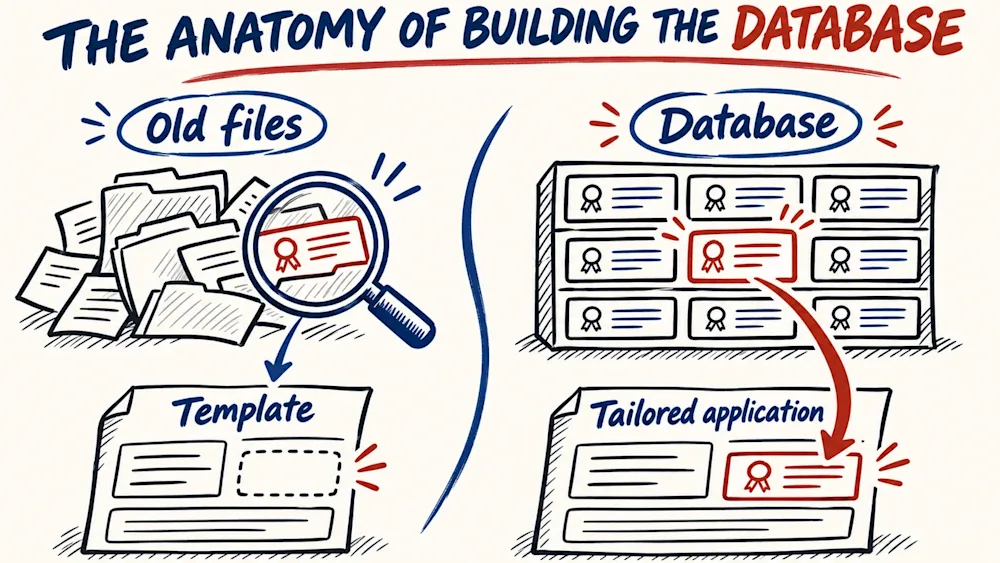
Build the Database Once. Let AI Do the Manual Work.
As consultants, we repeat the same manual work, client after client and call after call: the CV, the references, the proposal, the material from past sessions. AI can take that work over, but only from a database built once.
A call for experts shows it best, because it used to go the same way for me. It arrives with its own CV template and its own guidelines, my CV template is ready, our proposal template is ready, and I still lose the afternoon. Which version of my CV had the diagnostic work described properly? Which of our engagements is closest to this buyer, and where is the file that says what we actually delivered, not what we offered? The template knows exactly where everything goes. It has no idea what goes in.
In AI Is Easy, If the Data Is Structured I wrote about the client's data, the invoices and the sales files. This autumn I turned the same rule on my own records: my CV, our client portfolio and my advisory sessions with founders. The template had saved me the formatting, and the formatting was never where my hours went. My hours went into finding the evidence and checking it, from zero, every time. Once the evidence sits in a database, AI does the finding, and the afternoon I save on this call I save again on the next call, the next proposal and the next client.
Three ways to do the work you keep repeating
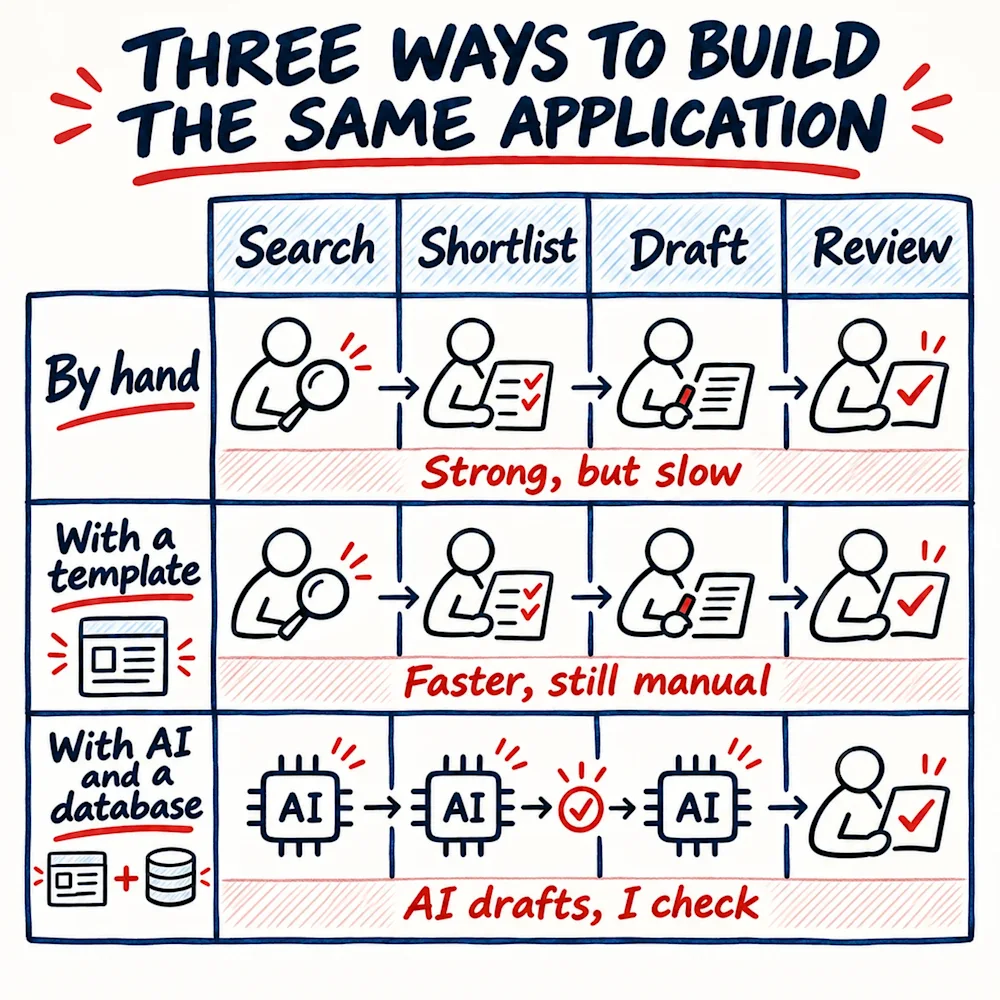
Every piece of that repeated work can be done three ways, and an application for a call shows them best. I have done it all three ways, and I think most of us are still on the second one. One thing makes the first two expensive: each call for experts comes with its own templates and its own guidelines, so what I already have never fits directly.
- By hand. I read the request, go through my old files, pick what fits and write the documents for this one application. The advantage is real: I tailor-made it, so it is a genuine, strong application. The cost is that it takes too much time to build from scratch, every time.
- With a template. The template saves time, because I do not start from scratch. But the next call asks me to follow its template and its guidelines, so I take my existing CV and references and apply them to their format, which is still a lot of manual work. The template gives me a box for a relevant project. It cannot tell me which project deserves the box.
- With AI and a database. I point AI at the call, the guidelines and the template included, and at my records, and it does the rest: it searches, shortlists and drafts in the format the call asks for. On top of that, AI tailors the wording of every part to fit the call. I ask it to show me which record supports each choice, and I review the examples and the wording before anything goes out.
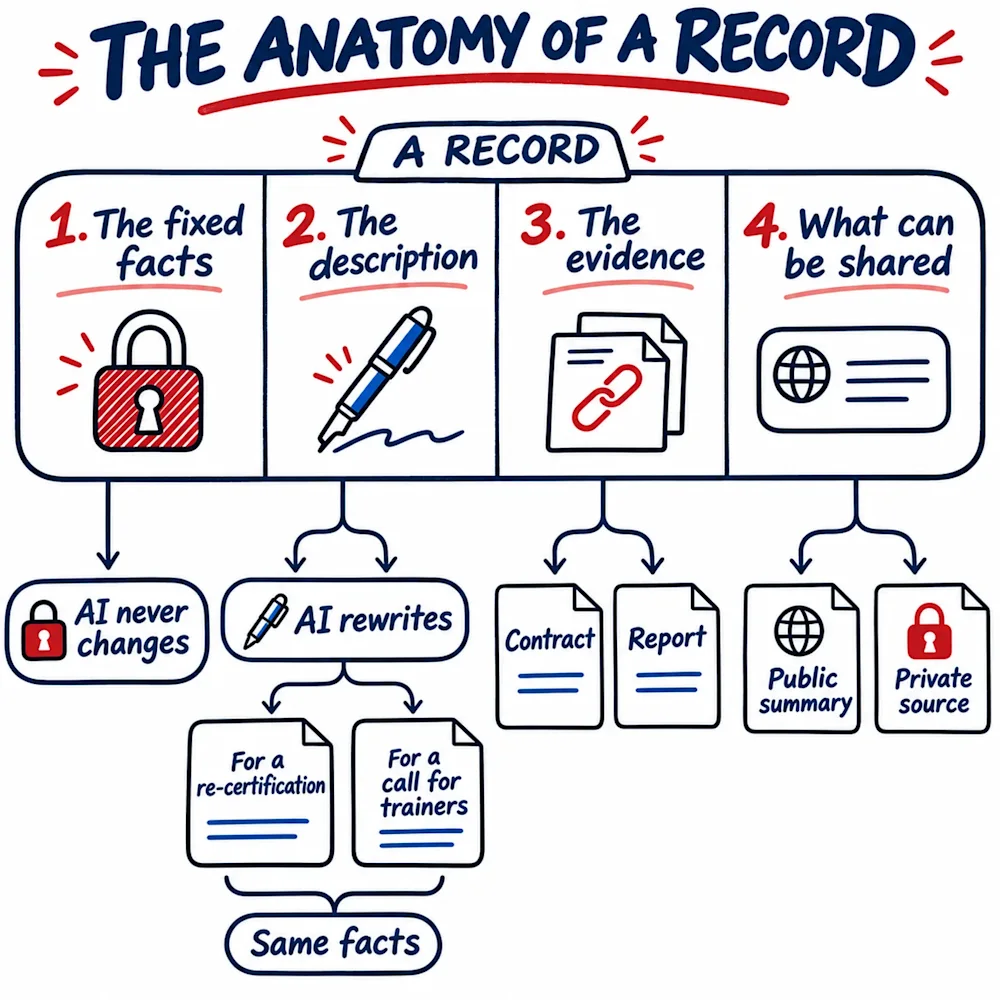
The anatomy of a record
A spreadsheet is enough to start. I call it the master: the table where the row lives and where every correction is made. I keep one per set of records, so mine are three. What makes it a database AI can work with is that every row is one thing, one project or one session, and every row has the same four parts.
- The fixed facts are the year, the organisation, the title, the location and the role. They are written once, corrected only in the master, and AI never improves them. Here is an example, a row from my own CV: 2025 to 2026, a donor-funded women's entrepreneurship programme, trainer and mentor, North Macedonia, under contract.
- The description is the one part that changes with the reader. AI rewrites it for the call. The same row, for a reader re-certifying me as a management consultant: "30 consulting days under contract: a needs assessment, workshops, one-to-one mentoring, and a programme report at the end." The same row, for a call for trainers: "Trained 70 women in three towns and ranked all 59 business plans they wrote." Same facts, different reader.
- The evidence is a pointer to the file that proves the row, the report or the transcript. For that row, the signed contract and the programme report. If I still have to open the same stack of files to know what a row means, I have built an index to the old search, not a database.
- What can be shared marks the row: public CV, proposal only, or never leaves the folder. That row is public. The contract behind it is not.
Back to the September call. It asked for three things: evaluation experience, expertise in its field, and advisory experience with founders. Consulting is the research and the report: we find out what is wrong and write it down. Advisory is working directly with the founder and the leadership team to reach their goals. Each of the three lives in a different set of records.
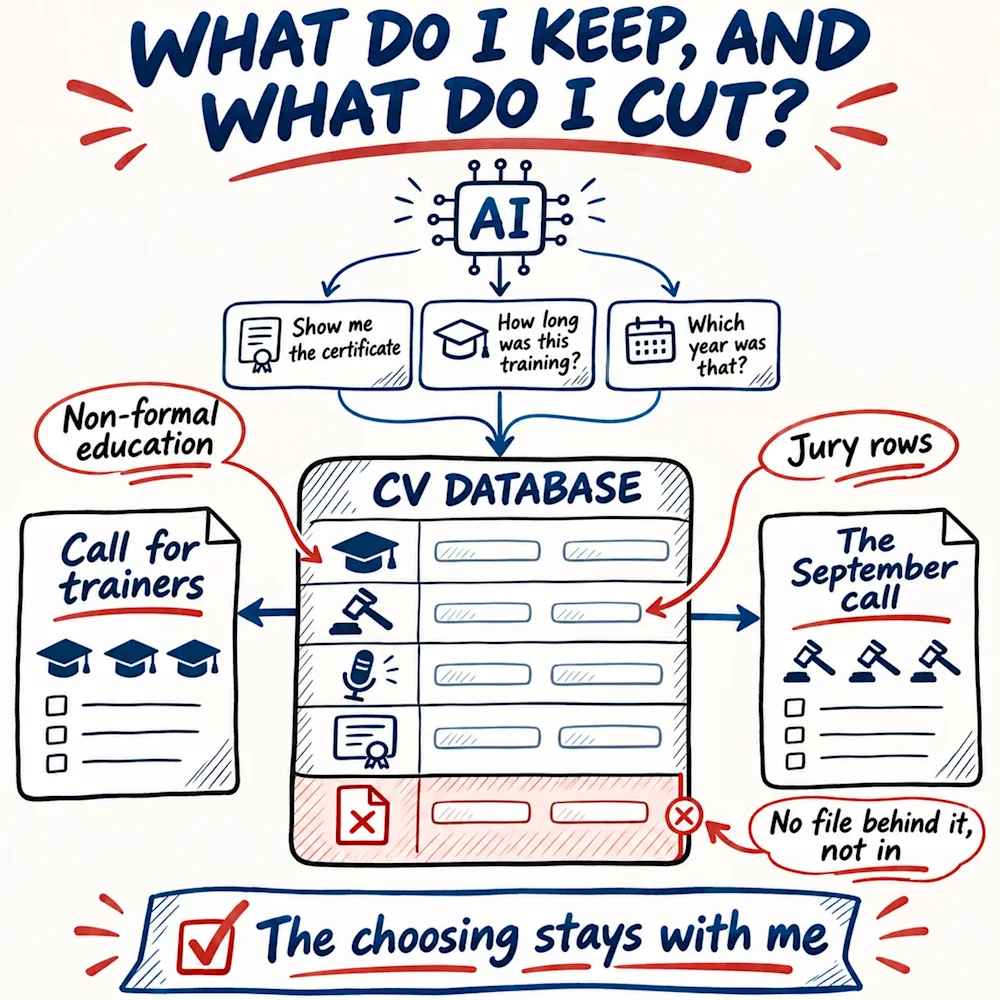
My CV. What do I keep, and what do I cut?
Meeting the requirements gets me into the pile. The decision is what deserves space once I am in it.
The database came first, and it took me a week. I collected everything from my professional life into it: education, work, non-formal education, public speaking, publications, juries. AI was the one finding the gaps: show me the certificate, how long was this training, which year was that. Filling those took a good part of the week.
Then the engine on top. Two examples from this autumn, both with their own guidelines and their own CV template. The first was my re-certification as a management consultant. AI downloaded the documents from the email, read the template, rebuilt my CV from the database into it, and then worked the wording so that every row spoke to a management consultant reading it. The second was a call for trainers working with young people. Same database, and the CV came out about youth training: AI took the non-formal education rows that matched the call, put them first and tweaked the wording. For the September call it swapped in the rows where I had sat on a jury or scored business plans and put the call's own words into the descriptions. The fixed facts stay fixed, only the descriptions move, and the choosing stays with me, with one rule on top: a result with no file behind it does not go into an application. When AI hits a gap, it flags it and points to the record, and I decide what to do with it.
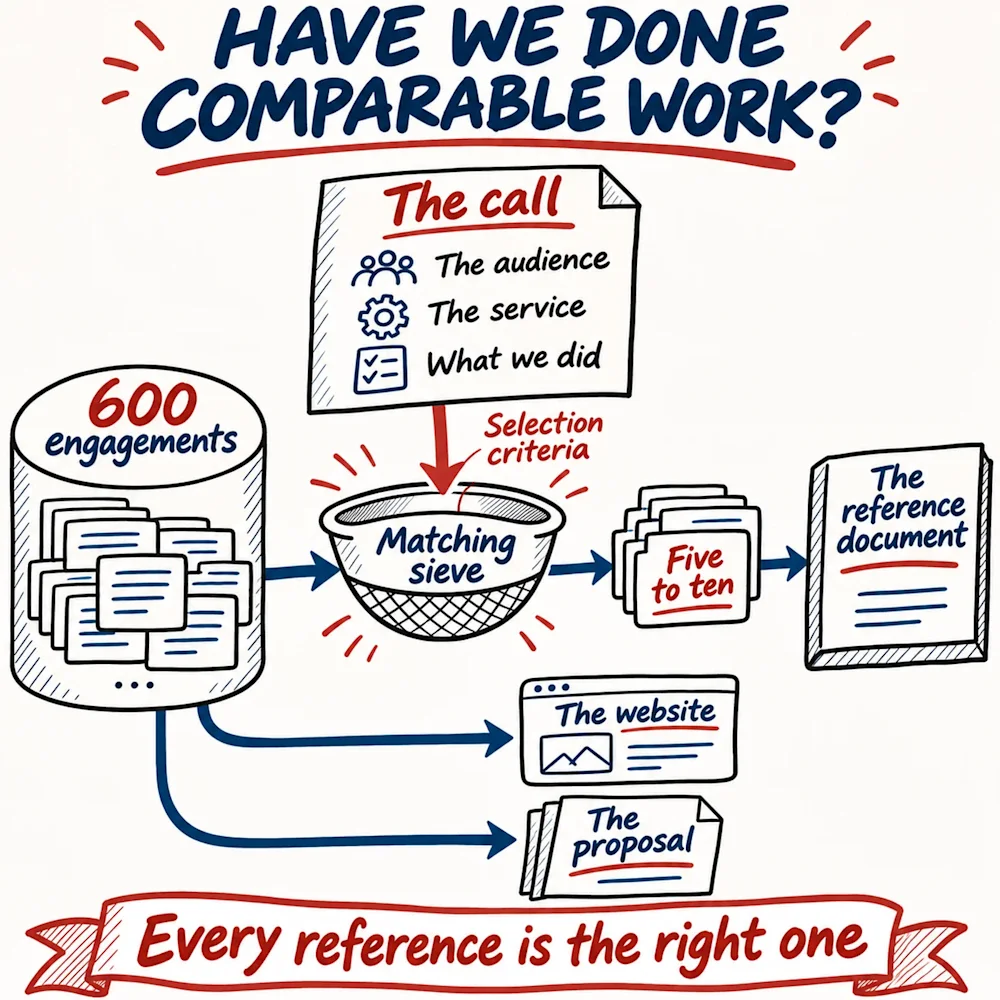
Our consulting references. Have we done comparable work?
When a buyer asks where we have done this before, the portfolio has 600+ engagements to choose from, and a proposal carries two or three.
For 600 engagements the database took me two weeks. The gaps were in the contracts, the pricing and other fields I had to fill by hand, and AI helped here too, finding each client's website and industry. In the workbook the client's industry, the audience we worked on and the service we delivered are separate fields, with room for what we did, the result, and a link back to the project files.
With the engine on top, the September call got its reference document from those rows. AI read all 600 against what the call asked for, picked the five to ten that came closest, and the document showed only those. A list of everything we have done buries the good references among the ordinary ones, and the reader stops looking before he reaches them. Five to ten that fit the call is a document where every reference is the right one. What lets AI find them is the audience, the service and what we did, each in its own field, not a familiar name.
Two things came on the side. The first is the website. The same rows now sit on our website as a portfolio, one entry per engagement, each named by the work and the kind of client instead of the client's name, such as lead generation for a Norwegian data security company, and each labelled by service, from outreach campaigns to market research and consulting. A buyer who searches for that kind of work, or asks an AI tool who has done it, lands on an entry that describes exactly that. Every entry is one more piece of public evidence that we have done the work, which gives us a far stronger presence in search and in AI answers than a page that only says what we offer.
The second is the proposal. When a new prospect asks for one, AI does what it did for the September call: it reads the rows against that prospect and picks the references of companies exactly like his, the same kind of business and the same service. The prospect reads about work we did for businesses like his own, not a list of our best-known names, so the question of whether we have done this before is answered before he asks it. The proposal starts from his world, and the references are the proof that we have already been in it.
My advisory sessions. Can I work with the people who have to make the changes?
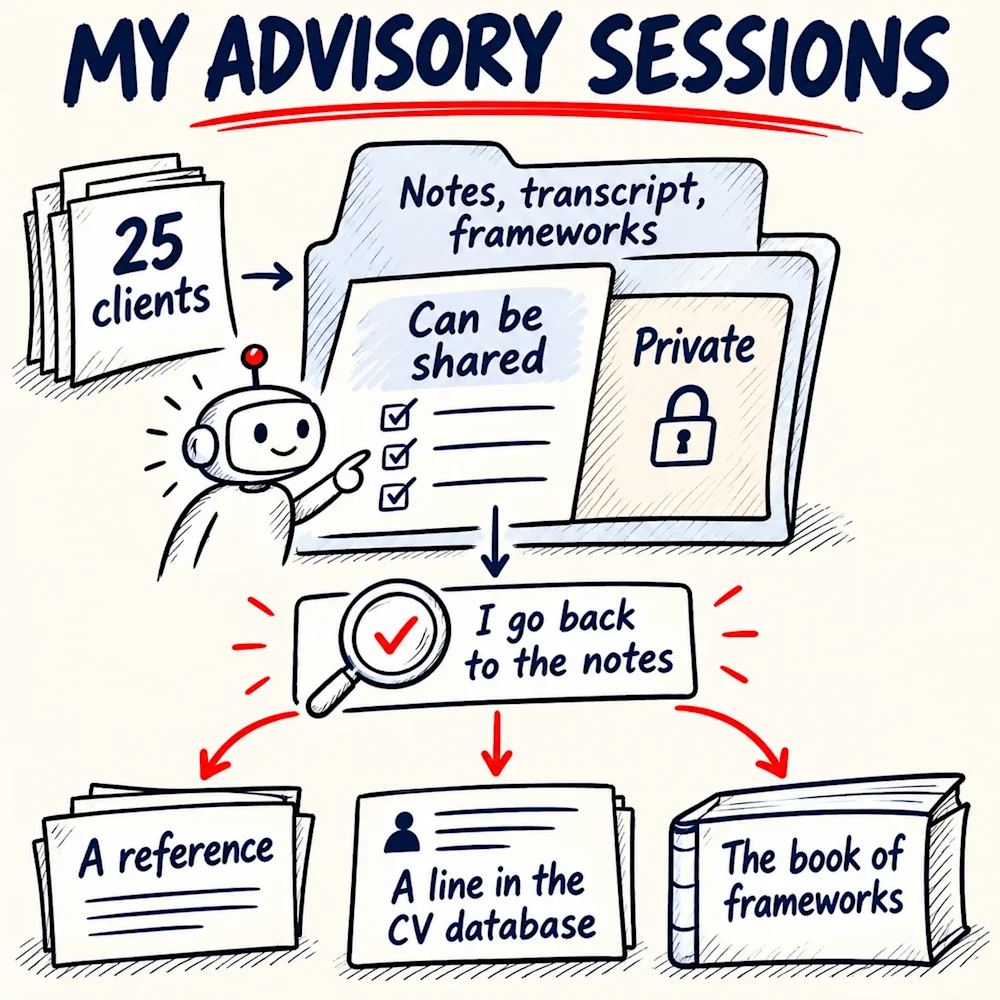
The consulting reference shows how we worked out what was wrong. The advisory reference has to show what it is like to work with me once the founder and his team have to do something about it.
That database took me one week: every founder I have worked with one to one, 25 clients, each with a record, and a second table with one row per session. The hard part was finding them. Most came through my personal profile on a freelance marketplace and paid outside its contracts, so the contracts did not show them. The message rooms and the payment emails did. Each record points to the notes, the transcript and the frameworks I used. Once I had it, I could use it for the calls. AI shortlists from the part of the record that can be shared, and I go back to the notes before anything goes in. Here is an example of a line that survives the check: "Helped the leadership team assign an owner to each action and agree how they would follow up." A line the notes do not support does not go in, and nothing private does either.
The other benefits are the ones I did not build it for. Every session where I used a framework is now findable, and that record is the material for the book of frameworks I am writing. Each client also gets a line in the CV database and a reference when a call asks for one, so the three databases feed each other.
One month, three databases
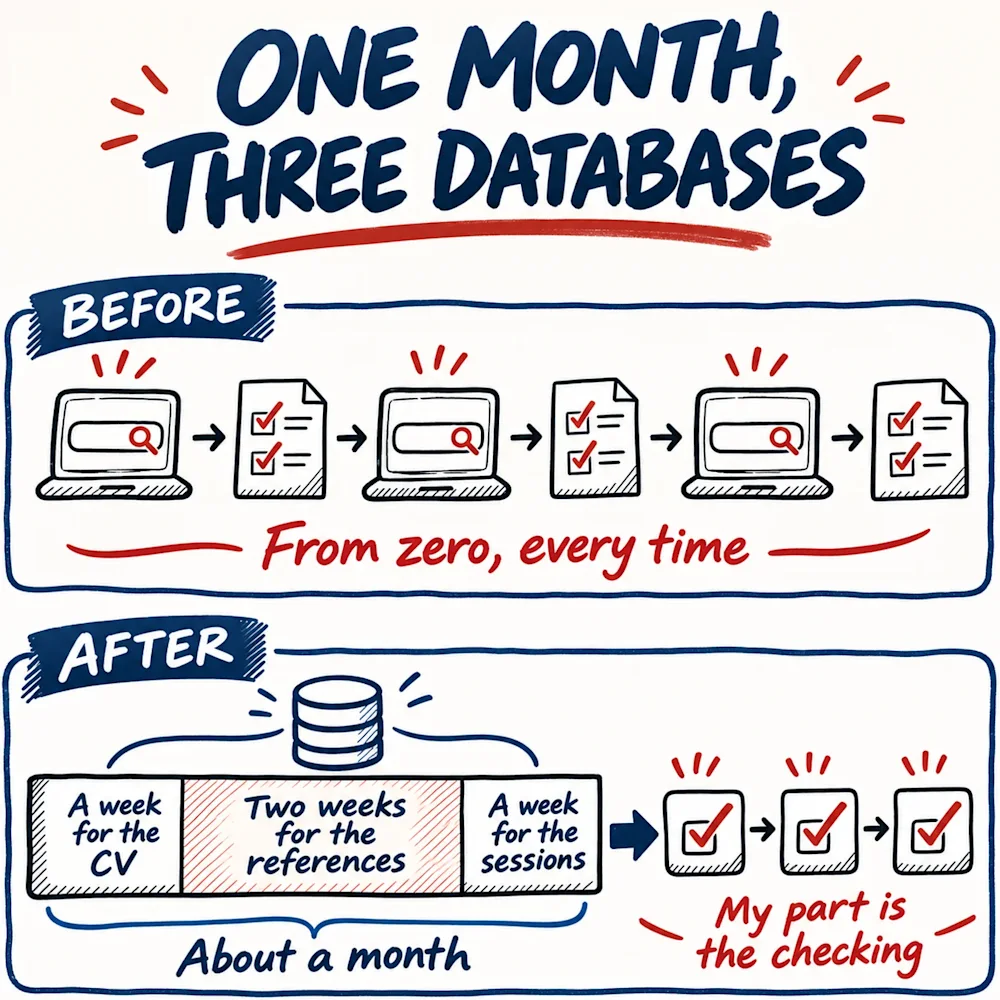
A week for the CV, two weeks for the references, a week for the sessions: about a month of setting up three databases around me. Since then the calls, the proposals, the website and the book all run fast from the same rows, and my part is the checking. I built the databases for the calls, and the rest came on the side, because the databases exist.
Start with the document you keep rebuilding
If you rebuild the same document for every client or call, that is your first database. Write down what you go looking for every time, and put a handful of those into a table with the four parts. Give AI the next client or call and the template you already use, and ask it what it would include and why, with the record behind each choice. Whatever you still have to look up is the next column.
The hours go into building the database once. After that, adding a row is almost zero effort: a new training in the CV, a finished engagement in the references, a new session in the advisory database. The next time I need them, they are ready and up to date, as long as the row is written in time.
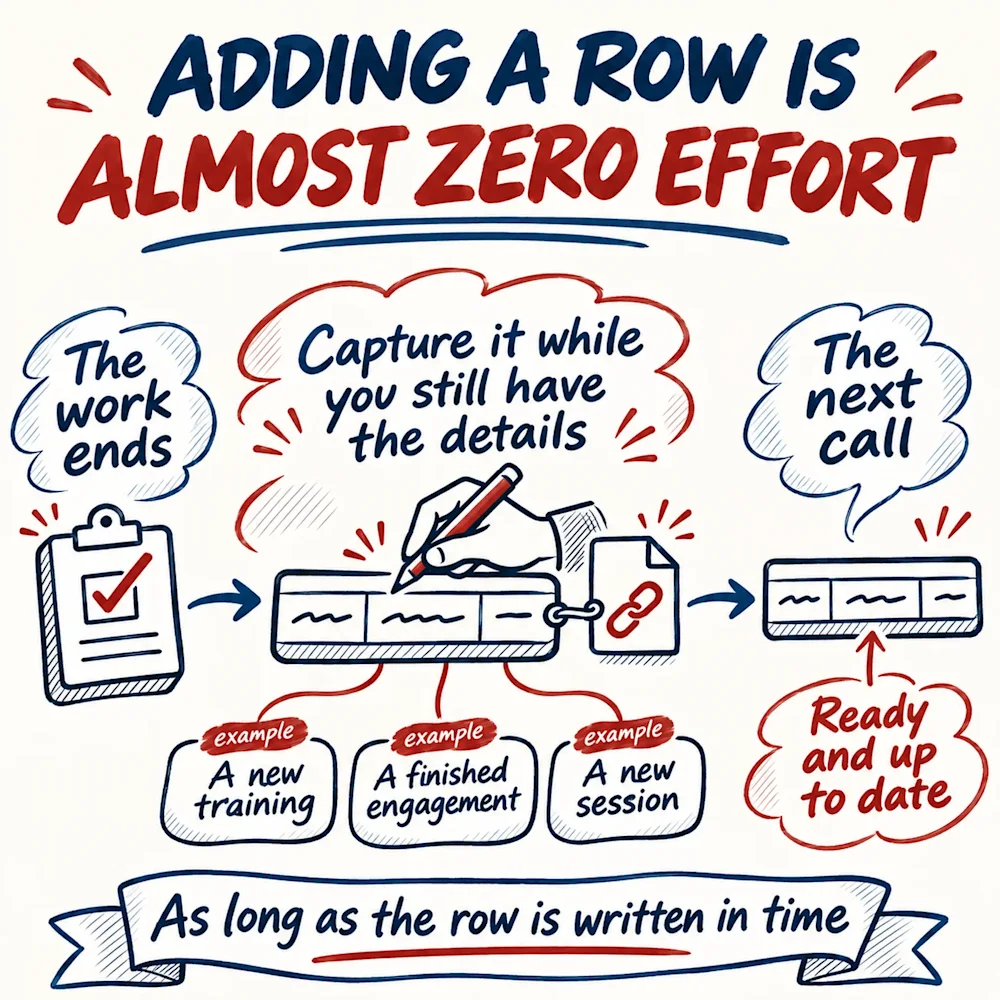
Capture the work while you still have the details and evidence.
Which document do you rebuild from scratch for every client or call, and what is the first thing you go looking for?
If this was useful, subscribe to Anatomy of Consulting on LinkedIn, and the next edition comes to you.
Questions readers ask
What makes a consultant's CV and portfolio AI-friendly?
One row per project, role or session, and every row with the same four parts: the fixed facts AI never changes, a description it rewrites for each client or call, a pointer to the evidence, and a mark for what can be shared. A spreadsheet with those four parts is already a database AI can search.
How long does it take to build the databases?
About a month for me: a week for the CV, two weeks for 600 client references, a week for the advisory sessions. Most of that time went into the gaps AI found: a missing certificate, a training with no length, a contract with no price.
What should AI do when a record has no evidence for a result?
Flag the gap and point to the record. Then you decide: look for the evidence, describe only the work you can support, or pick another reference. A result with no file behind it does not go into an application or a proposal.
Should I combine my CV, portfolio and advisory records into one database?
Keep them separate if they have different owners, fields or sharing rules. Mine are three sets, and for one application or proposal I give AI the records it may use from each and tell it what each set is for.
How do I stop tailored CVs from drifting apart?
Correct dates, titles and roles in the master record, never in a generated CV, or the next draft brings the old error back. Let the description change with the application; the fix for a wrong fact always goes into the master.
About the author
Dancho Dimkov writes Anatomy of Consulting, a publication about the practice of business diagnosis. Read more about the publication.
Stages referenced here are links in the diagnostic journey (7 links in total).