
The Layer That Keeps Consultants Irreplaceable
Every client who calls about AI says almost the same thing. "We want to use AI to cut costs." Sometimes it is "automate this," sometimes "do more with fewer people," but the wish underneath is the same: spend less.
Edition 2first published on LinkedIn
Every client who calls about AI says almost the same thing. "We want to use AI to cut costs." Sometimes it is "automate this," sometimes "do more with fewer people," but the wish underneath is the same: spend less.
Here is the trap, and it is a trap for us consultants more than for them. If we take that brief at face value and run an efficiency project, we have just done the one piece of AI work a free chatbot could have done for the client without us. We made ourselves easy to replace, on our own job.
I will say it plainly, and you can argue with me by the end: most of the AI work being sold to clients right now makes consultants more replaceable, not less. This issue is about how to flip that.
So before you scope the next AI project, it helps to see the whole map. AI value does not come in one size. It comes in three layers. The first half of this issue is the WHAT: the three layers, the framework worth saving. The second half is the WHY: why almost everyone, the AI tool included, stops at the bottom one. Where the two meet is where your fee lives.
The framework (the WHAT): three layers of AI value
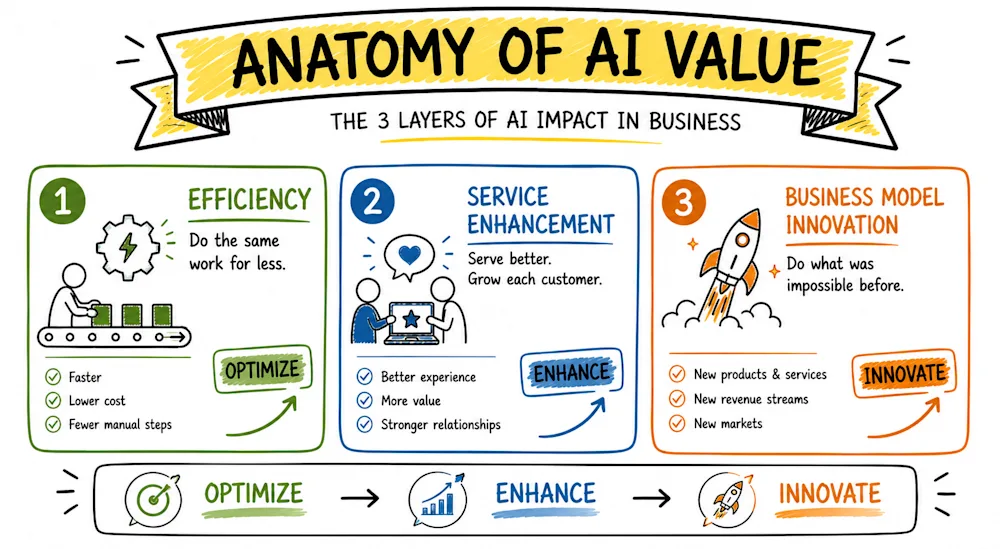
Think of AI value as three steps on a ladder. Most companies stand on the first step and never look up. Here are all three, in plain terms.
Layer 1 - Efficiency: do the same work for less
This is the obvious one. Take what you already do and make it cheaper and faster. Fewer manual steps, less time, lower cost. Draft the email, sort the data, answer the first support question.
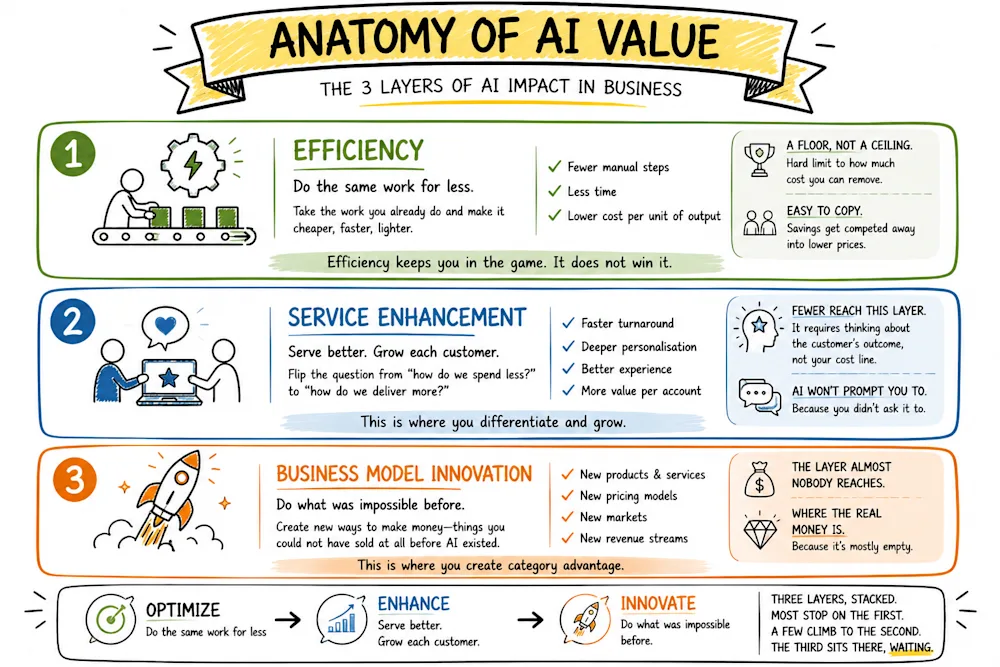
It is real, and worth doing. But two things are easy to miss. First, it has a floor: you can only cut cost down toward zero, no further. Second, everyone gets the same tools, so the saving does not stay yours for long. Your competitor copies it, and the saving turns into a lower price for the customer. Layer 1 keeps you in the game. It does not win it.
Layer 2 - Service enhancement: serve better, grow each client
Here you stop asking "how do we spend less?" and start asking "how do we give more?" You take the time AI frees up and put it back into the client: faster answers, more personal service, a better experience, more value in each account.
Fewer firms get here, and the reason is simple. It means thinking about the client's result, not your own cost line, and AI will not nudge you to do that, because you only asked it to cut costs.
Layer 3 - Business model innovation: do what was impossible before
This is the different one. It is not a cheaper or nicer version of what you sell. It is something you could not sell at all before AI existed: a new way to make money that the tool just made possible.
Almost no one reaches this layer. That is exactly why it is where the real money is. It is mostly empty.
Three layers. Most stop on the first, a few reach the second, the third sits there waiting. Save this part. It is the map you can hold up against any client's AI plan and ask one question: "which layer are we actually on?"
Same ladder, real businesses
The famous warning is Kodak. We remember it as the company that missed digital. It did not miss it. It invented the first digital camera. It missed the layer. It kept using efficiency thinking to protect its film profits, when the moment called for layer 3: a new business for a world that no longer needed film. It made the old thing cheaper instead of replacing it. I wrote a version of this for ICMCI (the International Council of Management Consulting Institutes, the global body for the consulting profession): the first job is to read which kind of value the situation needs, not the kind that feels safe.
You do not need to be a giant to climb. A B2B outreach agency automated its lead lists and first drafts (layer 1), put the freed time back into clients and built a portal to deliver more (layer 2), then sold a brand-new thing: AI-run outreach, and an AI agent that runs whole campaigns on its own (layer 3), a product that could not have existed a few years ago. A search agency went from faster keyword work, to deeper research, to a new service: getting clients quoted by AI answer tools, not just ranked on Google. A marketplace put an AI helper in front of buyers that turns plain questions into the right matches. Same ladder, very different shops.
The trap (the WHY): why everyone stops at the bottom
Here is the part almost no one stops to think about, and it is the heart of this issue. Why does almost everyone, the AI included, reach for cost-cutting first?
Start with how AI is built. It learned from almost everything people have ever written, and it gives back the most common answer. That sounds harmless. It is not. We are teaching AI on the average human and then asking it for a genius.
And the average is not the clever middle. Think about who fills the internet. The people who really know their field tend to check their work and post less. Everyone else posts far more, and far rougher. So the pile AI learns from leans toward the basic and the half-right. The most common answer was written by the people with the most time to write, not the most to say. AI does not hand you the smartest answer. It hands you the most repeated one, and the most repeated one is rarely the smartest.
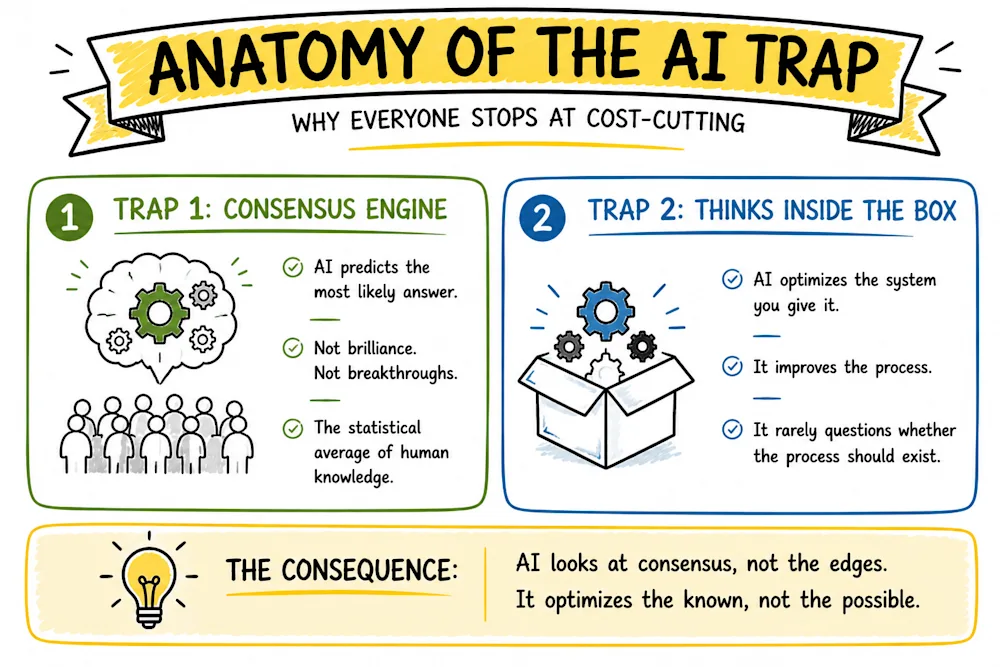
There are two traps hiding in that. Naming them is what makes a consultant stop and think.
Trap 1 - it executes the task; it does not question it. Most people, most days, are not paid to challenge the whole system. They get a task and they do it. That is normal. But it means the writing AI learned from is mostly people carrying out tasks, not people stepping back to ask "should this task exist at all?" So AI does the same. Hand it a job and it runs straight at the job. It will make your process cheaper. It will not ask whether the process, or the whole way the client makes money, should still be there.
Trap 2 - it follows the crowd. Every real breakthrough came from the few who thought differently, the ones whose idea looked wrong until it looked obvious. AI is built to give the most likely answer, which is the most common one, so it quietly sets the rare idea aside and hands you the safe one. Asking today's AI to invent your client's new business is like asking "the average of everyone" to design something no one has ever seen. The average never invents. It blends.
Put the two together and you get the thing almost no one says out loud. The higher you climb the ladder, the less AI can help. Layer 1 is everywhere in what it read, so it is strong there. Layer 3, a brand-new business model, barely shows up in what it read, so it is weakest exactly where the prize is. This is the line worth rereading: AI is loudest where the value is lowest, and quiet where the value is highest.
So here is where you come in as a consultant
Now the WHAT and the WHY click together. The WHAT says the money is on layer 3. The WHY says AI is weakest on layer 3. That leaves one obvious place for the consultant to stand.
Use AI without shame on layers 1 and 2, where it is strong. Let it cut costs and sharpen service. But layer 3, the new business model, is human work, and right now that human is you. Reading which layer the client really needs, and doing the layer-3 thinking the tool cannot, is the part of the job that does not get automated. Your value did not go down with AI. It moved up the ladder.
So the next time a client says "help us use AI to cut costs," you have a better answer than "sure." You can show them the ladder, point at the empty top step, and be the one person in the room who can help them reach it.
That is my claim. Now I want yours, in the comments, and I mean it. Two things. First: have you seen AI actually invent a layer-three move - a real new way to make money, not just a cheaper version of the old one? Show me, I am collecting these for my DBA dissertation. Second: if you think I am wrong, that AI can reach layer three on its own, tell me where my logic breaks. I would rather be corrected here than in front of a client.
And the smaller question, for your next AI scoping call: when a client says "cut costs with AI," which layer do you hear, and which one do they actually need?
Questions readers ask
What are the three layers of AI value?
Efficiency, doing the same work for less. Service enhancement, serving each client better and growing the account. Business model innovation, doing what was impossible before. Most AI work sold to SMEs never leaves the first layer.
Why do clients always ask for the cost-cutting version?
Because it is the only layer they can picture. A client saying "use AI to cut costs" is describing the outcome they can already imagine, not the one worth the most to them. If you take that brief at face value you deliver the cheapest version of your own work.
How do I move a client up from efficiency to the higher layers?
Ask what the freed capacity is for before you automate anything. Efficiency answers what the company stops spending. Service enhancement answers what each client now gets. Nobody buys layer three from a proposal that opens with headcount savings.
Why is this layer the consultant's moat?
Tools get cheaper every month and anyone can resell them. Deciding which layer a client's problem actually sits on is a judgement about their business, and no vendor will make that call for them.
What happens if a company only ever does layer one?
It gets a slightly cheaper version of the business it already had. Kodak had the technology and routed it to the bottom layer, protecting the existing model instead of building the new one.
About the author
Dancho Dimkov writes Anatomy of Consulting, a publication about the practice of business diagnosis. Read more about the publication.
Stages referenced here are links in the diagnostic journey (7 links in total).