
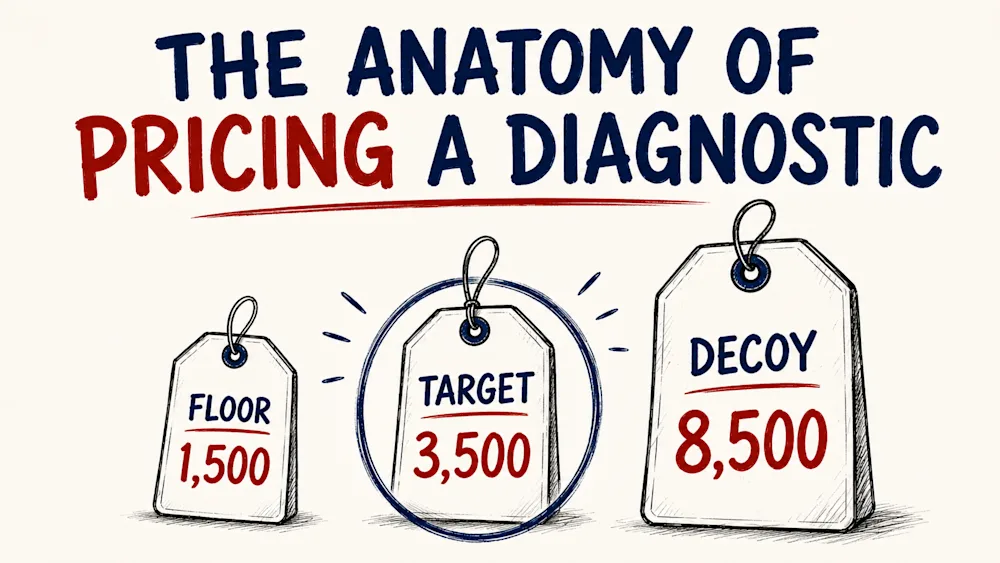
Let Them Compare You With You: Why Your Best Offer Should Never Stand Alone
Last week I showed you the ladder that carries a stranger to the diagnostic conversation. So let us say the ladder worked. The prospect climbed, the call happened, they want the diagnostic. And now comes the moment that undoes more consultants than any objection: you say a number.
Edition 15first published on LinkedIn
Last week I showed you the ladder that carries a stranger to the diagnostic conversation. So let us say the ladder worked. The prospect climbed, the call happened, they want the diagnostic. And now comes the moment that undoes more consultants than any objection: you say a number.
Most of us say one number. Alone. And then we hold our breath.
There is a strange contradiction in our profession. We advise clients to charge for value, we preach premium positioning, and then we price our own work like we are apologizing for it. But today I want to talk about something more specific than courage: what happens in the client's head the moment your one number lands.
The comparison you cannot prevent
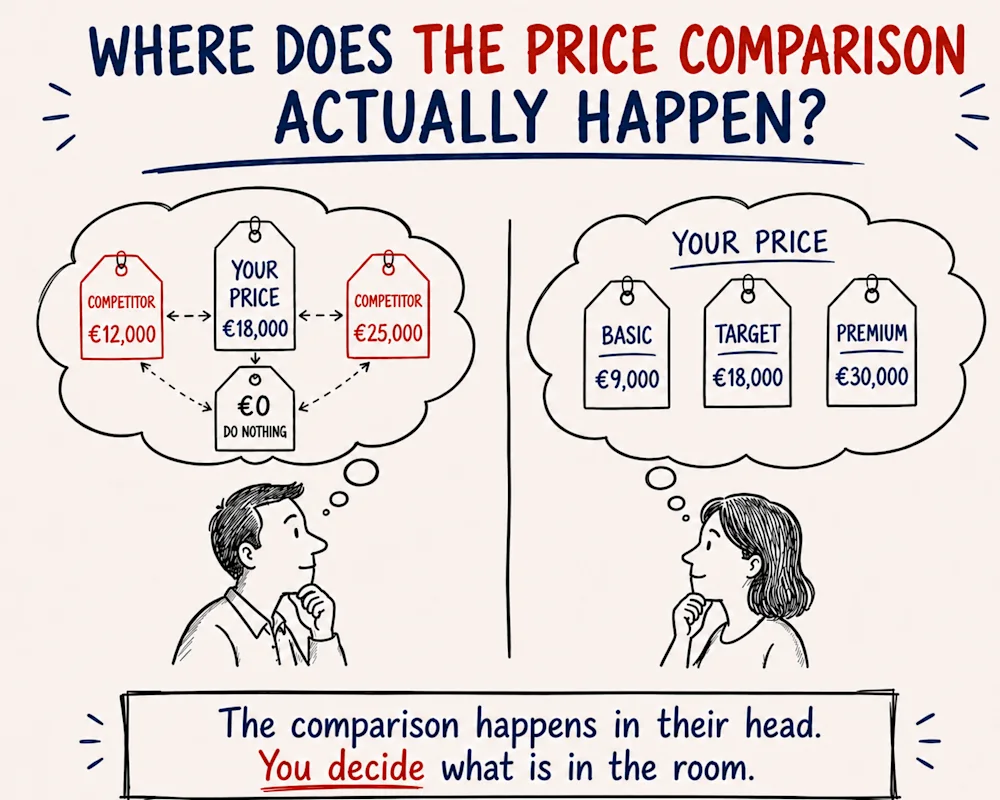
Here is the uncomfortable truth: the client never judges your price. They judge your price against the number sitting next to it. Always. The only question is who chose the neighbours.
Quote a single number and you have left the choice to them. The neighbours they pick are predictable: the cheaper consultant they talked to last month, and the oldest competitor of all, zero. Doing nothing costs nothing, this quarter at least. Your one brave number stands alone against both.
You cannot stop the comparison. It is how buying decisions work. But you can decide who is in it. Quote three numbers instead of one, and something quietly changes: the client stops comparing you with the market and starts comparing you with you. Whichever of your three numbers wins, you win. That is not a trick. It is simply refusing to let your price stand in a line-up you did not choose.
The professor who proved it
This is not consulting folklore. It is one of the most famous experiments in behavioural economics, told by Dan Ariely, a professor at MIT, in his book Predictably Irrational.
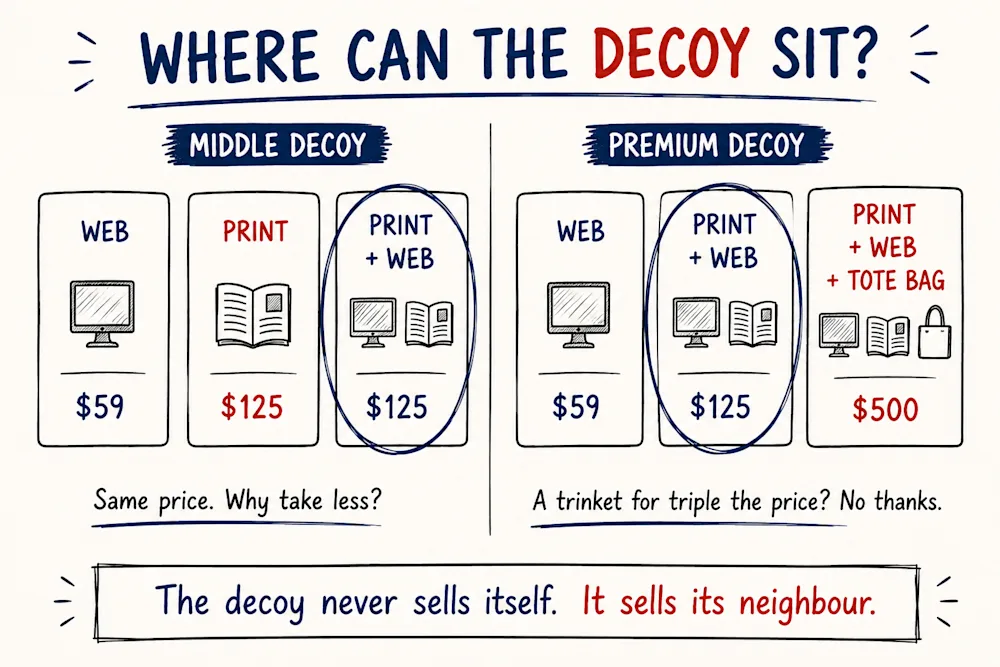
Ariely noticed that The Economist offered three subscriptions: web only for 59 dollars, print only for 125, and print plus web, also for 125. The print-only option looked like a mistake. Who would take print alone when the same money buys print and web together?
Nobody. And that was the point. When Ariely put all three in front of his students, 16 percent chose the cheap web option, nobody chose print only, and 84 percent chose print plus web. Then he removed the "pointless" option and asked a new group. The result flipped: 68 percent took the cheap option, and only 32 percent took the combo.
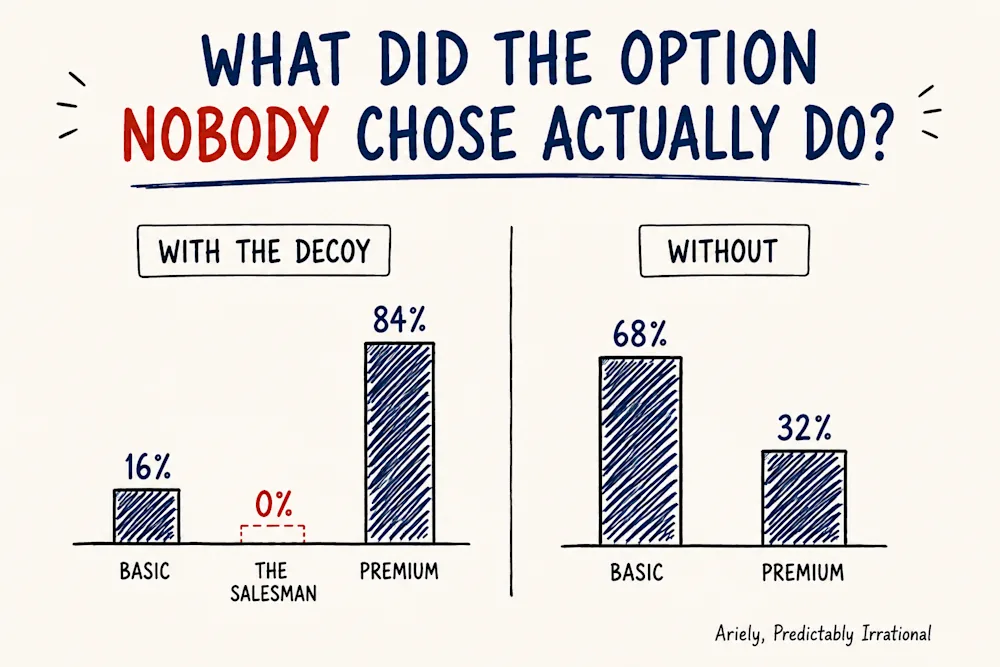
The option nobody buys is not dead weight. It is the salesman of its neighbour. That useless print-only subscription had one job: to stand next to the combo and lose, visibly. The moment a buyer can see one option clearly beat another, the winner stops being expensive and starts being obvious.
One rule, two decoys
Here is the rule underneath the trick: a decoy never sells itself. It sells the option that obviously beats it. So the craft is not "add a third price". The craft is: decide which offer you actually want to sell, your target, and then build it a neighbour it beats without contest. There are two ways to build that neighbour, and each one suits a different kind of client.
The middle decoy: lose in public. This is the Economist play. Your target is the full offer, and the decoy is built from it by subtraction: strip real scope out, and lower the price only a little, so the gap in content is far larger than the gap in price. The full version carries everything; the decoy carries two-thirds of it for almost the same money. Nobody needs to explain anything. The client looks at the two lines, sees that one of them is simply a worse deal, and chooses your target feeling sharp.
Use the middle decoy when your clients are comparison shoppers, the ones who read every line of a proposal hunting for the best deal. The decoy hands them exactly what they came for: a comparison they can win. Behavioural economists call it the attraction effect: an option that resembles the target but is clearly weaker pulls the choice toward the target it imitates.
The premium decoy: redraw the scale. The mirror build. Your target is the middle, and the decoy is built by addition: add some scope, and raise the price far beyond what the addition justifies. It sits at the top of the page looking magnificent and slightly absurd, and almost nobody buys it. That is fine. It was never meant to sell. Its job is to move the goalposts of "expensive": next to it, your real number stops being the big scary figure in the conversation and becomes the sensible middle.
Use the premium decoy when the price itself is the fright, when you know your real number lands above what the client had in mind. You cannot argue a mental anchor away, but you can place a bigger one over it. Researchers call this the compromise effect: shown a visible extreme, buyers retreat to the middle and feel wise doing it.
Two builds, opposite directions, one purpose: the client compares, chooses freely, and lands on the offer you built the menu around.
The rules that keep it honest
The third line: the floor. If the menu is a target plus a decoy, what is the third price? The floor: the smallest honest version of your service, the MVP you cannot strip any further without the work losing its meaning. The floor is not a decoy. It is a real offer, really delivered, and some clients will rightly start there. Its jobs are different: it makes the first yes easy, it respects the client whose budget truly is the ceiling, and it holds the bottom of the scale so the rest of the menu has somewhere to stand. And remember last week's lesson: the client who buys the floor is not a small deal. They are on the first rung.
Exactly three. One price gives the client nothing to compare against, so they find their own comparisons. Ten prices create a different disaster: a confused mind does not buy. Three lines, three jobs: the floor, the target, and the decoy.
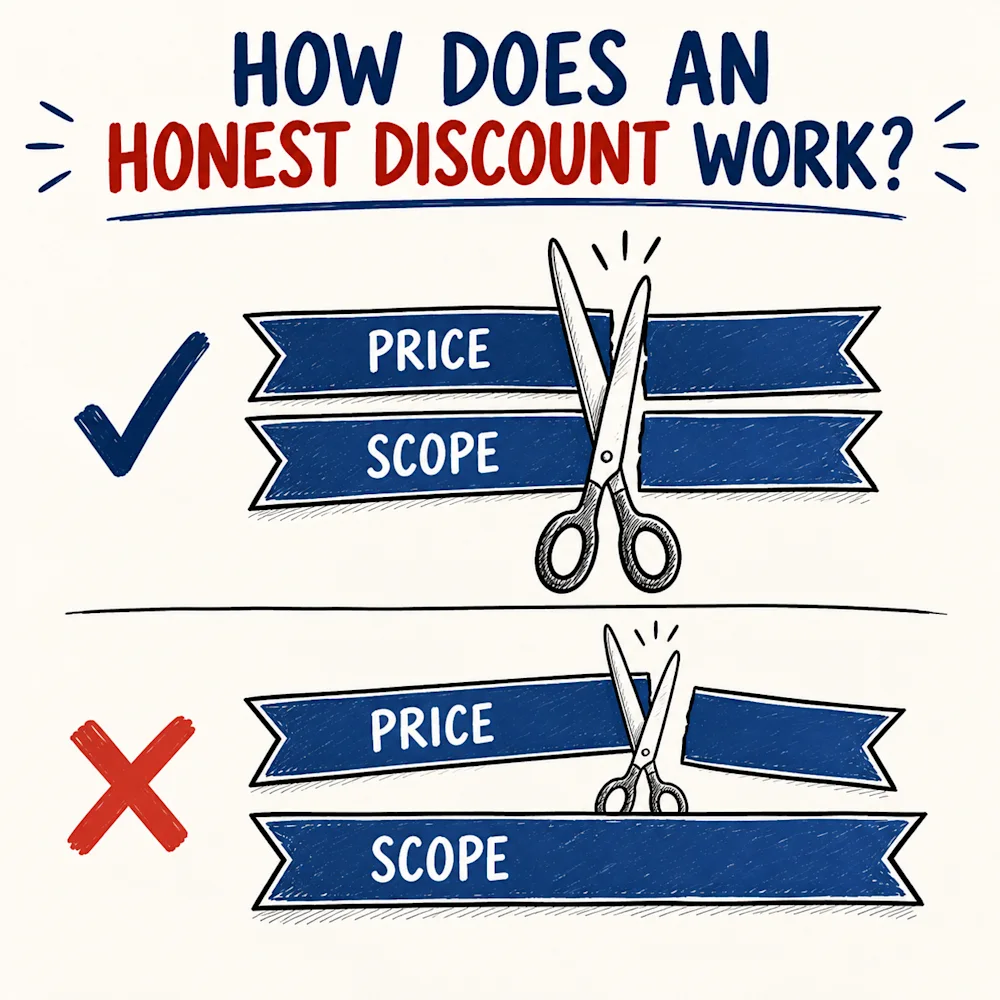
When they negotiate, price never drops alone. At BizzBee we price everything in three tiers, our outreach service included, and we hear "you are expensive, our budget is X" every week. We never discount. We open the package and take scope out until it matches X. The price moves, and something leaves the box with it. This is not stubbornness. A naked discount tells the client your first number was never real, and it reprices everything you will ever quote them. Scope-for-price keeps your numbers honest and, more often than you would expect, the client looks at what just left the box and finds the original budget after all.
Pricing your diagnostic, in three steps
Since this series is about the diagnostic, here is the reference, the way I would hand it to a consultant building their menu tomorrow.
Step one: define the target. Decide what the diagnostic you actually want to sell contains, and what it should cost. This is a business decision, not a psychology one. The decoy comes after the price, never instead of it.
Step two: choose your decoy. Middle or premium, and the previous section is the compass. Comparison shoppers get a middle decoy to defeat. Price-frightened buyers get a premium decoy to retreat from.
Step three: build the neighbour. For a middle decoy, strip a few things out of the diagnostic and keep the price close to the full one, so the gap in content is much bigger than the gap in price. The full version wins on sight. For a premium decoy, add some scope and raise the price exponentially, far beyond what the added scope justifies. The extreme does its quiet work on the scale, and your target becomes the sensible choice.
And the third line writes itself: the floor, the smallest honest diagnostic you can deliver, the one you cannot strip further. Floor, target, decoy. Three lines, three jobs.
Then let the menu do what a menu does. The client compares you with you, and whichever way they lean, they land where you wanted them.
You don't defend a price. You give it neighbours.
Two questions for the comments. How many numbers are on your proposal today, one or three? And if you built your menu tomorrow, which decoy would you build: the stripped middle that loses in public, or the inflated third that redraws the scale?
Questions readers ask
Why should my best offer never stand alone?
Because a single price gives the client nothing to compare it with except their own budget. Three prices let them compare you with you, which is a comparison you can design. One price makes them compare you with not buying.
What is the rule behind a decoy?
A decoy never sells itself. It sells the option that obviously beats it. So the craft is not adding a third price, it is deciding which offer you want chosen and building the others to lose to it.
What is the middle decoy?
The Economist play. Take the full offer and build the decoy from it by subtraction: strip real scope out and lower the price only a little. The target offer then looks like the obvious choice, because it is.
How do I keep this honest?
Every option has to be one you would actually deliver at that price. A decoy nobody could buy is a lie on a page. If a client picks the decoy, you do the work and you do not complain.
How do I price a diagnostic with this?
Decide the offer you want chosen, build one option above it and one below it from the same scope, and put all three on the proposal. The number you want is the one in the middle that looks unreasonable not to take.
About the author
Dancho Dimkov writes Anatomy of Consulting, a publication about the practice of business diagnosis. Read more about the publication.
Stages referenced here are links in the diagnostic journey (7 links in total).