
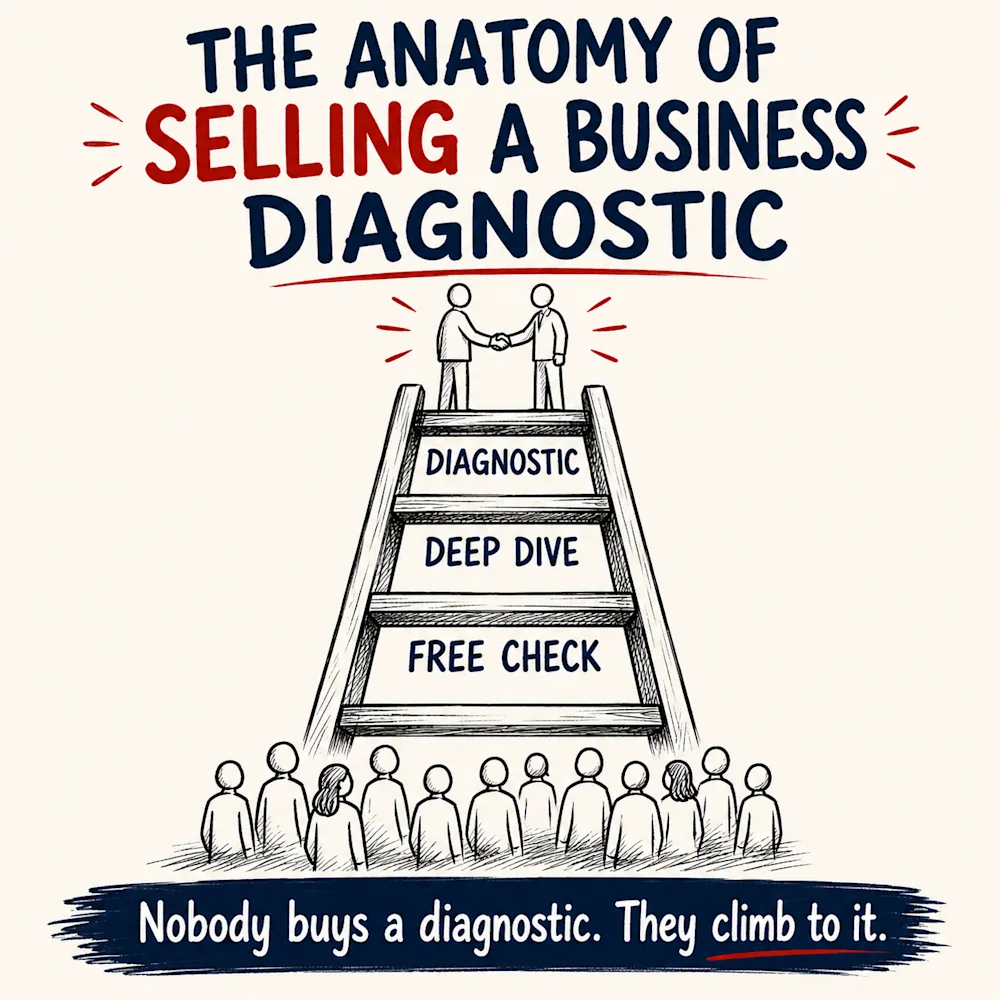
How to Sell a Diagnostic: The Ladder That Does It for You
This week, in the comments under one of my posts, I wrote a sentence that probably deserved a longer answer: identifying the operational root cause, the actual diagnostic, is something the client undervalues, and often is not willing to pay for.
Edition 14first published on LinkedIn
This week, in the comments under one of my posts, I wrote a sentence that probably deserved a longer answer: identifying the operational root cause, the actual diagnostic, is something the client undervalues, and often is not willing to pay for.
If you sell diagnostics, or business plans, or any serious analysis, you have felt this. The work you consider the most valuable part of the engagement is the part the client is least eager to buy.
Some clients do buy a diagnostic directly. A referral arrives already convinced, a past client comes back, someone has watched you work for years. Those sales are easy because the trust was built long before the invoice. This issue is about everyone else: the companies that have never heard of you. For them, the direct route fails quietly, and often.
Not to turn this into a sales piece, and not to brag, but selling consulting happens to be a craft I have spent a long time on. At BizzBee we run a dedicated service for consultants who want to sell better, and my book Sweet Leads is entirely about filling the pipeline with qualified, high-value B2B leads. I mention both for one reason only: so you know that what follows is not theory, and that I have earned the right to speak on this topic. Because this summer we built the whole machine, end to end, for my own diagnostic business, and I will show you the exact ladder, with the doors open.
You cannot pitch what the client undervalues
Nobody wakes up wanting a diagnostic. Owners wake up wanting more sales, more cash, more air. I wrote a whole issue about that: small businesses will not pay for a management consultant, because they are not shopping for what we are selling. Diagnosis has it even worse than consulting in general. To the client, it feels like the part before the real work. The homework. The invoice that comes before anything changes.
So pitching the diagnostic harder is pitching the thing they value least, louder. The move is different: you do not pitch the value, you grow the client into seeing it. Step by step, with proof at every step, until the diagnostic stops being your idea and starts being their next logical move.
High-ticket is a relationship sale
There is a second reason the direct route fails, and it is about price.
A proper diagnostic should not be cheap, and every consultant who has delivered one knows why: it is a lot of work. Depending on the depth, it costs 3,000, 5,000, 10,000 dollars. Between us, I believe it should be priced even higher. But if you work with SMEs, you also know that this is usually their ceiling. And whatever the number on the invoice, the diagnostic is the entry point into high-ticket consulting: the engagement that follows a good diagnostic is many times the diagnostic itself. Now be honest about the mechanics: nobody sees an ad between two cat videos, reads "business diagnostic", and swipes a credit card for thousands of dollars. You are not selling a five-dollar ebook. Nothing at this price sells on impulse to a stranger.
And consulting has one more property that makes cold selling nearly impossible: it is a relationship sale. Walk into an unknown company and pitch a diagnostic, and you are asking someone to pay thousands to a person they met twenty minutes ago, for work whose value only becomes visible after it is delivered. No trust, no sale. Most consultants know this feeling personally.
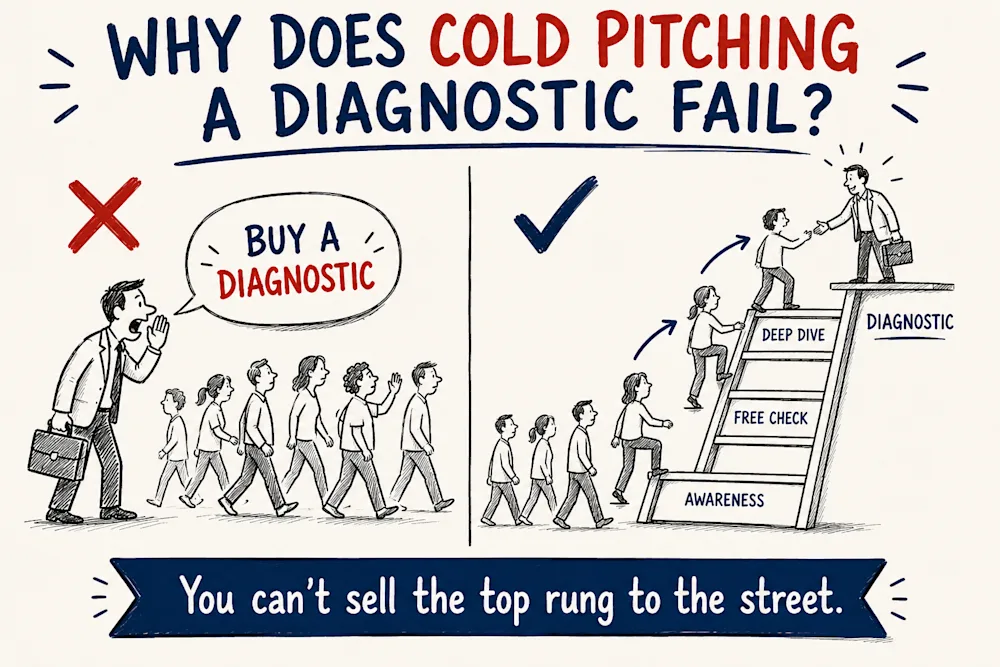
Put the two together, high price plus trust-dependent, and the conclusion writes itself: what you need is not a better pitch. It is a machine that builds the relationship and the understanding at the same time, while sorting out who is serious. That machine is a ladder.
The value ladder, and how we built it for Business Pulse
The principle on every rung is the same: ask small, give real. Each rung asks the lead for a slightly bigger commitment and pays them back immediately with something genuinely useful, so that climbing feels natural and staying feels fine. And instead of explaining it as theory, let me show you each rung twice: first the instrument, then the real thing, exactly as we built it for my own diagnostic business.
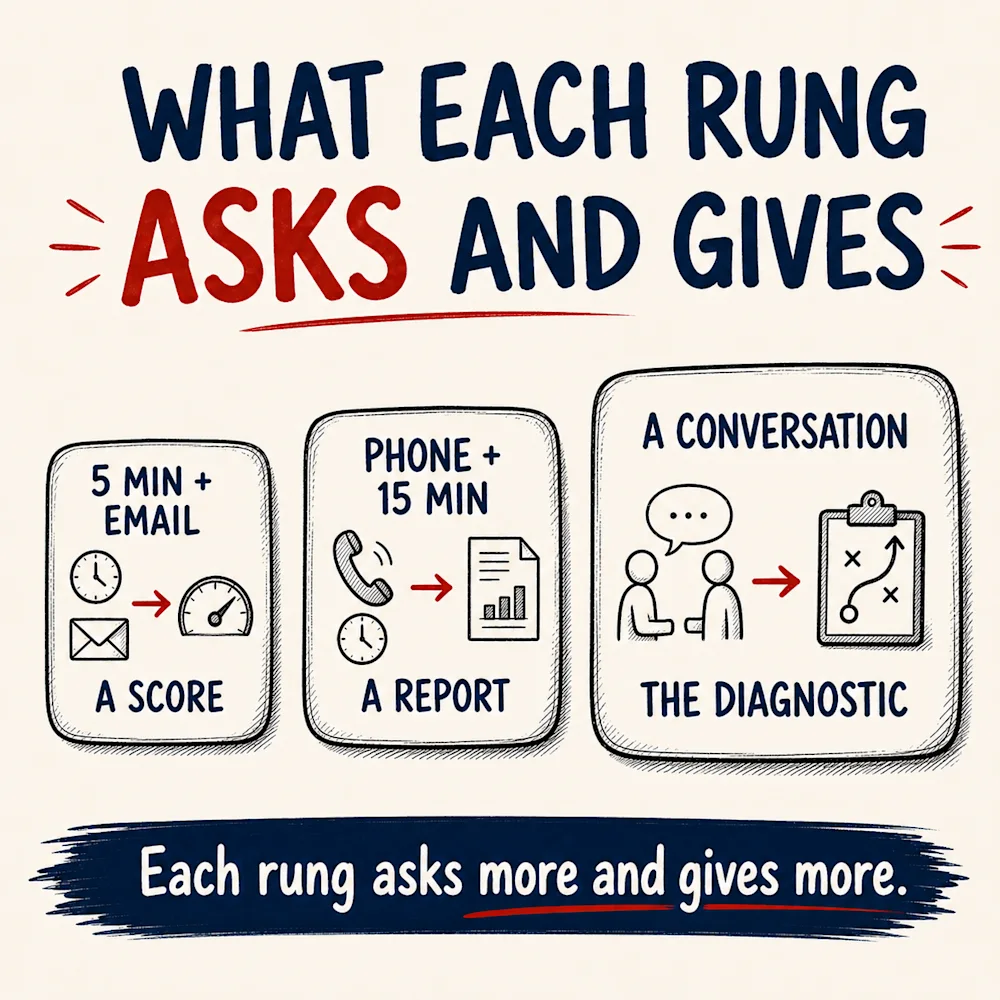
Rung one: the free check. We ask for five minutes and an email address. In return, the visitor gets a general self-assessment of their business with an instant score: a number instead of a feeling. Notice what happened in the exchange. They received the first taste of diagnosis for free, and you learned who they are and roughly where it hurts.
In Business Pulse, this rung is a free business health check: about four minutes, and the result comes back instantly as a score across the four areas we look at in every business: Clarity, Structure, Growth, and AI & Digital.
Rung two: the deep dive. We ask for a phone number and fifteen minutes. In return, a deep-dive self-assessment of their weakest area (one of the four: Clarity, Structure, Growth, or AI & Digital), answered honestly, comes back as a detailed report. And stop for a moment on the words "their weakest area", because this is the gold mine of the whole ladder: on rung one, the prospect told you, with their own answers, exactly where it hurts. You are not guessing what to talk about. From this moment on, everything they hear from you stays focused on that one weakness. The deep dive is also a real ask, and that is the point: whoever climbs this rung is telling you, through their own effort, that the problem is real and they are serious about understanding it.
In Business Pulse, four deep dives sit behind the entry check, one per area, so the second rung matches whatever the first rung exposed. Clarity asks whether you see your business as it really is. Structure asks whether the business runs without you. Growth asks whether you control your growth, or your growth controls you. And AI & Digital asks whether technology is actually working for you. Each is a serious thirty-plus-question assessment with a detailed report at the end. Between the rungs, email does the quiet work: every message speaks to the lead's own weakest area, because a sequence that talks about them will always beat a newsletter that talks about you.
Rung three: the conversation. Only now comes the bigger ask: a conversation about the actual diagnostic. And here is where everything changes. By this point you have already delivered value twice. They have seen their score, read their report, and received emails that talked about their situation, not your services. You are no longer a stranger with a pitch. You are the person who has already helped, twice, asking whether they want to go deeper.
In Business Pulse, the top of the ladder is the diagnostic itself, and notice that this rung is not a page with a form. It is a human conversation: a real call with a real consultant, the paid, professional version of what they have now tasted twice. The machine carried them up the ladder; a person takes it from there.
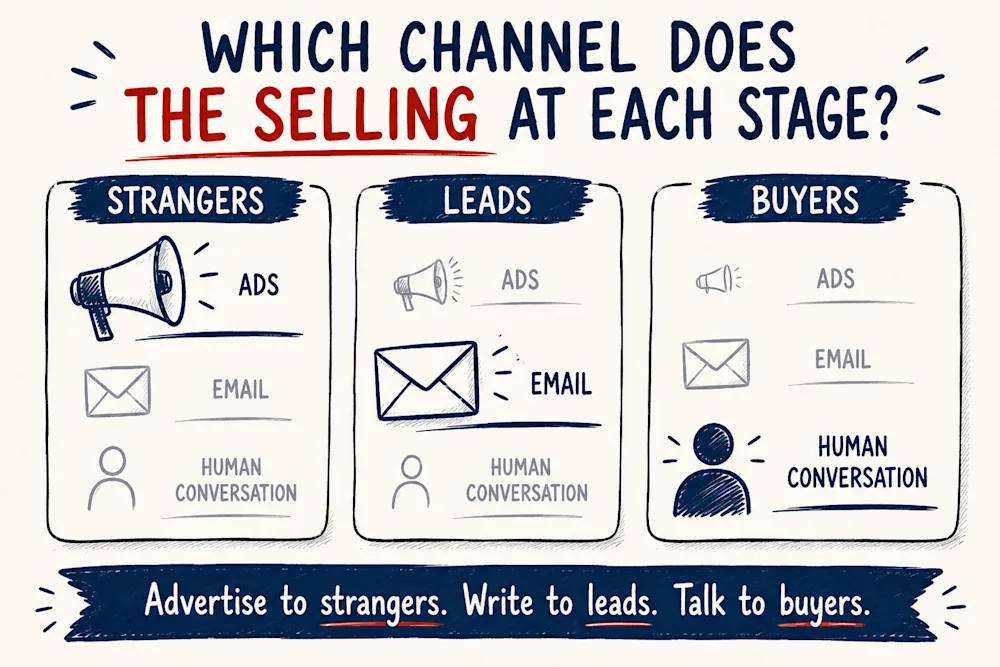
One more pattern runs through the ladder, and it is worth stating as a rule: you advertise to strangers, you write to leads, and you talk to buyers. The less you know about someone, the more you rely on ads; the more they have told you, the more personal the channel becomes, until at the top it is simply two people talking. Advertising gets them onto the ladder. It cannot carry them up.
If you are a consultant, do the useful thing: walk through it. Take the five-minute check as if you were your own prospect. Watch what is asked of you at each step, what you get back, and when the bigger ask arrives. Then steal the shape. Your expertise is different, your assessments will be different, but the ladder is the ladder.
The honest arithmetic
I will not pretend the ladder is magic, because it is arithmetic. Across assessment funnels, the research is consistent: from completed first-rung checks to booked conversations, you land in the low single digits. A hundred completed checks producing a handful of serious diagnostic conversations is not failure. It is success, because of who those few are: pre-qualified by their own effort, pre-warmed by the value you already delivered, and pre-sold on why diagnosis matters, because they have twice experienced a smaller version of it.
Compare that with the alternative. Cold pitching a high-ticket diagnostic has no arithmetic at all.
Three lessons, and the door
You sell a diagnostic by educating, not pitching. The client undervalues it, so pitching amplifies the wrong thing. Every rung of the ladder is a small lesson in what diagnosis is worth, delivered as value rather than argument.
High-ticket means relationship sale. Price and trust decide the sale long before the meeting does. The ladder builds the relationship while it qualifies the lead, which is why the final conversation feels so different from a cold pitch.
The ladder does the selling for you. You do not persuade anyone to skip five rungs. You make each next step small, obvious, and worth it.
And one closing thought that reframes the whole economics. The diagnostic is not really the product. It is the entry into the company. Done properly, it opens work far beyond itself: the implementation, the restructuring, the growth engagement, the relationship that lasts years. That is exactly why it deserves a machine and not a pitch. You are not building a funnel to sell a report. You are building a funnel to start relationships that compound.
Nobody buys a diagnostic. They climb to it.
Two questions for the comments. How do you sell your diagnostics today: referral, direct pitch, or some version of a ladder? And what is your free first rung, the small thing a stranger can get from you in five minutes? If you do not have one, what would it be?
Questions readers ask
Why can't I pitch a diagnostic directly?
Because the client undervalues it before they have seen what it produces. Identifying the operational root cause is the part a client cannot judge the worth of in advance, so a cold pitch asks them to pay for something they cannot price.
What does the ladder do that a pitch does not?
It lets the prospect climb rather than be sold. Each rung gives them something real and earns the right to the next conversation, so by the time the diagnostic comes up they have already seen how you think.
What are the actual conversion numbers?
Low single digits from completed first-rung checks to booked conversations. A hundred completed checks producing a handful of serious diagnostic conversations is the expected result, not a failure. Cold pitching a high-ticket diagnostic has no arithmetic at all to compare it against.
Why does high-ticket work have to be a relationship sale?
Because nobody signs a large engagement with someone they met once. The ladder is a way of building the relationship at scale instead of one coffee at a time.
What makes a good first rung?
Something that is genuinely useful on its own and honest about being the first step. If the free rung only makes sense as bait, the prospect feels it and the ladder stops at rung one.
About the author
Dancho Dimkov writes Anatomy of Consulting, a publication about the practice of business diagnosis. Read more about the publication.
Stages referenced here are links in the diagnostic journey (7 links in total).