
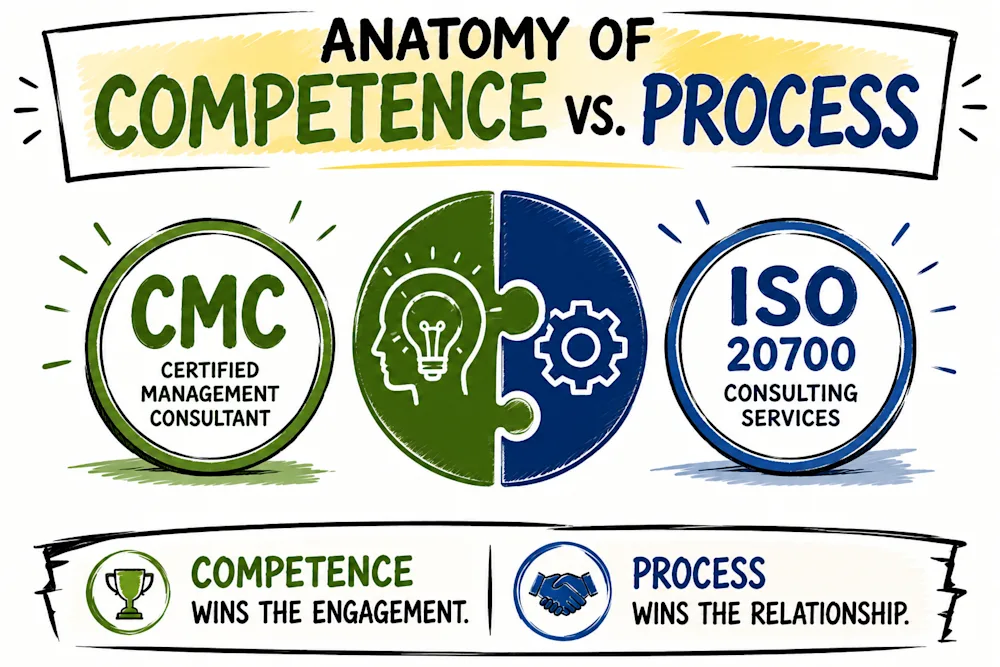
Competence vs Process: Which Half Loses More Consulting Clients?
Ask a room of consultants what makes one of us worth hiring and you will get a hundred answers about competence. Years of experience. The right credentials. A real track record. Who is actually any good.
Edition 5first published on LinkedIn
Ask a room of consultants what makes one of us worth hiring and you will get a hundred answers about competence. Years of experience. The right credentials. A real track record. Who is actually any good.
Almost no one mentions the other half. And the other half is where clients are quietly lost.
Think about the last client who did not come back. Odds are it was not because you were not smart enough. It was because the engagement felt chaotic. The scope drifted. There were surprises on the invoice. It never got cleanly closed. You were good, and it still did not feel professional.
That is the split worth naming. Being a consultant worth trusting has two halves: are you good (competence), and do you run the work properly (process). There is a credential for each, and most of us only ever chase the first.
The competence half: CMC
Start with CMC, because plenty of clients - and plenty of consultants - have never had it explained. CMC stands for Certified Management Consultant. It is the only internationally recognised, competence-based certification our profession has, awarded through ICMCI (the International Council of Management Consulting Institutes) and its national member institutes - so the bar is globally consistent, even though you are assessed locally.
The phrase that matters is competence-based. CMC is not a course you attend and a certificate you collect at the end. It assesses the individual against a defined framework: proven consulting ability, a genuine track record of client engagements with references that are actually checked, an assessment of how you work, a commitment to a code of ethics, and ongoing development to renew it. It is held by a relatively small share of consultants, which is part of why it carries weight.
This matters because, in most places, anyone can print "consultant" on a business card - there is no licence to practise. CMC is the closest thing the profession has to an independent, vetted stamp on the person. It answers the client's first question: is this person genuinely capable and accountable, or just confident and well-marketed? But it is only the first question.
The process half: ISO 20700
If CMC is about the person, ISO 20700 is about the work. It is the international standard for management consultancy services, published by ISO - the same global body behind quality standards like ISO 9001 - and it was the first standard ever written specifically for how consulting engagements are delivered.
Here is the key difference: it does not measure how clever you are. It is a guideline for how the work is run, in three phases. Contracting: agreeing scope, objectives, deliverables, roles, expectations and risk before the work starts. Delivering: managing the assignment, communication, change and knowledge transfer while it runs. Closing: completing the deliverables, evaluating, gathering feedback and formally closing the engagement.
If that sounds unglamorous, that is exactly the point. It is the half most of us run on instinct and never name - which, if you have read this newsletter before, should sound familiar. We improvise the scoping conversation, we wing the mid-engagement communication, we let projects trail off instead of closing them cleanly. ISO 20700 exists because consulting was for a long time a "trust me" business with no shared definition of a well-run engagement. It gives both sides one, so the client always knows what is happening, when, and what they are paying for.
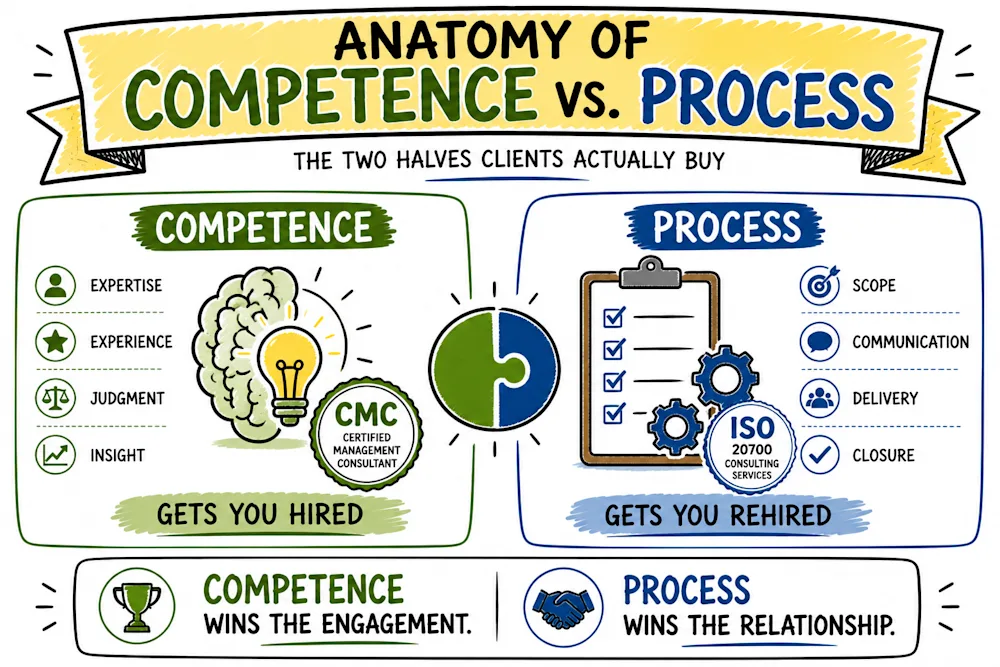
Why you need both halves
Hold the two up together and the gaps become obvious.
Competence without process is the brilliant consultant whose engagements feel chaotic. The advice is right, but the client spends the whole project unsure what is happening or what they are paying for. They often cannot explain why, but they do not come back. Being good was not enough.
Process without competence is the opposite, and worse: a smooth, well-run delivery of mediocre advice. Everything is scoped and closed beautifully, and none of it is worth much.
You need both, and they do different jobs. Competence gets you hired. Process gets you rehired - and referred. One wins the engagement; the other wins the relationship.
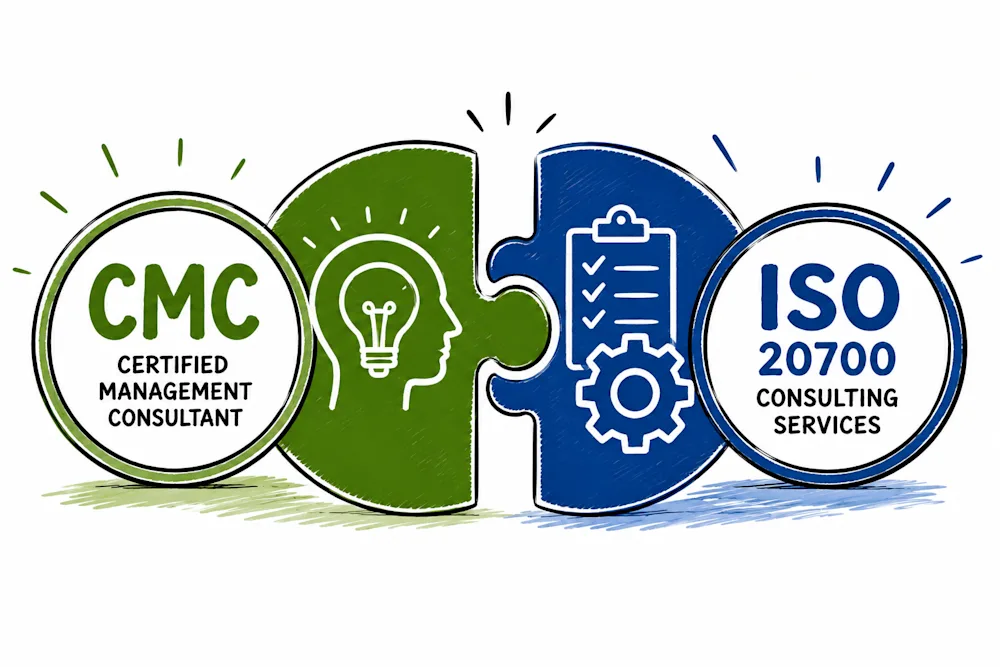
Not badges - gaps
The point of holding both is not to collect letters after your name. It is that they close the two gaps a client actually judges you on: whether you are good, and whether working with you feels professional. Most consultants are strong on one and quietly weak on the other. It is worth asking yourself, honestly, which half is yours.
I hold both - the CMC, and as of recently ISO 20700 - and not for the certificates. They are useful because they force the honesty: not just "am I good?" but "do I actually run this properly?"
So a question for the comments. Which half do you think loses more clients - not being good enough, or running a messy engagement? My money is on the second. What is yours?
Questions readers ask
What is the difference between CMC and ISO 20700?
CMC is a competence-based certification of the individual, awarded through ICMCI and its national member institutes. ISO 20700 is a guideline for how the engagement is run, covering contracting, delivering and closing. One is about you, the other is about the work.
Which half actually loses clients?
Process, more often than competence. Think about the last client who did not come back. Usually it was not that you were not good enough. The scope drifted, the invoice held surprises, and it never got cleanly closed.
Is CMC worth getting?
It is competence-based, so it is not a course you attend and a certificate you collect. It assesses proven consulting ability, a real track record with references that get checked, how you work, a code of ethics, and it has to be renewed. That is what makes it carry weight, and also why most consultants do not have it.
Do I need to be certified in ISO 20700 to use it?
No. It is a guideline, not a licence. You can run your engagements to it tomorrow without any badge, and the client will feel the difference in the contracting conversation before they feel anything else.
How should I use these two standards in practice?
Not as badges, as gaps. Read each one and mark what you are not doing. Competence gets you hired. Process gets you rehired.
About the author
Dancho Dimkov writes Anatomy of Consulting, a publication about the practice of business diagnosis. Read more about the publication.
Stages referenced here are links in the diagnostic journey (7 links in total).